Health Sciences CTS-451 Research Group, University of Almeria, Almeria, Spain.
Department of Journalism and Communication, University Carlos III of Madrid, Madrid, Spain.
PLoS One. 2019 Jun 20;14(6):e0218521. doi: 10.1371/journal.pone.0218521. eCollection 2019.
The concept of 'patient experience' has become central to how to improve healthcare. Remote communication with patients is today a frequent practice in healthcare services, showing similar outcomes to standard outpatient care while enabling cost reduction in both formal and informal care. The purpose of this study was to analyse the experiences of people with telemonitoring pacemakers.
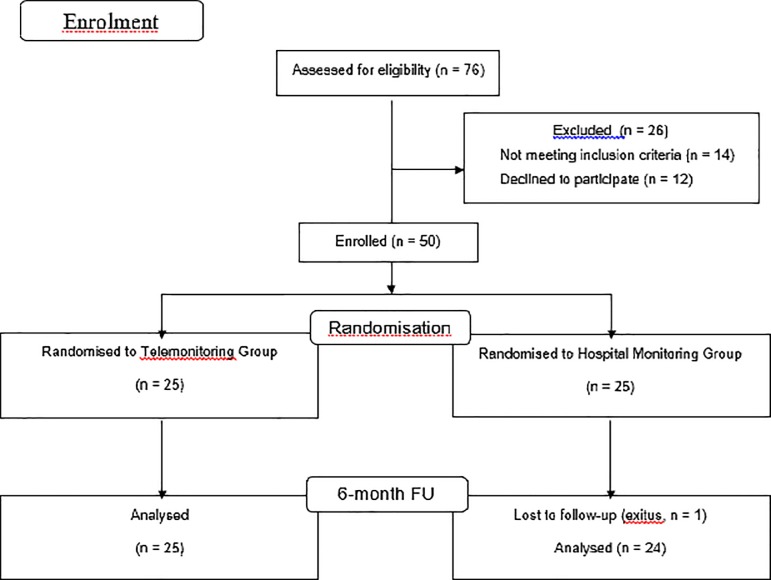
Patients were randomly allocated to either the telemonitoring or hospital monitoring follow-ups. Using the 'Generic Short Patient Experiences Questionnaire' (GS-PEQ), as well as an ad-hoc survey from the 'telehealth patient satisfaction survey' and 'costs survey', patients' experiences were measured six months after the pacemaker implant in a cohort of 50 consecutive patients. The mean age was 74.8 (± 11.75) years and 26 (52%) patients were male of which 1 was lost in follow-up. Finally, 24 patients were followed up with standard hospital monitoring, while 25 used the telemonitoring system. Differences in baseline characteristics between groups were not found.
Findings showed overall positive and similar experiences in patients living with telemonitoring and hospital monitoring pacemakers. Significant differences were found in GS-PEQ concerning how telemonitoring patients received less information about their diagnosis/afflictions (p = 0.046). We did not find significant differences in other items such as 'confidence in the clinicians' professional skills', 'treatment perception adapted to their situation', 'involvement in decisions regarding the treatment', 'perception of hospital organisation', 'waiting before admission', 'satisfaction of help and treatment received', 'benefit received', and 'incorrect treatment'.
The remote communication of pacemakers was met with positive levels of patients' experiences similarly to patients in the hospital monitoring follow-up. However, telemonitoring patients received less information. Thus, improving the quality and timing of information is required in telemonitoring patients in the planning and organisation of future remote communication healthcare services for people living with a pacemaker implant.
“患者体验”的概念已成为改善医疗保健的核心。远程与患者沟通如今是医疗服务中的常见做法,其结果与标准门诊护理相似,同时还能降低正式和非正式护理的成本。本研究的目的是分析使用远程监控起搏器患者的体验。
患者被随机分配到远程监控或医院监测随访中。使用“通用简短患者体验问卷”(GS-PEQ),以及“远程医疗患者满意度调查”和“成本调查”中的一份特别调查,在 50 名连续患者的队列中,在起搏器植入后 6 个月测量患者的体验。平均年龄为 74.8(±11.75)岁,26 名(52%)患者为男性,其中 1 名随访时失访。最后,24 名患者接受标准医院监测随访,而 25 名患者使用远程监控系统。两组患者的基线特征无差异。
研究结果表明,使用远程监控和医院监测起搏器的患者总体体验积极且相似。在 GS-PEQ 中,关于远程监控患者获得的关于其诊断/疾病的信息较少,存在显著差异(p = 0.046)。我们没有发现其他项目(如“对临床医生专业技能的信任”、“根据其情况调整治疗的感知”、“参与治疗决策”、“对医院组织的感知”、“住院前等待”、“对所获得的帮助和治疗的满意度”、“获益”和“治疗不当”)存在显著差异。
远程起搏器通讯得到了患者积极体验,与接受医院监测随访的患者相似。然而,远程监控患者获得的信息较少。因此,在规划和组织未来远程通讯医疗服务时,需要提高远程监控患者的信息质量和及时性,以满足使用起搏器植入患者的需求。