Julian Thomas Henry, Syeed Rubiya, Glascow Nicholas, Zis Panagiotis
The Medical School, University of Sheffield, Beech Hill Rd, Sheffield, S10 2RX, UK.
Medical School, University of Cyprus, Nicosia, Cyprus.
Clin Auton Res. 2020 Feb;30(1):29-41. doi: 10.1007/s10286-019-00618-8. Epub 2019 Jun 20.
Autonomic dysfunction is a known consequence of chronic and excessive alcohol consumption. The aim of this systematic review was to characterise this phenomenon, describe the frequency at which it occurs and to explore the best management strategies.
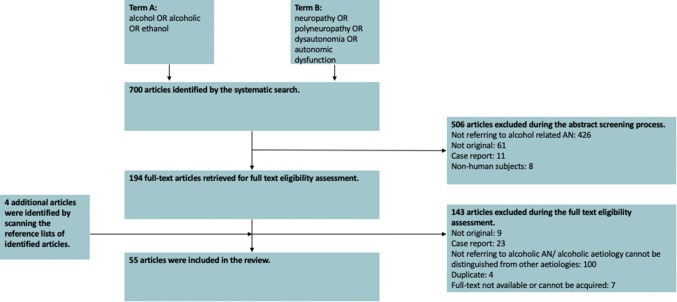
A systematic, computer-based search was conducted using the PubMed database. All studies identified by the search were evaluated independently by at least three authors. For inclusion, studies had to report human subjects consuming ethanol in excess. Case reports and non-original studies were excluded from this review.
A total of 55 studies were included in this review. According to cardiovascular reflex tests, 16-73% of chronic alcohol abusers suffer from autonomic dysfunction. The most commonly occurring symptom is erectile dysfunction, whilst other features such as postural dizziness are rare. The most important risk factor for this condition is total lifetime dose of ethanol, although there is mixed evidence supporting the role of other risk factors. The only management strategy currently explored in the literature is abstinence, which appears to lead to significant improvement in autonomic investigations.
Current literature includes studies of highly heterogeneous populations, consuming differing volumes of alcohol over variable periods of time and utilising a number of different autonomic test batteries and criteria to diagnose autonomic dysfunction. Therefore, further research using homogeneous methods for measuring autonomic dysfunction in the field is needed. Despite this limitation, our review demonstrated that autonomic dysfunction is very common among alcohol abusers.
自主神经功能障碍是长期过量饮酒已知的后果。本系统评价的目的是描述这一现象,说明其发生频率,并探索最佳管理策略。
使用PubMed数据库进行基于计算机的系统检索。检索到的所有研究均由至少三位作者独立评估。纳入的研究必须报告有过量饮用乙醇的人类受试者。病例报告和非原创性研究被排除在本评价之外。
本评价共纳入55项研究。根据心血管反射试验,16%至73%的慢性酗酒者患有自主神经功能障碍。最常见的症状是勃起功能障碍,而其他特征如体位性头晕则很少见。这种情况最重要的危险因素是乙醇的终生总剂量,尽管关于其他危险因素的作用存在混合证据。目前文献中探讨的唯一管理策略是戒酒,这似乎能使自主神经检查有显著改善。
当前文献包括对高度异质性人群的研究,这些人群在不同时间段饮用不同量的酒精,并使用多种不同的自主神经测试组合和标准来诊断自主神经功能障碍。因此,需要在该领域采用同质方法测量自主神经功能障碍进行进一步研究。尽管有此局限性,但我们的评价表明自主神经功能障碍在酗酒者中非常常见。