Department of Cardiac Biochemistry, All India Institute of Medical Sciences, Delhi, India.
UNICEF, Delhi, India.
Biochem Med (Zagreb). 2019 Jun 15;29(2):020708. doi: 10.11613/BM.2019.020708.
Preanalytical conditions are critical for blood sample integrity and poses challenge in surveys involving biochemical measurements. A cross sectional study was conducted to assess the stability of select biomarkers at conditions that mimic field situations in surveys.
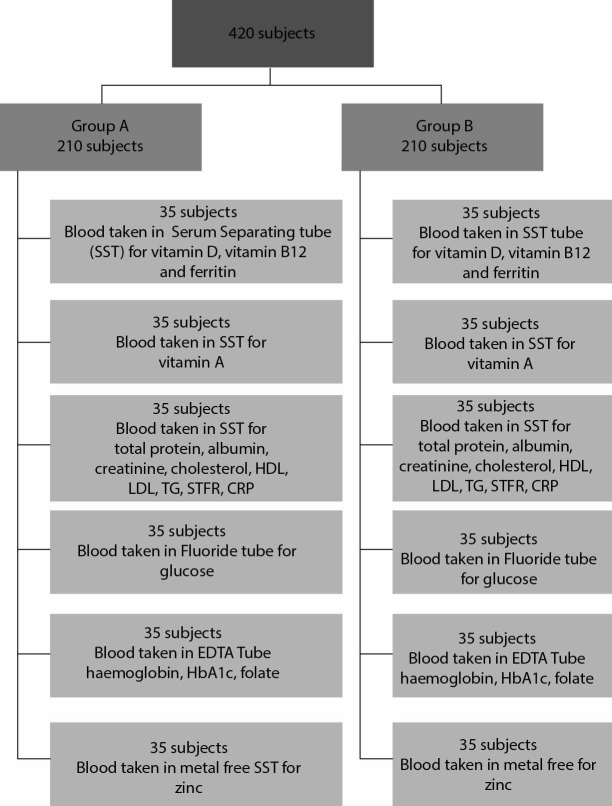
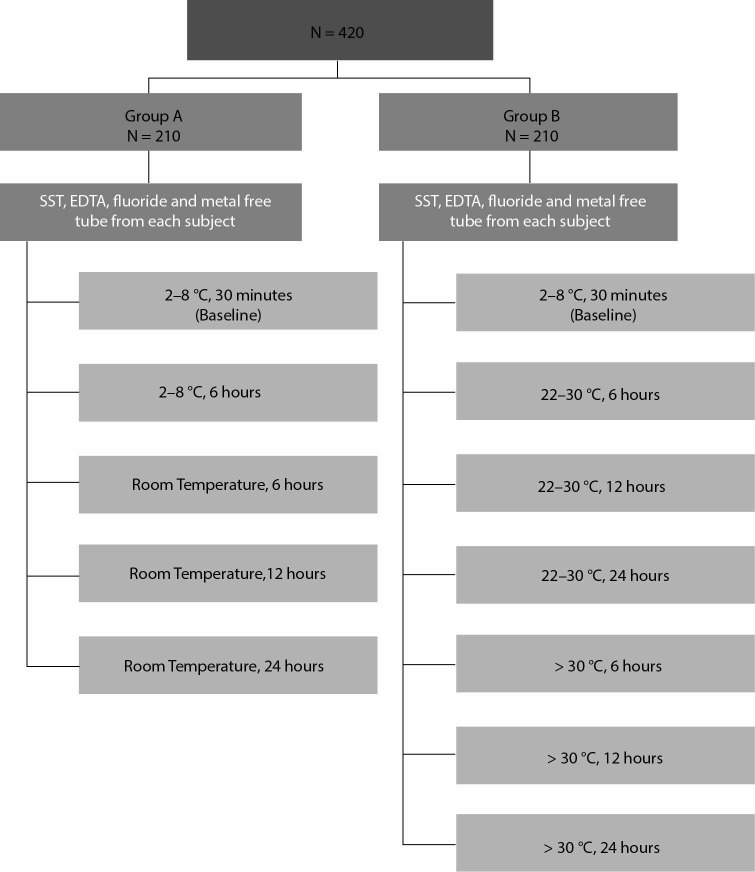
Blood from 420 volunteers was exposed to 2 - 8 °C, room temperature (RT), 22 - 30 °C and > 30 °C for 30 min, 6 hours, 12 hours and 24 hours prior to centrifugation. After different exposures, whole blood (N = 35) was used to assess stability of haemoglobin, HbA1c and erythrocyte folate; serum (N = 35) for assessing stability of ferritin, C-reactive protein (CRP), vitamins B12, A and D, zinc, soluble transferrin receptor (sTfR), total cholesterol, high density lipoprotein cholesterol (HDL), low density lipoprotein cholesterol (LDL), tryglicerides, albumin, total protein and creatinine; and plasma (N = 35) was used for glucose. The mean % deviation of the analytes was compared with the total change limit (TCL), computed from analytical and intra-individual imprecision. Values that were within the TCL were deemed to be stable.
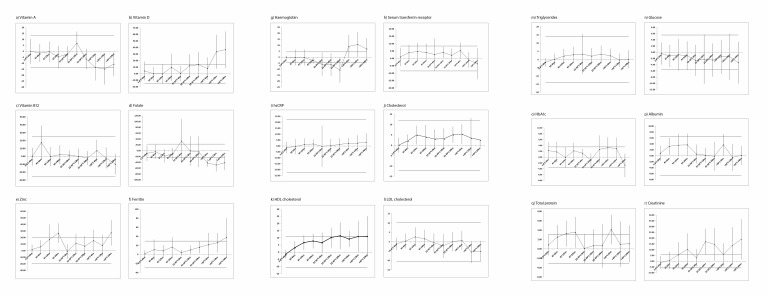
Creatinine (mean % deviation 14.6, TCL 5.9), haemoglobin (16.4%, TCL 4.4) and folate (33.6%, TCL 22.6) were unstable after 12 hours at 22-30°C, a temperature at which other analytes were stable. Creatinine was unstable even at RT for 12 hours (mean % deviation: 10.4). Albumin, CRP, glucose, cholesterol, LDL, triglycerides, vitamins B12 and A, sTfR and HbA1c were stable at all studied conditions.
All analytes other than creatinine, folate and haemoglobin can be reliably estimated in blood samples exposed to 22-30°C for 12 hours in community-based studies.
分析前条件对血液样本的完整性至关重要,在涉及生化测量的调查中带来了挑战。本研究通过一项横断面研究来评估在模拟调查现场条件下,部分生物标志物的稳定性。
420 名志愿者的血液在离心前分别暴露于 2-8°C、室温(RT)、22-30°C 和 >30°C 30 分钟、6 小时、12 小时和 24 小时。在不同的暴露条件下,使用全血(N=35)评估血红蛋白、HbA1c 和红细胞叶酸的稳定性;血清(N=35)评估铁蛋白、C 反应蛋白(CRP)、维生素 B12、A 和 D、锌、可溶性转铁蛋白受体(sTfR)、总胆固醇、高密度脂蛋白胆固醇(HDL)、低密度脂蛋白胆固醇(LDL)、甘油三酯、白蛋白、总蛋白和肌酐的稳定性;血浆(N=35)用于评估葡萄糖的稳定性。将分析物的平均%偏差与总变化限值(TCL)进行比较,TCL 是根据分析和个体内不精密度计算得出的。如果分析物的值在 TCL 范围内,则认为是稳定的。
肌酐(平均%偏差 14.6,TCL 5.9)、血红蛋白(16.4%,TCL 4.4)和叶酸(33.6%,TCL 22.6)在 22-30°C 下 12 小时后不稳定,而其他分析物在该温度下稳定。即使在 RT 下 12 小时,肌酐也不稳定(平均%偏差:10.4)。白蛋白、CRP、葡萄糖、胆固醇、LDL、甘油三酯、维生素 B12 和 A、sTfR 和 HbA1c 在所有研究条件下均稳定。
在社区为基础的研究中,在 22-30°C 下暴露 12 小时的血液样本中,除了肌酐、叶酸和血红蛋白外,所有分析物都可以可靠地估计。