Kivitz Alan J, Nash Peter, Tahir Hasan, Everding Andrea, Mann Heřman, Kaszuba Andrzej, Pellet Pascale, Widmer Albert, Pricop Luminita, Abrams Ken
Altoona Centre for Clinical Research, Duncansville, PA, USA.
University of Queensland, Brisbane, Australia.
Rheumatol Ther. 2019 Sep;6(3):393-407. doi: 10.1007/s40744-019-0163-5. Epub 2019 Jun 21.
To assess the efficacy and safety of the subcutaneous (s.c.) secukinumab 150 mg with loading (150 mg) or without loading (150 mg no-load) regimen through 104 weeks in patients with active psoriatic arthritis (PsA) in the FUTURE 4 (NCT02294227) study.
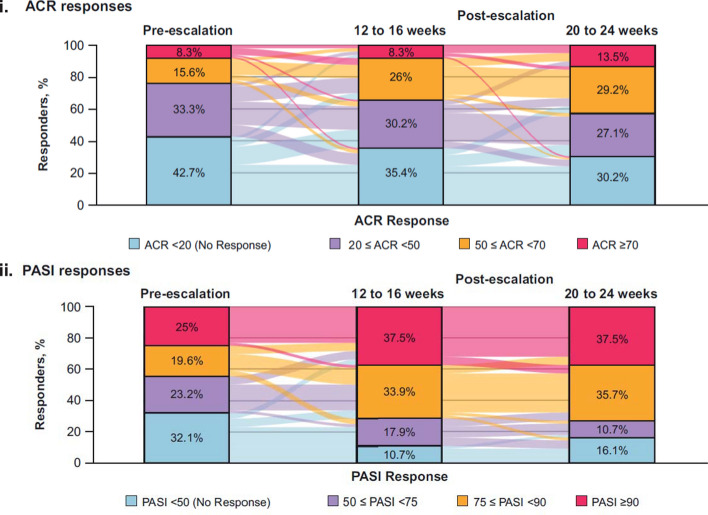
Patients with PsA (N = 341) were randomized to s.c. secukinumab 150 mg, 150 mg no-load or placebo at baseline, weeks 1, 2, 3 and every 4 weeks thereafter. All placebo patients were reassigned to secukinumab 150 mg no-load at either week 16 (non-responders) or week 24 (responders). The primary end point was ACR20 at week 16. Patients could have their dose escalated from 150 to 300 mg based on their physician's decision starting at week 36. Pre- and post-escalation ACR and PASI responses were also assessed.
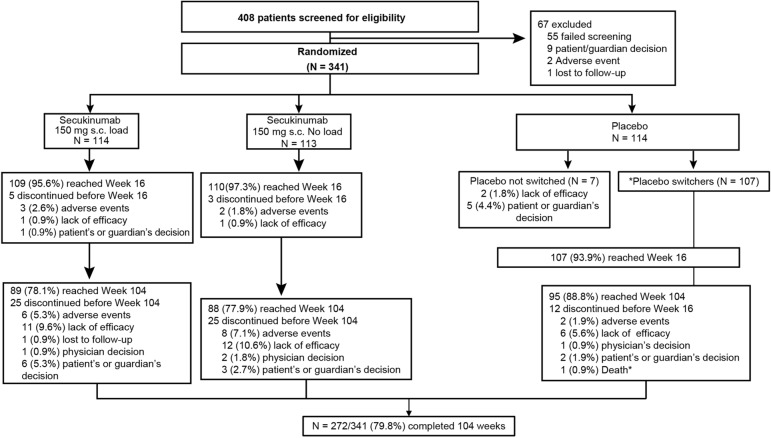
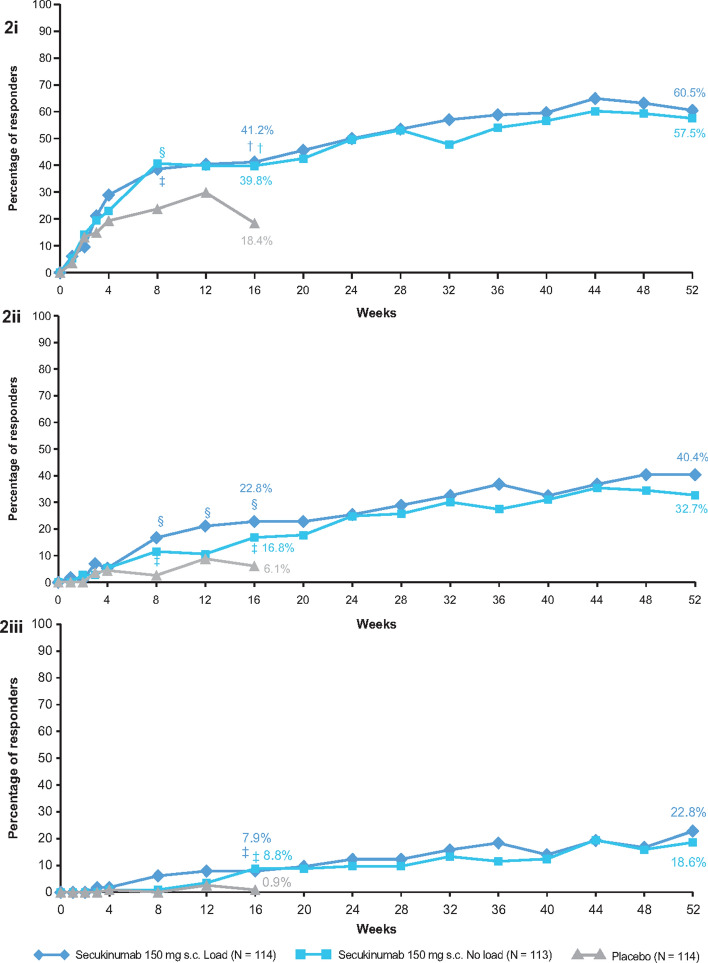
A total of 95.6% (326/341), 84.5% (288/341) and 79.8% (272/341) patients completed 16, 52 and 104 weeks of treatment, respectively. The primary end point was met; ACR20 response rate at week 16 was 41.2% and 39.8% with the 150 mg and 150 mg no-load groups, respectively, versus placebo (18.4%; adjusted P value = 0.0003 for both treatment arms). Efficacy responses observed at week 16 in both treatment regimens were sustained up to week 52 and 104, with many patients continuing to show improvements up to week 104. After dose escalation to 300 mg, the proportion of patients with non-/low-level ACR/PASI response decreased with increasing proportions of patients having higher ACR/PASI responses. No new or unexpected safety signals were reported.
The secukinumab 150 mg or 150 mg no-load regimen demonstrated significant and sustained improvements in the signs and symptoms of psoriatic arthritis through 104 weeks; the loading regimen was associated with numerically higher and earlier responses for some high-hurdle end points. Improved efficacy was observed upon dose escalation from 150 to 300 mg. The safety profile was consistent with previous reports.
ClinicalTrials.gov identifier, NCT02294227.
Novartis Pharma AG, Basel, Switzerland.
在FUTURE 4(NCT02294227)研究中,评估皮下注射150mg司库奇尤单抗负荷剂量(150mg)或无负荷剂量(150mg无负荷)方案治疗活动性银屑病关节炎(PsA)患者104周的疗效和安全性。
PsA患者(N = 341)在基线、第1、2、3周以及此后每4周随机接受皮下注射150mg司库奇尤单抗、150mg无负荷司库奇尤单抗或安慰剂治疗。所有安慰剂组患者在第16周(无反应者)或第24周(反应者)重新分配接受150mg无负荷司库奇尤单抗治疗。主要终点为第16周时达到美国风湿病学会(ACR)20%改善标准。从第36周开始,患者可根据医生的决定将剂量从150mg增加至300mg。还评估了剂量增加前后的ACR和银屑病面积和严重程度指数(PASI)反应。
分别有95.6%(326/341)、84.5%(288/341)和79.8%(272/341)的患者完成了16周、52周和104周的治疗。达到了主要终点;150mg组和150mg无负荷组在第16周时的ACR20反应率分别为41.2%和39.8%,而安慰剂组为18.4%(两个治疗组的校正P值均为0.0003)。两种治疗方案在第16周观察到的疗效反应持续至第52周和104周,许多患者在第104周时仍持续改善。剂量增加至300mg后,ACR/PASI反应为非/低水平的患者比例下降同时ACR/PASI反应较高的患者比例增加。未报告新的或意外的安全信号。
皮下注射150mg司库奇尤单抗或150mg无负荷方案在104周内显著且持续改善了银屑病关节炎的体征和症状;负荷剂量方案在一些高难度终点方面在数值上有更高且更早的反应。从150mg增加至300mg剂量时观察到疗效改善。安全性与先前报告一致。
ClinicalTrials.gov标识符,NCT02294227。
瑞士巴塞尔诺华制药有限公司。