School of Psychology, University of Glasgow, Glasgow, UK.
Quality and Usability Lab, Technische Universität Berlin, Berlin, Germany.
Eur J Neurosci. 2019 Oct;50(8):3380-3388. doi: 10.1111/ejn.14497. Epub 2019 Jul 8.
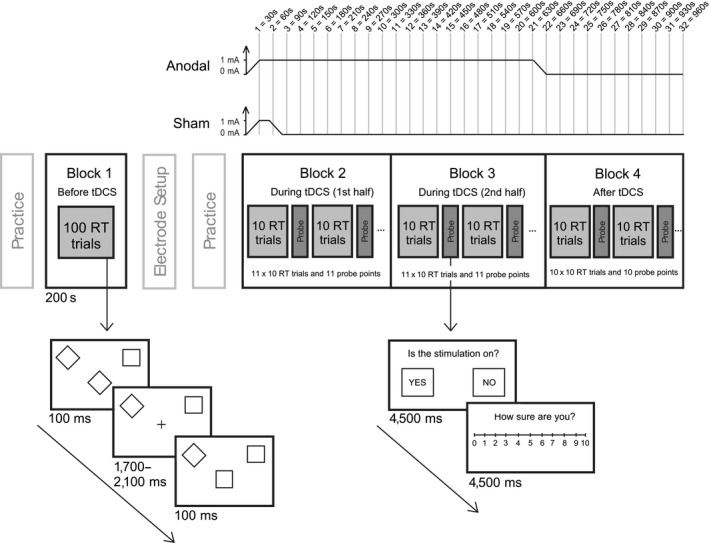
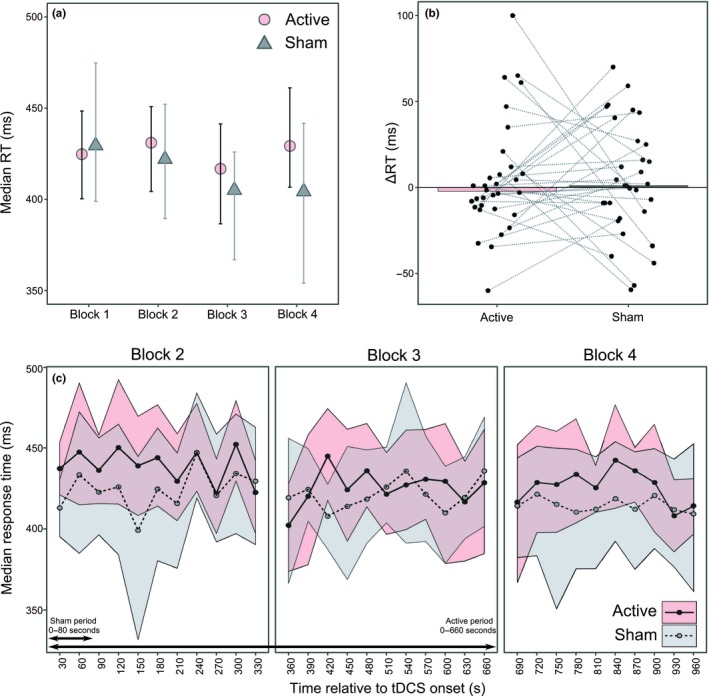
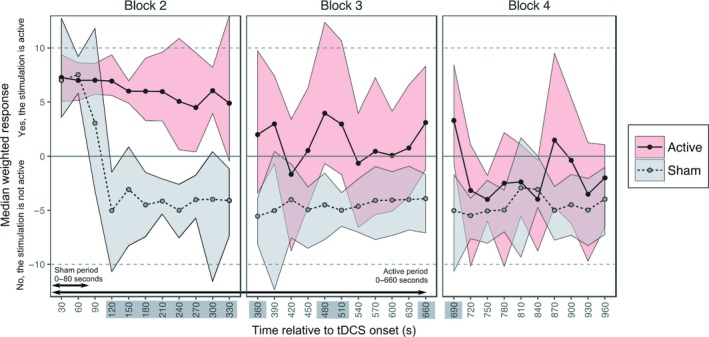
Studies using transcranial direct current stimulation (tDCS) typically compare an active protocol relative to a shorter sham (placebo) protocol. Both protocols are presumed to be perceptually identical on the scalp, and thus represent an effective method of delivering double-blinded experimental designs. However, participants often show above-chance accuracy when asked which condition involved active/sham retrospectively. We assessed the time course of sham-blinding during active and sham tDCS. We predicted that participants would be aware that the current is switched on for longer in the active versus sham protocol. Thirty-two adults were tested in a preregistered, double-blinded, within-subjects design. A forced-choice reaction time task was undertaken before, during and after active (10 min 1 mA) and sham (20 s 1 mA) tDCS. The anode was placed over the left primary motor cortex (C3) to target the right hand, and the cathode on the right forehead. Two probe questions were asked every 30 s: "Is the stimulation on?" and "How sure are you?". Distinct periods of non-overlapping confidence intervals were identified between conditions, totalling 5 min (57.1% of the total difference in stimulation time). These began immediately after sham ramp-down and lasted until the active protocol had ended. We therefore show a failure of placebo control during 1 mA tDCS. These results highlight the need to develop more effective methods of sham-blinding during transcranial electrical stimulation protocols, even when delivered at low-intensity current strengths.
研究通常使用经颅直流电刺激 (tDCS) 将主动方案与更短的假方案 (安慰剂) 进行比较。头皮上假定两种方案在感知上是相同的,因此代表了提供双盲实验设计的有效方法。然而,当被要求回顾性地指出哪个条件涉及主动/假时,参与者通常表现出高于机会的准确性。我们评估了在主动和假 tDCS 期间假盲的时间过程。我们预测,参与者会意识到在主动方案中电流的开启时间比假方案更长。32 名成年人在预先注册的、双盲的、个体内设计中进行了测试。在主动 (10 分钟 1 mA) 和假 (20 秒 1 mA) tDCS 之前、期间和之后进行了强制选择反应时间任务。阳极放置在左初级运动皮层 (C3) 上方,以靶向右手,阴极放置在右额头上。每 30 秒问两个探针问题:“刺激是否开启?”和“你有多确定?”。条件之间确定了不重叠的置信区间的不同时期,总计 5 分钟(刺激时间总差异的 57.1%)。这些时期立即在假斜坡下降后开始,并持续到主动方案结束。因此,我们在 1 mA tDCS 期间显示出安慰剂控制失败。这些结果强调了即使在低强度电流强度下,也需要开发更有效的经颅电刺激方案中的假盲方法。