Department of Bioengineering, University of California-San Francisco Berkeley Joint Program, Room A-C106-B, 1 Irving St, San Francisco, CA, 94143, USA.
Department of Radiology and Biomedical Imaging, UC-San Francisco, San Francisco, CA, 94143, USA.
Cancer Imaging. 2019 Jun 22;19(1):41. doi: 10.1186/s40644-019-0227-3.
To determine if mammographic features from deep learning networks can be applied in breast cancer to identify groups at interval invasive cancer risk due to masking beyond using traditional breast density measures.
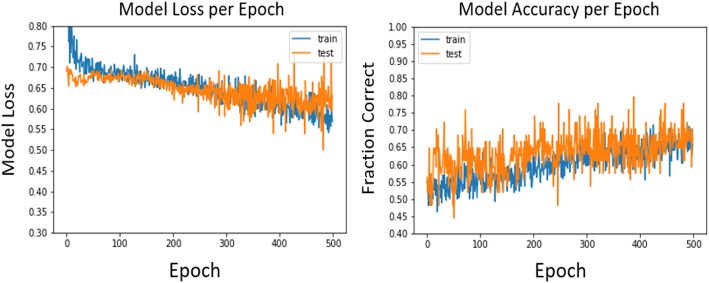
Full-field digital screening mammograms acquired in our clinics between 2006 and 2015 were reviewed. Transfer learning of a deep learning network with weights initialized from ImageNet was performed to classify mammograms that were followed by an invasive interval or screen-detected cancer within 12 months of the mammogram. Hyperparameter optimization was performed and the network was visualized through saliency maps. Prediction loss and accuracy were calculated using this deep learning network. Receiver operating characteristic (ROC) curves and area under the curve (AUC) values were generated with the outcome of interval cancer using the deep learning network and compared to predictions from conditional logistic regression with errors quantified through contingency tables.
Pre-cancer mammograms of 182 interval and 173 screen-detected cancers were split into training/test cases at an 80/20 ratio. Using Breast Imaging-Reporting and Data System (BI-RADS) density alone, the ability to correctly classify interval cancers was moderate (AUC = 0.65). The optimized deep learning model achieved an AUC of 0.82. Contingency table analysis showed the network was correctly classifying 75.2% of the mammograms and that incorrect classifications were slightly more common for the interval cancer mammograms. Saliency maps of each cancer case found that local information could highly drive classification of cases more than global image information.
Pre-cancerous mammograms contain imaging information beyond breast density that can be identified with deep learning networks to predict the probability of breast cancer detection.
为了确定深度学习网络的乳腺摄影特征是否可应用于乳腺癌中,以确定因传统乳腺密度测量以外的因素而导致的间隔浸润性癌风险的群体。
回顾了我们诊所于 2006 年至 2015 年间获取的全视野数字化筛查乳腺 X 线照片。通过使用 ImageNet 初始化权重的深度学习网络进行转移学习,以对在乳腺 X 线照片后 12 个月内发生浸润性间隔癌或筛查发现癌症的乳腺 X 线照片进行分类。进行超参数优化,并通过显著图可视化网络。使用此深度学习网络计算预测损失和准确性。使用深度学习网络的间隔癌结果生成接收器工作特征(ROC)曲线和曲线下面积(AUC)值,并与通过误差通过列联表量化的条件逻辑回归的预测进行比较。
将 182 例间隔癌和 173 例筛查发现癌症的癌前乳腺 X 线照片按 80/20 的比例分为训练/测试病例。仅使用乳腺影像报告和数据系统(BI-RADS)密度,正确分类间隔癌的能力为中等(AUC=0.65)。优化后的深度学习模型的 AUC 为 0.82。列联表分析表明,网络正确分类了 75.2%的乳腺 X 线照片,并且间隔癌乳腺 X 线照片的错误分类略为常见。对每个癌症病例的显著图进行分析发现,局部信息可以高度驱动病例的分类,而不是全局图像信息。
癌前乳腺 X 线照片包含除乳腺密度以外的影像学信息,可以通过深度学习网络识别,以预测乳腺癌检测的概率。