Celiac Disease Research Center, Faculty of Medicine and Health Technology, Tampere University, Tampere, Finland.
Faculty of Social Sciences, Tampere University, Tampere, Finland.
Sci Rep. 2019 Jun 25;9(1):9217. doi: 10.1038/s41598-019-45679-x.
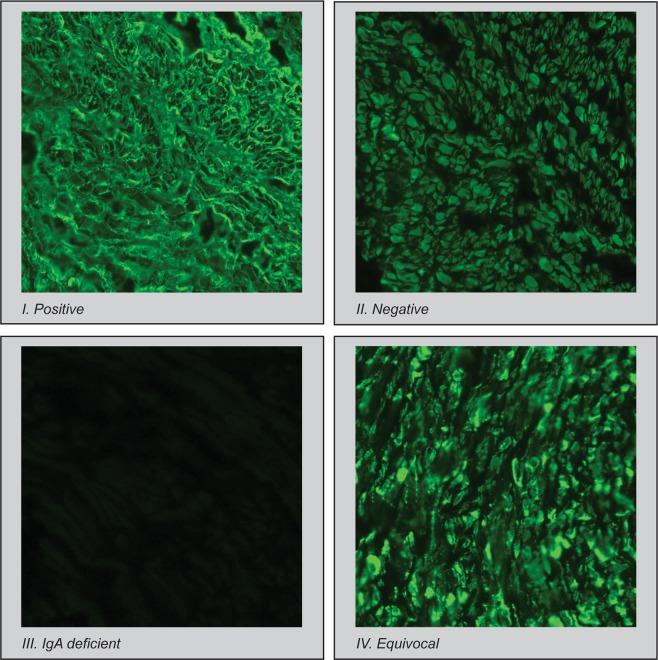
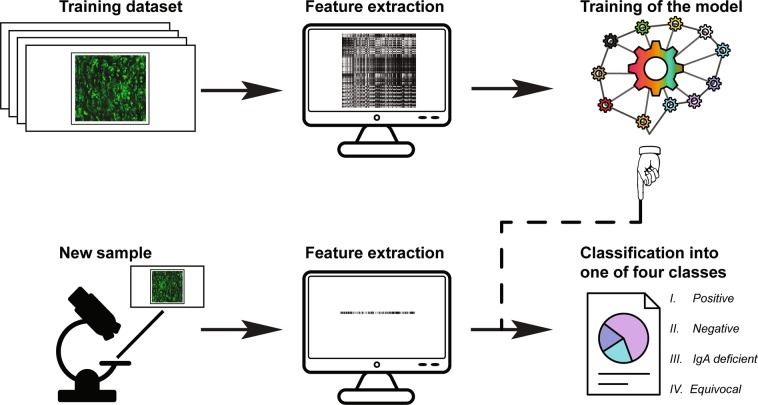
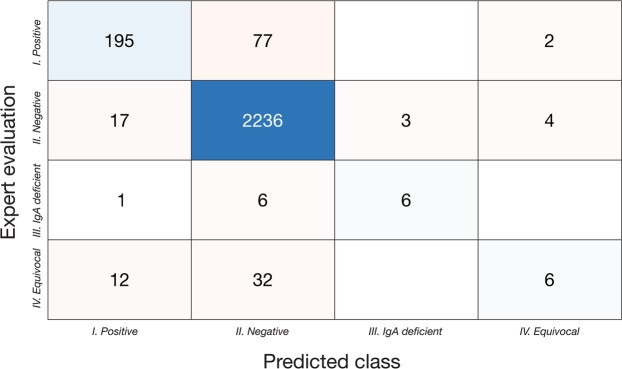
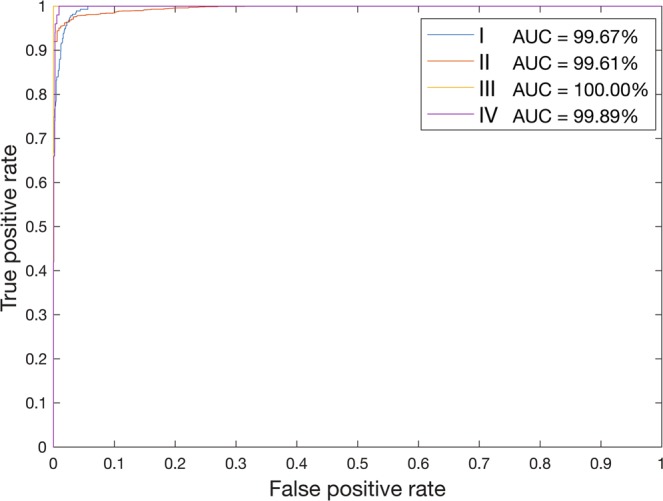
Widespread use of endomysial autoantibody (EmA) test in diagnostics of celiac disease is limited due to its subjectivity and its requirement of an expert evaluator. The study aimed to determine whether machine learning can be applied to create a new observer-independent method of automatic assessment and classification of the EmA test for celiac disease. The study material comprised of 2597 high-quality IgA-class EmA images collected in 2017-2018. According to standard procedure, highly-experienced professional classified samples into the following four classes: I - positive, II - negative, III - IgA deficient, and IV - equivocal. Machine learning was deployed to create a classification model. The sensitivity and specificity of the model were 82.84% and 99.40%, respectively. The accuracy was 96.80%. The classification error was 3.20%. The area under the curve was 99.67%, 99.61%, 100%, and 99.89%, for I, II, III, and IV class, respectively. The mean assessment time per image was 16.11 seconds. This is the first study deploying machine learning for the automatic classification of IgA-class EmA test for celiac disease. The results indicate that using machine learning enables quick and precise EmA test analysis that can be further developed to simplify EmA analysis.
由于endomysial 自身抗体(EmA)试验的主观性和对专家评估员的要求,其在乳糜泻诊断中的广泛应用受到限制。本研究旨在确定机器学习是否可用于创建一种新的、观察者独立的乳糜泻 EmA 试验自动评估和分类方法。研究材料包括 2017 年至 2018 年期间收集的 2597 份高质量 IgA 类 EmA 图像。根据标准程序,经验丰富的专业人员将样本分为以下四类:I - 阳性,II - 阴性,III - IgA 缺乏,和 IV - 可疑。采用机器学习来创建分类模型。该模型的灵敏度和特异性分别为 82.84%和 99.40%,准确性为 96.80%。分类错误率为 3.20%。曲线下面积分别为 99.67%、99.61%、100%和 99.89%,对应于 I、II、III 和 IV 类。每张图像的平均评估时间为 16.11 秒。这是第一项使用机器学习对乳糜泻的 IgA 类 EmA 试验进行自动分类的研究。结果表明,使用机器学习可以实现快速、准确的 EmA 试验分析,这可以进一步开发以简化 EmA 分析。