Darraj Hussain, Badedi Mohammed, Poore Kirsten R, Hummadi Abdulrahman, Khawaji Abdullah, Solan Yahia, Zakri Ibrahim, Sabai Abdullah, Darraj Majid, Mutawwam Dhayf Alrahman, Daghreeri Mohammed, Sayed Safaa, Alaallah Wael, Alfadhly Abdulaziz, Alsabaani Abdullah
Jazan Health Affairs, Ministry of Health, Jazan, Saudi Arabia.
Institute of Development Sciences, Faculty of Medicine, University of Southampton, Southampton, UK.
Diabetes Metab Syndr Obes. 2019 Jun 5;12:853-862. doi: 10.2147/DMSO.S203700. eCollection 2019.
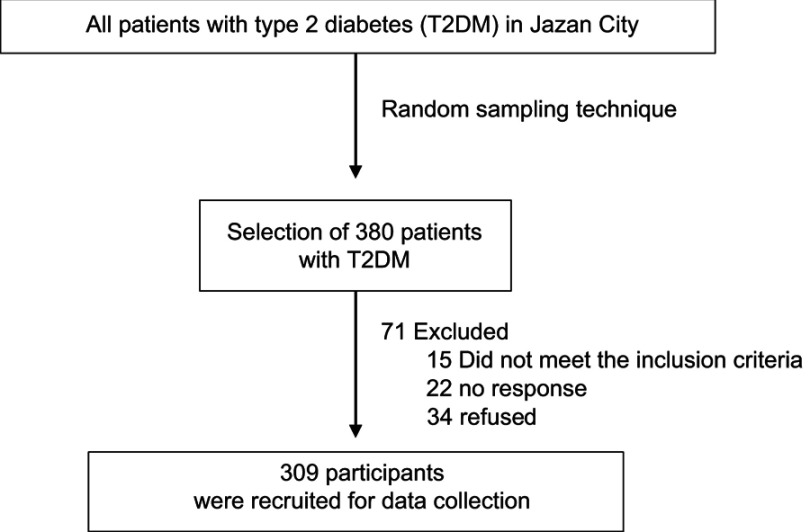
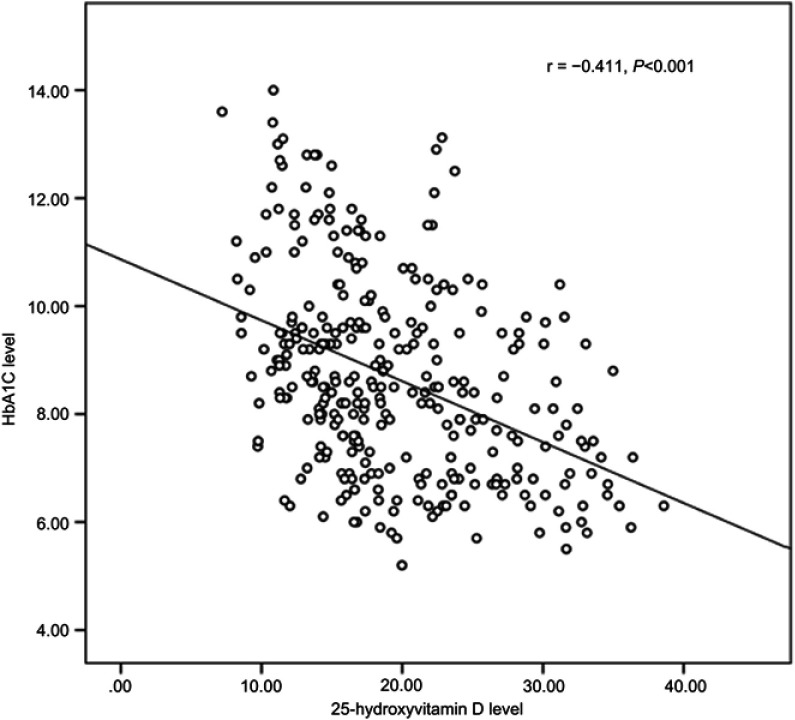
The prevalence of vitamin D deficiency (VDD) is predicted to be high in patients with type 2 diabetes mellitus (T2DM), but the exact figure is not known in Jazan, Saudi Arabia. Emerging data suggests that VDD plays a role in glycemic control. The aim of this study was to measure the prevalence of VDD among T2DM patients and to investigate its association with patients' characteristics and glycemic control in Jazan. This is an analytical cross-sectional study which recruited 309 patients with T2DM randomly from primary health care centers in Jazan. Logistic regression analysis was conducted to determine the VDD predictors and to examine the association of VDD and glycemic control. The VDD prevalence was found to be 60.8% in patients with T2DM. Age, gender, diabetic retinopathy (DR), dyslipidemia, glycemic control, and obesity were significantly associated with VDD, and all except obesity were independent predictors of VDD. There was a significant negative correlation between 25-hydroxyvitamin D and HbA1c. VDD was a significant independent predictor of poor glycemic control after adjustment for hypertension, DR, diabetic neuropathy, type of diabetes medication, diabetes duration, and education level. In this Saudi Arabian population, VDD is highly prevalent in people with T2DM and is associated with poor glycemic control. Health education targeting patients with T2DM and national strategies regarding vitamin D fortification are needed to prevent VDD in Saudi Arabia. Earlier VDD diagnosis by health care providers may help to improve the outcome for patients with T2DM. Establishing the causal association between VDD and glycemic control and clarifying the biological role of vitamin D in T2DM are important aims for future studies.
预计2型糖尿病(T2DM)患者中维生素D缺乏(VDD)的患病率较高,但沙特阿拉伯吉赞地区的确切数字尚不清楚。新出现的数据表明,VDD在血糖控制中起作用。本研究的目的是测量吉赞地区T2DM患者中VDD的患病率,并调查其与患者特征及血糖控制的关系。这是一项分析性横断面研究,从吉赞的初级卫生保健中心随机招募了309例T2DM患者。进行逻辑回归分析以确定VDD的预测因素,并检验VDD与血糖控制的关系。结果发现,T2DM患者中VDD的患病率为60.8%。年龄、性别、糖尿病视网膜病变(DR)、血脂异常、血糖控制和肥胖与VDD显著相关,除肥胖外,所有因素均为VDD的独立预测因素。25-羟基维生素D与糖化血红蛋白(HbA1c)之间存在显著负相关。在调整了高血压、DR、糖尿病神经病变、糖尿病药物类型、糖尿病病程和教育水平后,VDD是血糖控制不佳的显著独立预测因素。在这个沙特阿拉伯人群中,VDD在T2DM患者中非常普遍,并且与血糖控制不佳有关。在沙特阿拉伯,需要针对T2DM患者开展健康教育以及制定有关维生素D强化的国家战略,以预防VDD。医疗保健人员尽早诊断VDD可能有助于改善T2DM患者的预后。确定VDD与血糖控制之间的因果关系以及阐明维生素D在T2DM中的生物学作用是未来研究的重要目标。