Almetwazi Mansour S, Noor Ahmad O, Almasri Diena M, Popovici Ioana, Alhawassi Tariq, Alburikan Khalid A, Harrington Catherine A
Clinical Pharmacy Department, College of Pharmacy, King Saud University, Riyadh, Saudi Arabia.
Medication Safety Research Chair, College of Pharmacy, King Saud University, Riyadh, Saudi Arabia.
Saudi Pharm J. 2017 Dec;25(8):1179-1183. doi: 10.1016/j.jsps.2017.09.001. Epub 2017 Sep 12.
To evaluate the association between the level of vitamin D and glycemic control among patients with diabetes.
We analyzed data collected from NHANES 2003-2006. We included only non-pregnant adult diabetic persons 18 years or older. Participants who had vitamin D level less than 20 ng/ml were considered as having vitamin D deficiency. Participants were considered to have a glucose control if the HbA level was less than 7% [53 mmol/L]. We used student's test to compare the difference in HbA means between people with Diabetes with and without a vitamin D deficiency. We used a multivariate logistic regression model to predict the relationship between glucose control and vitamin D deficiency. We used race/ethnicity, BMI, age, gender, type of diabetic medication used, having health insurance or not, and comorbid conditions (hypertension, anemia, cholesterol, liver disease, and kidney disease) as control variables.
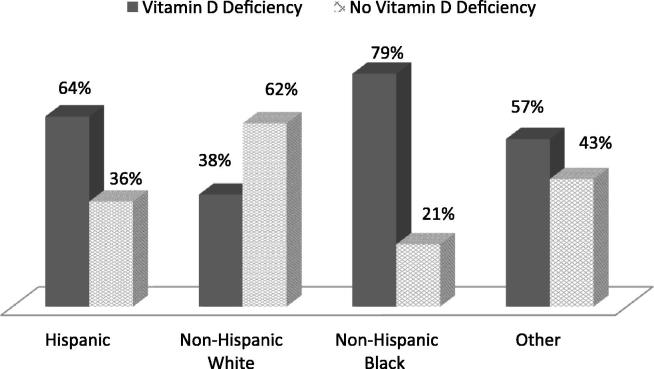
The study population included a total of 929 non-institutionalized, non-pregnant, diabetic adult persons. About 57% of patients with diabetes had a vitamin D deficiency. Blacks (non-Hispanic patients) with diabetes had the highest rate of vitamin D deficiency (79%). The unadjusted means of HbA were significantly different between diabetic patients with no vitamin D deficiency and those with a vitamin D deficiency (7.06% [54 mmol/L], 7.56 % [59 mmol/L], respectively, P < 0.0001). Multivariate adjustment showed a small but not significant, increase in odds (11%) of having uncontrolled diabetes in patients with a vitamin D deficiency after adjustment for other factors.
Vitamin D deficiency is very common in patients with diabetes. We found no significant association between vitamin D level and glycemic control in patients with diabetes after adjustment for control variables.
评估糖尿病患者维生素D水平与血糖控制之间的关联。
我们分析了从2003 - 2006年美国国家健康与营养检查调查(NHANES)收集的数据。我们仅纳入年龄在18岁及以上的非妊娠成年糖尿病患者。维生素D水平低于20 ng/ml的参与者被视为维生素D缺乏。如果糖化血红蛋白(HbA)水平低于7%[53 mmol/L],则参与者被认为血糖得到控制。我们使用学生t检验来比较有和没有维生素D缺乏的糖尿病患者之间HbA均值的差异。我们使用多元逻辑回归模型来预测血糖控制与维生素D缺乏之间的关系。我们将种族/民族、体重指数(BMI)、年龄、性别、所使用的糖尿病药物类型、是否有医疗保险以及合并症(高血压、贫血、胆固醇、肝病和肾病)作为控制变量。
研究人群总共包括929名非机构化、非妊娠的成年糖尿病患者。约57%的糖尿病患者存在维生素D缺乏。患有糖尿病的黑人(非西班牙裔患者)维生素D缺乏率最高(79%)。没有维生素D缺乏的糖尿病患者与有维生素D缺乏的糖尿病患者之间,未经调整的HbA均值有显著差异(分别为7.06%[54 mmol/L]和7.56%[59 mmol/L],P < 0.0001)。多变量调整显示,在对其他因素进行调整后,维生素D缺乏患者血糖未得到控制的几率有小幅但不显著的增加(11%)。
维生素D缺乏在糖尿病患者中非常普遍。在对控制变量进行调整后,我们发现糖尿病患者的维生素D水平与血糖控制之间没有显著关联。