Department of Neurology, Ruhr-University Bochum, St. Josef-Hospital Bochum, Gudrunstr. 56, 44791 Bochum, Germany.
Int J Mol Sci. 2019 Jun 25;20(12):3109. doi: 10.3390/ijms20123109.
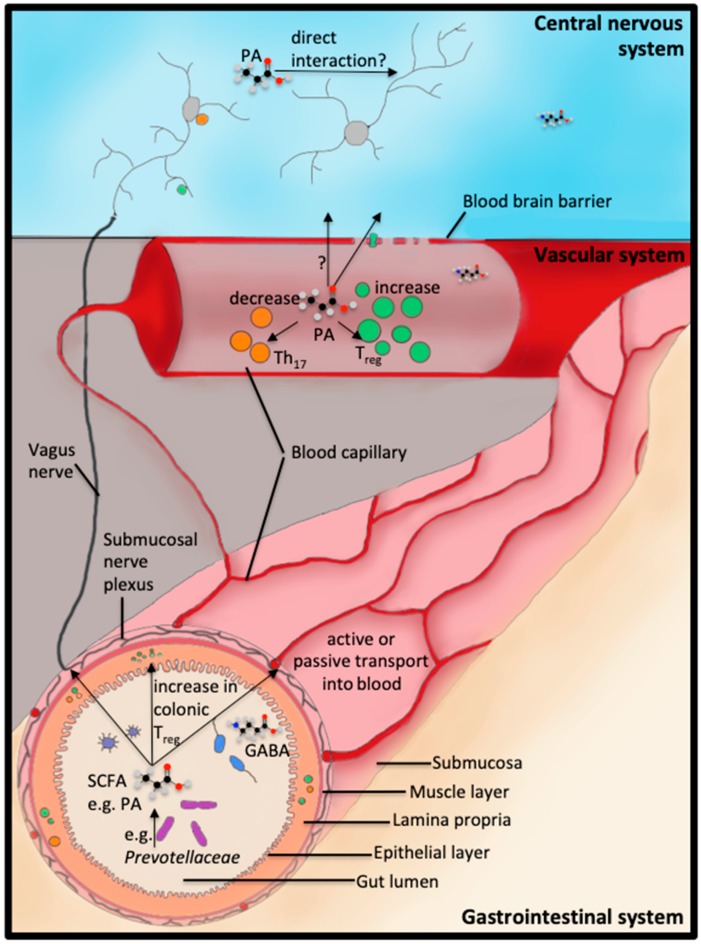
Within the last century, human lifestyle and dietary behaviors have changed dramatically. These changes, especially concerning hygiene, have led to a marked decrease in some diseases, i.e., infectious diseases. However, other diseases that can be attributed to the so-called 'Western' lifestyle have increased, i.e., metabolic and cardiovascular disorders. More recently, multifactorial disorders, such as autoimmune and neurodegenerative diseases, have been associated with changes in diet and the gut microbiome. In particular, short chain fatty acid (SCFA)-producing bacteria are of high interest. SCFAs are the main metabolites produced by bacteria and are often reduced in a dysbiotic state, causing an inflammatory environment. Based on advanced technologies, high-resolution investigations of the abundance and composition of the commensal microbiome are now possible. These techniques enable the assessment of the relationship between the gut microbiome, its metabolome and gut-associated immune and neuronal cells. While a growing number of studies have shown the indirect impact of gut metabolites, mediated by alterations of immune-mediated mechanisms, the direct influence of these compounds on cells of the central nervous system needs to be further elucidated. For instance, the SCFA propionic acid (PA) increases the amount of intestine-derived regulatory T cells, which furthermore can positively affect the central nervous system (CNS), e.g., by increasing remyelination. However, the question of if and how PA can directly interact with CNS-resident cells is a matter of debate. In this review, we discuss the impact of an altered microbiome composition in relation to various diseases and discuss how the commensal microbiome is shaped, starting from the beginning of human life.
在过去的一个世纪里,人类的生活方式和饮食行为发生了巨大的变化。这些变化,尤其是在卫生方面,导致一些疾病(如传染病)的发病率显著下降。然而,其他可以归因于所谓的“西方”生活方式的疾病(如代谢和心血管疾病)却有所增加。最近,多因素疾病,如自身免疫和神经退行性疾病,与饮食和肠道微生物群的变化有关。特别是,短链脂肪酸(SCFA)产生菌受到了高度关注。SCFAs 是细菌产生的主要代谢物,在菌群失调状态下往往会减少,导致炎症环境。基于先进的技术,现在可以对共生微生物群的丰度和组成进行高分辨率的研究。这些技术使我们能够评估肠道微生物群、其代谢物以及与肠道相关的免疫和神经元细胞之间的关系。虽然越来越多的研究表明,肠道代谢物通过改变免疫介导的机制间接影响中枢神经系统,但这些化合物对中枢神经系统细胞的直接影响仍需进一步阐明。例如,短链脂肪酸丙酸(PA)会增加肠道来源的调节性 T 细胞的数量,这进一步可以对中枢神经系统(CNS)产生积极影响,例如通过增加髓鞘形成。然而,PA 是否以及如何能与中枢神经系统内的细胞直接相互作用仍存在争议。在这篇综述中,我们讨论了改变的微生物群组成与各种疾病的关系,并讨论了共生微生物群是如何形成的,从人类生命的开始。