1 Medical Physics Graduate Program, Duke University, Durham, NC, USA.
2 Department of Radiation Oncology, Duke University Medical Center, Durham, NC, USA.
Technol Cancer Res Treat. 2019 Jan 1;18:1533033819858661. doi: 10.1177/1533033819858661.
To develop an automated optimization program to generate optimal beam settings for whole-breast radiation therapy driven by clinically oriented goals.
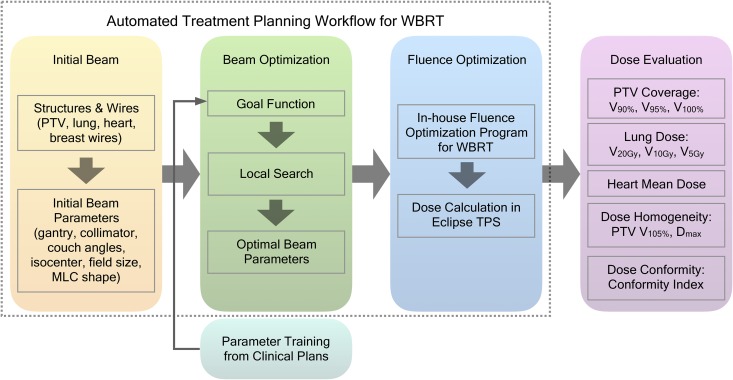
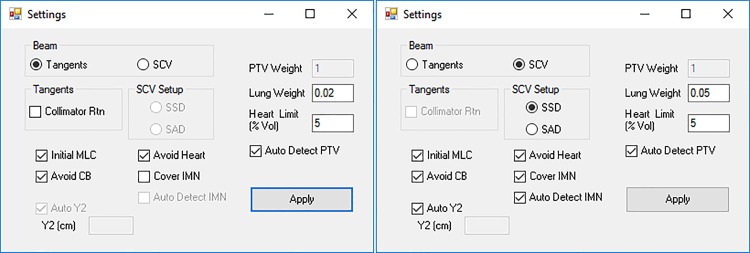
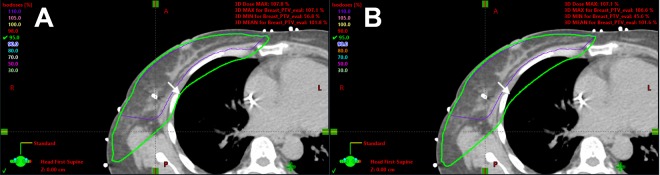
Forty patients were retrospectively included in this study. Each patient's planning images, contoured structures of planning target volumes, organs-at-risk, and breast wires were used to optimize for patient-specific-beam settings. Two beam geometries were available tangential beams only and tangential plus supraclavicular beams. Beam parameters included isocenter position, gantry, collimator, couch angles, and multileaf collimator shape. A geometry-based goal function was defined to determine such beam parameters to minimize out-of-field target volume and in-field ipsilateral lung volume. For each geometry, the weighting in the goal function was trained with 10 plans and tested on 10 additional plans. For each query patient, the optimal beam setting was searched for different gantry-isocenter pairs. Optimal fluence maps were generated by an in-house automatic fluence optimization program for target coverage and homogeneous dose distribution, and dose calculation was performed in Eclipse. Automatically generated plans were compared with manually generated plans for target coverage and lung and heart sparing.
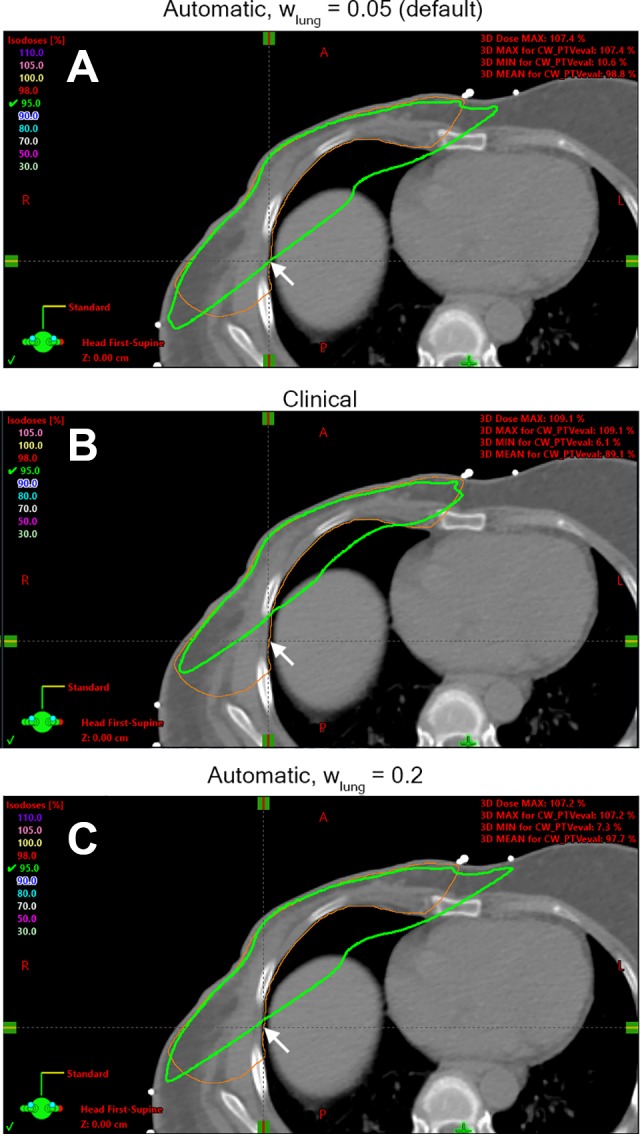
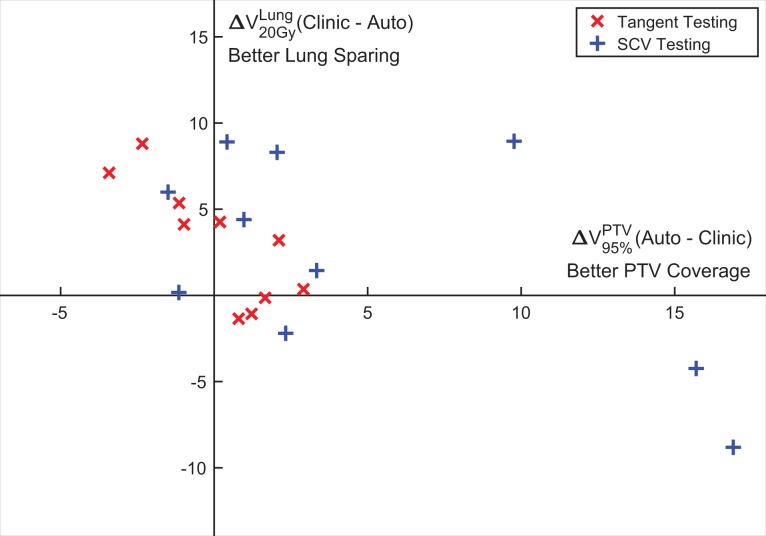
The program successfully produced a set of beam parameters for every patient. Beam optimization time ranged from 10 to 120 s. The automatic plans had overall comparable plan quality to manually generated plans. For all testing cases, the mean target V was 91.0% for the automatic plans and 88.5% for manually generated plans. The mean ipsilateral lung V was lower for the automatic plans (15.2% vs 17.9%). The heart mean dose, maximum dose of the body, and conformity index were all comparable.
We developed an automated goal-driven beam setting optimization program for whole-breast radiation therapy. It provides clinically relevant solutions based on previous clinical practice as well as patient specific anatomy on a substantially faster time frame.
开发一种自动化优化程序,为基于临床目标的全乳房放射治疗生成最佳射束设置。
本研究回顾性纳入 40 例患者。每位患者的计划图像、计划靶区轮廓结构、危及器官和乳房导丝均用于优化患者特定的射束设置。可提供两种射束几何形状:切线射束和切线加锁骨上射束。射束参数包括等中心位置、旋转机架角度、准直器角度、治疗床角度和多叶准直器形状。定义了基于几何形状的目标函数,以确定这些射束参数,使野外靶区体积和场内同侧肺体积最小化。对于每种几何形状,用 10 个计划在目标函数中进行加权训练,并在另外 10 个计划中进行测试。对于每个查询患者,在不同的旋转机架-等中心对之间搜索最佳射束设置。通过内部自动适形优化程序为靶区覆盖和均匀剂量分布生成最佳的射束强度图,并在 Eclipse 中进行剂量计算。自动生成的计划与手动生成的计划进行了靶区覆盖和肺与心脏保护的比较。
该程序成功地为每位患者生成了一组射束参数。射束优化时间范围为 10 至 120 秒。自动计划的整体计划质量与手动生成的计划相当。对于所有测试病例,自动计划的平均靶区 V 为 91.0%,而手动生成计划为 88.5%。自动计划的同侧肺 V 平均值较低(15.2%对 17.9%)。心脏平均剂量、身体最大剂量和适形指数均相当。
我们开发了一种用于全乳房放射治疗的自动化目标驱动射束设置优化程序。它基于以往的临床实践以及患者特定的解剖结构,在更短的时间内提供有临床意义的解决方案。