
一种针对复杂分数反应与占有率数据的具有结合亲和力、激活效力和信号放大参数的受体模型。
A Receptor Model With Binding Affinity, Activation Efficacy, and Signal Amplification Parameters for Complex Fractional Response Versus Occupancy Data.
作者信息
Buchwald Peter
机构信息
Department of Molecular and Cellular Pharmacology, Diabetes Research Institute, Miller School of Medicine, University of Miami, Miami, FL, United States.
出版信息
Front Pharmacol. 2019 Jun 11;10:605. doi: 10.3389/fphar.2019.00605. eCollection 2019.
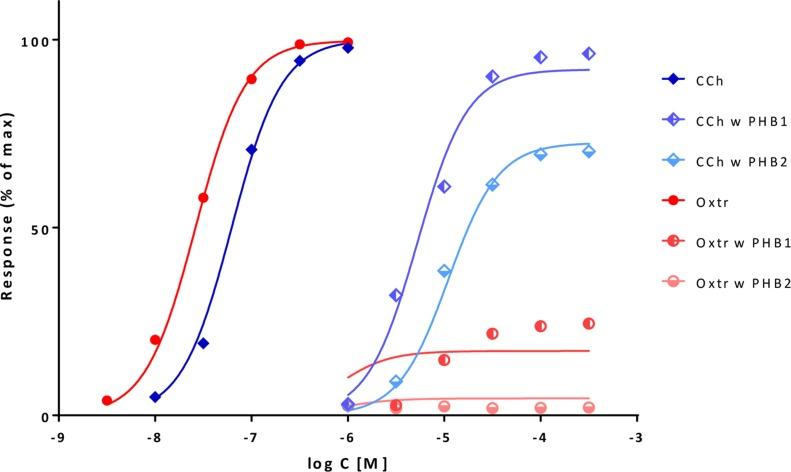
In quantitative pharmacology, multi-parameter receptor models are needed to account for the complex nonlinear relationship between fractional occupancy and response that can occur due to the intermixing of the effects of partial receptor activation and post-receptor signal amplification. Here, a general two-state receptor model and corresponding quantitative forms are proposed that unify three distinct processes, each characterized with its own parameter: 1) receptor binding, characterized by , the equilibrium dissociation constant used for binding affinity; 2) receptor activation, characterized by an (intrinsic) efficacy parameter ; and 3) post-activation signal transduction (amplification), characterized by a gain parameter . Constitutive activity is accommodated via an additional parameter quantifying the activation of the ligand-free receptor. Receptors can be active or inactive in both their ligand-free and ligand-bound states (two-state receptor theory), but ligand binding alters the likelihood of activation (induced fit). Because structural data now confirm that for most receptors in their active conformation, the small-molecule ligand-binding site is buried inside, straightforward binding to the active form (direct conformational selection) is unlikely. The proposed general equation has parameters that are more intuitive and better suited for optimization by nonlinear regression than those of the operational (Black and Leff) or del Castillo-Katz model. The model provides a unified framework for fitting complex data including a) fractional responses that do not match independently measured fractional occupancies, b) responses measured after partial irreversible inactivation of the "receptor reserve" (Furchgott method), c) fractional responses that are different along distinct downstream pathways (biased agonism), and d) responses with constitutive receptor activity. Furthermore, unlike previous models, the present one can be reduced back for special cases of its parameters to consecutively nested simplified forms that can be used on their own when adequate (e.g., = 0, no constitutive activity; = 1: model for partial agonism; = 1: Clark equation).
在定量药理学中,需要多参数受体模型来解释由于部分受体激活和受体后信号放大效应的混合而可能出现的占有率分数与反应之间复杂的非线性关系。在此,提出了一种通用的双态受体模型及其相应的定量形式,该模型统一了三个不同的过程,每个过程都有其自身的参数:1)受体结合,其特征为 ,即用于结合亲和力的平衡解离常数;2)受体激活,其特征为一个(内在)效能参数 ;3)激活后信号转导(放大),其特征为一个增益参数 。组成性活性通过一个额外的 参数来体现,该参数量化了无配体受体的激活情况。受体在其无配体和结合配体状态下都可以是活跃的或不活跃的(双态受体理论),但配体结合会改变激活的可能性(诱导契合)。由于结构数据现在证实,对于大多数处于活性构象的受体,小分子配体结合位点被埋在内部,因此直接与活性形式结合(直接构象选择)不太可能。所提出的通用方程的参数比操作(布莱克和莱夫)模型或德尔卡斯蒂略 - 卡茨模型的参数更直观,更适合通过非线性回归进行优化。该模型为拟合复杂数据提供了一个统一的框架,这些复杂数据包括:a)与独立测量的占有率分数不匹配的分数反应;b)在“受体储备”部分不可逆失活后测量的反应(弗奇戈特方法);c)沿不同下游途径不同的分数反应(偏向激动作用);d)具有组成性受体活性的反应。此外,与以前的模型不同,当前模型可以针对其参数的特殊情况简化为连续嵌套的简化形式,在适当的时候可以单独使用(例如, = 0,无组成性活性; = 1:部分激动作用的 模型; = 1:克拉克方程)。




 Zotero 插件