Department of Laboratory Medicine, Tan Tock Seng Hospital, Singapore.
Institute of Biodiversity Animal Health and Comparative Medicine, College of Medical Veterinary and Life Sciences, University of Glasgow, Glasgow, United Kingdom.
PLoS Negl Trop Dis. 2019 Jun 27;13(6):e0007421. doi: 10.1371/journal.pntd.0007421. eCollection 2019 Jun.
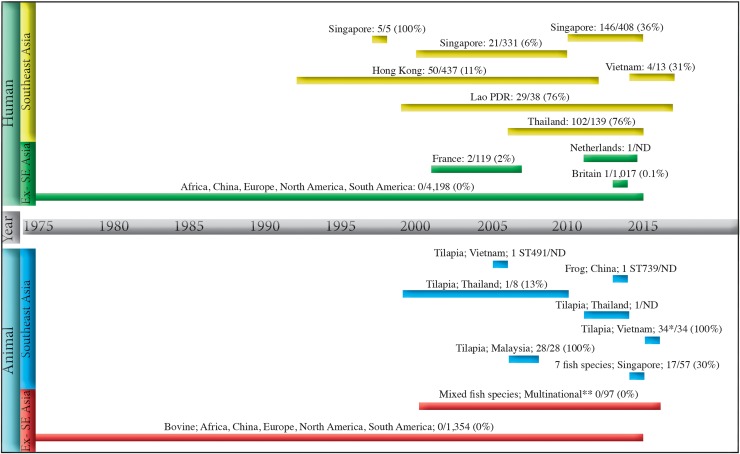
In 2015, Singapore had the first and only reported foodborne outbreak of invasive disease caused by the group B Streptococcus (GBS; Streptococcus agalactiae). Disease, predominantly septic arthritis and meningitis, was associated with sequence type (ST)283, acquired from eating raw farmed freshwater fish. Although GBS sepsis is well-described in neonates and older adults with co-morbidities, this outbreak affected non-pregnant and younger adults with fewer co-morbidities, suggesting greater virulence. Before 2015 ST283 had only been reported from twenty humans in Hong Kong and two in France, and from one fish in Thailand. We hypothesised that ST283 was causing region-wide infection in Southeast Asia.
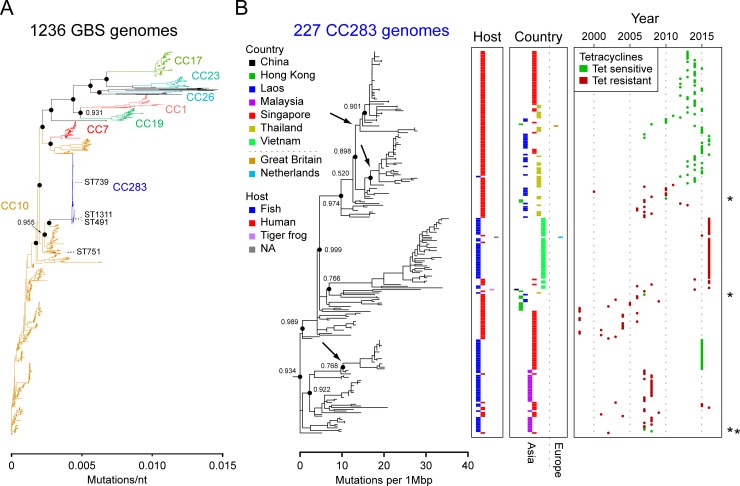
METHODOLOGY/PRINCIPAL FINDINGS: We performed a literature review, whole genome sequencing on 145 GBS isolates collected from six Southeast Asian countries, and phylogenetic analysis on 7,468 GBS sequences including 227 variants of ST283 from humans and animals. Although almost absent outside Asia, ST283 was found in all invasive Asian collections analysed, from 1995 to 2017. It accounted for 29/38 (76%) human isolates in Lao PDR, 102/139 (73%) in Thailand, 4/13 (31%) in Vietnam, and 167/739 (23%) in Singapore. ST283 and its variants were found in 62/62 (100%) tilapia from 14 outbreak sites in Malaysia and Vietnam, in seven fish species in Singapore markets, and a diseased frog in China.
GBS ST283 is widespread in Southeast Asia, where it accounts for a large proportion of bacteraemic GBS, and causes disease and economic loss in aquaculture. If human ST283 is fishborne, as in the Singapore outbreak, then GBS sepsis in Thailand and Lao PDR is predominantly a foodborne disease. However, whether transmission is from aquaculture to humans, or vice versa, or involves an unidentified reservoir remains unknown. Creation of cross-border collaborations in human and animal health are needed to complete the epidemiological picture.
2015 年,新加坡出现了首例也是唯一报告的由 B 群链球菌(GBS;无乳链球菌)引起的食源性侵袭性疾病暴发。疾病主要为败血性关节炎和脑膜炎,与从食用生养殖淡水鱼中获得的序列类型(ST)283 有关。尽管 GBS 败血症在新生儿和伴有合并症的老年人中已有很好的描述,但此次暴发影响了无妊娠和年轻且合并症较少的成年人,表明其毒力更强。在 2015 年之前,ST283 仅在香港的 20 名人类和法国的 2 名人类以及泰国的 1 条鱼中被报道过。我们假设 ST283 正在东南亚地区引起广泛的感染。
方法/主要发现:我们进行了文献综述,对来自六个东南亚国家的 145 株 GBS 分离株进行了全基因组测序,并对包括来自人类和动物的 227 种 ST283 变体在内的 7468 个 GBS 序列进行了系统发育分析。尽管 ST283 几乎不存在于亚洲以外地区,但在 1995 年至 2017 年期间,我们在所有分析的亚洲侵袭性分离株中均发现了 ST283。它占老挝人民民主共和国 38 个人类分离株中的 29 株(76%),泰国 139 株中的 102 株(73%),越南 13 株中的 4 株(31%)和新加坡 739 株中的 167 株(23%)。在马来西亚和越南的 14 个暴发地点的 62/62(100%)罗非鱼、新加坡市场的 7 种鱼类和中国的一只患病青蛙中发现了 ST283 及其变体。
GBS ST283 在东南亚广泛传播,在该地区,它构成了很大比例的血源性 GBS,并导致水产养殖中的疾病和经济损失。如果人类 ST283 是来自鱼类,就像在新加坡的暴发一样,那么泰国和老挝人民民主共和国的 GBS 败血症主要是食源性疾病。但是,传播是从水产养殖到人类,还是反之,还是涉及到未被识别的宿主,尚不清楚。需要在人类和动物健康方面建立跨境合作,以完成流行病学研究。