Department of Neurology, National Taiwan University Hospital, College of Medicine, National Taiwan University, Taipei, 100, Taiwan.
Department of Gastroenterology, National Taiwan University Hospital, College of Medicine, National Taiwan University, Taipei, Taiwan.
J Neuroinflammation. 2019 Jun 27;16(1):129. doi: 10.1186/s12974-019-1528-y.
Emerging evidence suggests that gut microbiome composition alterations affect neurodegeneration through neuroinflammation in the pathogenesis of Parkinson's disease (PD). Here, we evaluate gut microbiota alterations and host cytokine responses in a population of Taiwanese patients with PD.
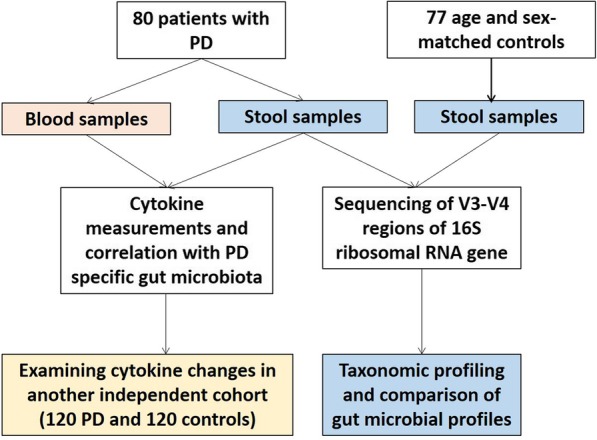
Fecal microbiota communities from 80 patients with PD and 77 age and gender-matched controls were assessed by sequencing the V3-V4 region of the 16S ribosomal RNA gene. Diet and comorbidities were controlled in the analyses. Plasma concentrations of IL-1β, IL-2, IL-4, IL-6, IL-13, IL-18, GM-CSF, IFNγ, and TNFα were measured by a multiplex immunoassay and relationships between microbiota, clinical characteristics, and cytokine levels were analyzed in the PD group. We further examined the cytokine changes associated with the altered gut microbiota seen in patients with PD in another independent cohort of 120 PD patients and 120 controls.
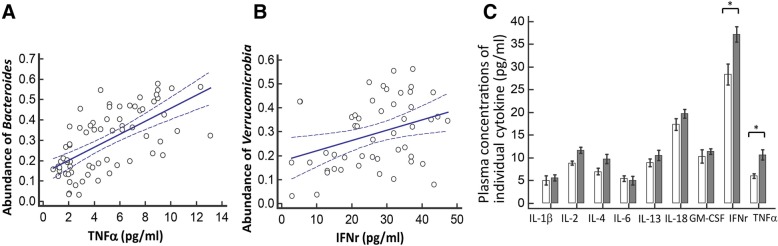
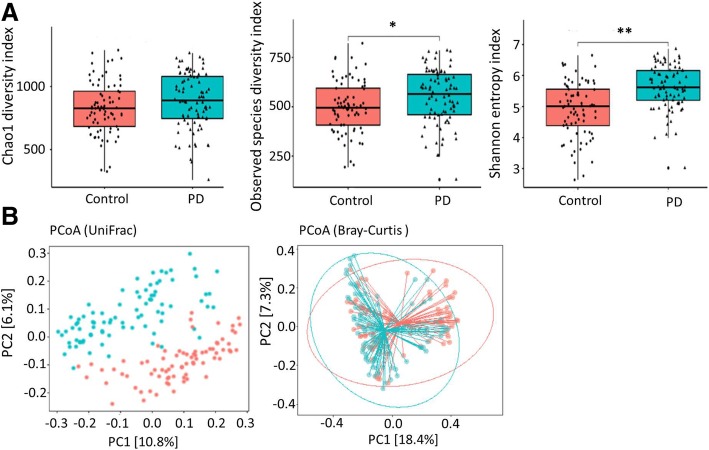
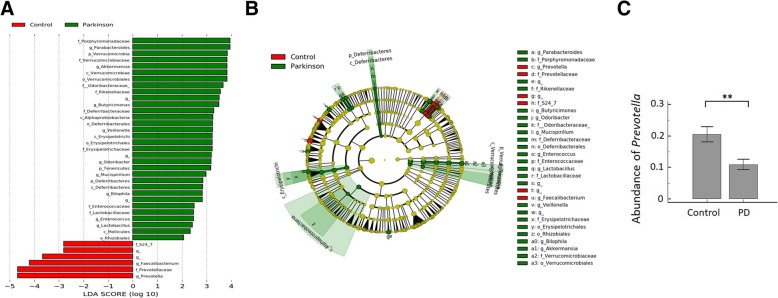
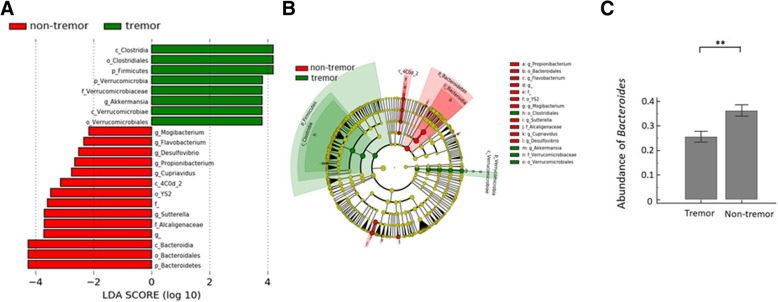
Microbiota from patients with PD was altered relative to controls and dominated by Verrucomicrobia, Mucispirillum, Porphyromonas, Lactobacillus, and Parabacteroides. In contrast, Prevotella was more abundant in controls. The abundances of Bacteroides were more increased in patients with non-tremor PD subtype than patients with tremor subtype. Bacteroides abundance was correlated with motor symptom severity defined by UPDRS part III motor scores (rho = 0.637 [95% confidence interval 0.474 to 0.758], P < 0.01). Altered microbiota was correlated with plasma concentrations of IFNγ and TNFα. There was a correlation between Bacteroides and plasma level of TNFα (rho = 0.638 [95% CI: 0.102-0.887], P = 0.02); and a correlation between Verrucomicrobia abundance and plasma concentrations of IFNγ (rho = 0.545 [95% CI - 0.043-0.852], P = 0.05). The elevated plasma cytokine responses were confirmed in an additional independent 120 patients with PD and 120 controls (TNFα: PD vs. control 8.51 ± 4.63 pg/ml vs. 4.82 ± 2.23 pg/ml, P < 0.01; and IFNγ: PD vs. control: 38.45 ± 7.12 pg/ml vs. 32.79 ± 8.03 pg/ml, P = 0.03).
This study reveals altered gut microbiota in PD and its correlation with clinical phenotypes and severity in our population. The altered plasma cytokine profiles associated with gut microbiome composition alterations suggest aberrant immune responses may contribute to inflammatory processes in PD.
越来越多的证据表明,肠道微生物组组成的改变通过神经炎症影响神经退行性变,从而在帕金森病(PD)的发病机制中起作用。在这里,我们评估了台湾 PD 患者群体的肠道微生物群改变和宿主细胞因子反应。
通过测序 16S 核糖体 RNA 基因的 V3-V4 区,评估了 80 名 PD 患者和 77 名年龄和性别匹配的对照者的粪便微生物群落。在分析中控制了饮食和合并症。通过多重免疫测定法测量了血浆中 IL-1β、IL-2、IL-4、IL-6、IL-13、IL-18、GM-CSF、IFNγ和 TNFα 的浓度,并在 PD 组中分析了微生物群、临床特征和细胞因子水平之间的关系。我们还在另一组 120 名 PD 患者和 120 名对照者中进一步检查了与 PD 患者肠道微生物群改变相关的细胞因子变化。
与对照组相比,PD 患者的微生物群发生了改变,优势菌为厚壁菌门、黏液螺旋菌属、卟啉单胞菌属、乳杆菌属和拟杆菌属。相比之下,普雷沃氏菌属在对照组中更为丰富。非震颤 PD 亚型患者的拟杆菌属丰度较震颤 PD 亚型患者更高。Bacteroides 的丰度与 UPDRS 第三部分运动评分定义的运动症状严重程度相关(rho=0.637[95%置信区间 0.474-0.758],P<0.01)。改变的微生物群与血浆 IFNγ和 TNFα浓度相关。Bacteroides 与血浆 TNFα水平之间存在相关性(rho=0.638[95%CI:0.102-0.887],P=0.02);而 Verrucomicrobia 丰度与血浆 IFNγ浓度之间存在相关性(rho=0.545[95%CI-0.043-0.852],P=0.05)。在另外 120 名 PD 患者和 120 名对照者中,进一步证实了升高的血浆细胞因子反应(TNFα:PD 与对照:8.51±4.63 pg/ml 与 4.82±2.23 pg/ml,P<0.01;和 IFNγ:PD 与对照:38.45±7.12 pg/ml 与 32.79±8.03 pg/ml,P=0.03)。
本研究揭示了 PD 中肠道微生物组的改变及其与人群中临床表型和严重程度的相关性。与肠道微生物群组成改变相关的改变的血浆细胞因子谱表明,异常的免疫反应可能导致 PD 中的炎症过程。