Department of Gastroenterology, Shanxi Provincial People's Hospital, Taiyuan, China.
People's Hospital Affiliated to Shanxi Medical University, Taiyuan, China.
Front Cell Infect Microbiol. 2019 Jun 12;9:206. doi: 10.3389/fcimb.2019.00206. eCollection 2019.
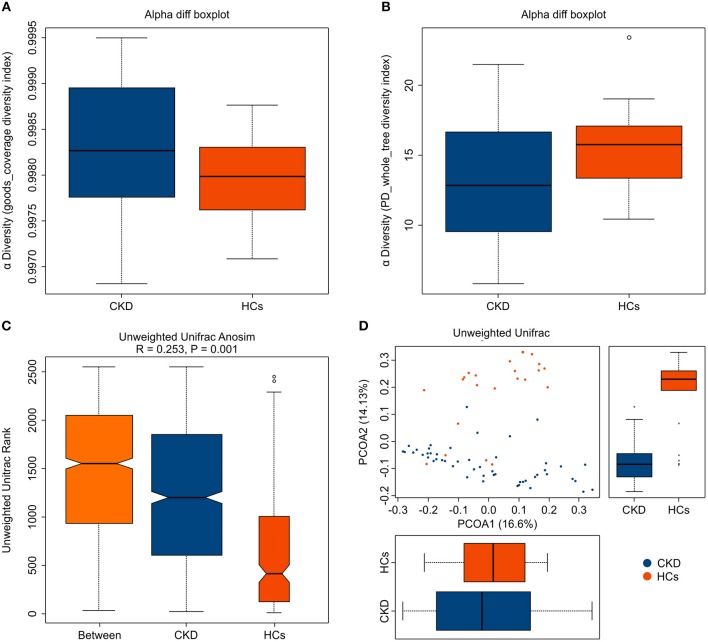
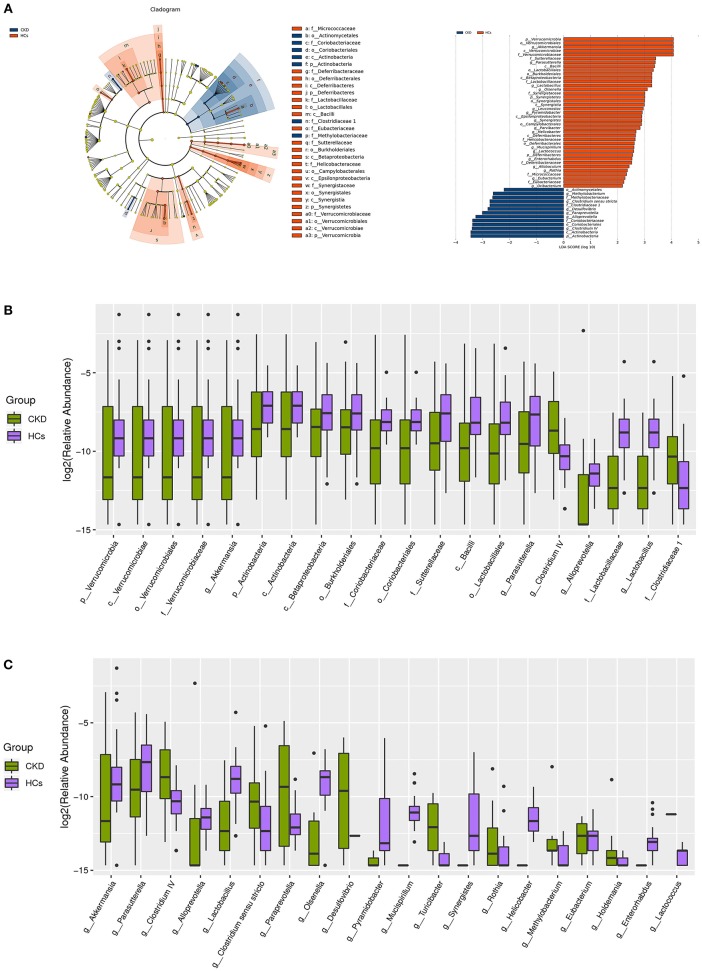
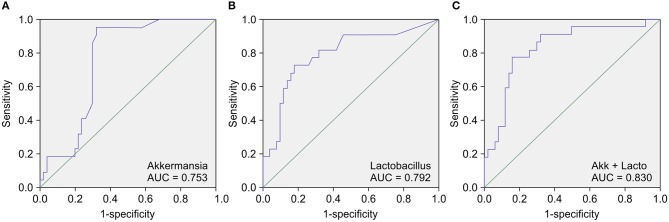
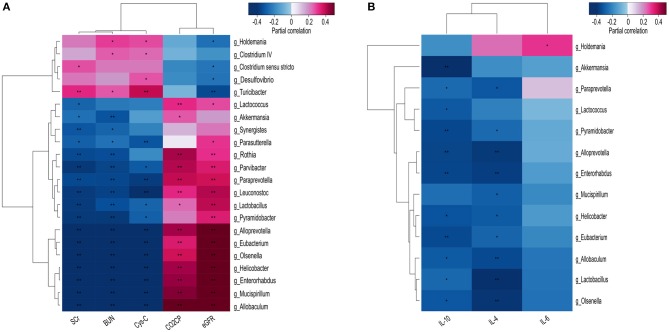
Alterations to the gut microbiota have been previously suggested to be tightly linked to chronic systemic inflammation, which is a major contributing factor to complications and disease progression in chronic kidney disease (CKD). Nevertheless, the effect of gut dysbiosis on the pathogenesis and/or production of inflammatory factors in CKD has not been extensively studied to date. In the present study, we conducted 16S ribosomal DNA pyrosequencing using fecal microbiota samples and analyzed the production of serum inflammatory factors in 50 patients with CKD and 22 healthy control (HC) subjects. The results revealed that compared to the HC subjects, patients with CKD exhibited a significant reduction in the richness and structure of their fecal microbiota. At the phylum level, compared to the HC group, patients with CKD also presented reduced abundance of Actinobacteria but increased abundance of Verrucomicrobia. Moreover, the genera , and were enriched in the fecal samples of patients with CKD, while and were enriched in those of the HC subjects. The abundance of in the CKD group was significantly lower than that in the HC group (3.08 vs. 0.67%); this decrease in the abundance of , an important probiotic, in patients with CKD is a striking discovery as it has not been previously reported. Finally, we analyzed whether these changes to the fecal microbiota correlated with CKD clinical characteristics and/or the production of known inflammatory factors. Altered levels of the microbiota genera , and were shown to be correlated with CKD disease-severity indicators, including the estimated glomerular filtration rate. Most notably, was significantly negatively correlated with the production of interleukin-10. The results of the present study suggest that microbiota dysbiosis may promote chronic systemic inflammation in CKD. Furthermore, they support that modifying the gut microbiota, especially , may be a promising potential therapeutic strategy to attenuate the progression of, and/or systemic inflammation in, CKD.
先前有研究表明,肠道微生物群的改变与慢性系统性炎症密切相关,而慢性系统性炎症是慢性肾脏病(CKD)并发症和疾病进展的主要因素之一。然而,迄今为止,肠道菌群失调对 CKD 发病机制和/或炎症因子产生的影响尚未得到广泛研究。在本研究中,我们使用粪便微生物群样本进行了 16S 核糖体 DNA 焦磷酸测序,并分析了 50 例 CKD 患者和 22 例健康对照(HC)受试者的血清炎症因子产生情况。结果表明,与 HC 组相比,CKD 患者的粪便微生物群丰富度和结构明显降低。在门水平上,与 HC 组相比,CKD 患者的放线菌丰度降低,而疣微菌丰度增加。此外, 、 和 在 CKD 患者的粪便样本中富集,而 和 在 HC 组的粪便样本中富集。CKD 组的 丰度明显低于 HC 组(3.08 对 0.67%);在 CKD 患者中,这种重要益生菌 的丰度降低是一个惊人的发现,因为以前没有报道过。最后,我们分析了这些粪便微生物群的变化是否与 CKD 临床特征和/或已知炎症因子的产生有关。结果表明,微生物群属 、 和 的改变与 CKD 疾病严重程度指标,包括肾小球滤过率相关。最值得注意的是, 与白细胞介素-10 的产生呈显著负相关。本研究结果表明,肠道微生物群失调可能促进 CKD 的慢性系统性炎症。此外,它们支持通过改变肠道微生物群,特别是 ,可能是一种有前途的潜在治疗策略,以减轻 CKD 的进展和/或全身炎症。