State Key Laboratory of Ophthalmology, Zhongshan Ophthalmic Center, Sun Yat-sen University, Guangzhou 510060, China.
Eye Institute of Xiamen University, Fujian Provincial Key Laboratory of Ophthalmology and Visual Science, School of Medicine, Xiamen University, Xiamen 361102, China.
Oxid Med Cell Longev. 2019 May 22;2019:3632169. doi: 10.1155/2019/3632169. eCollection 2019.
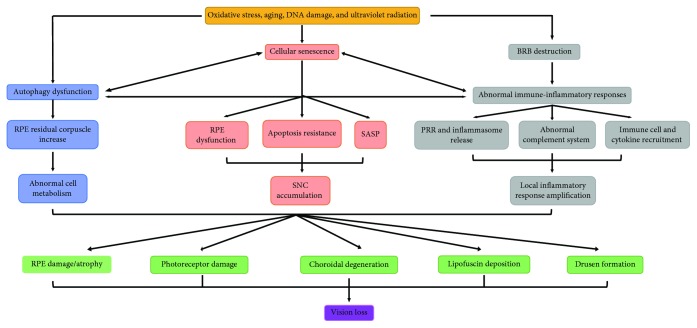
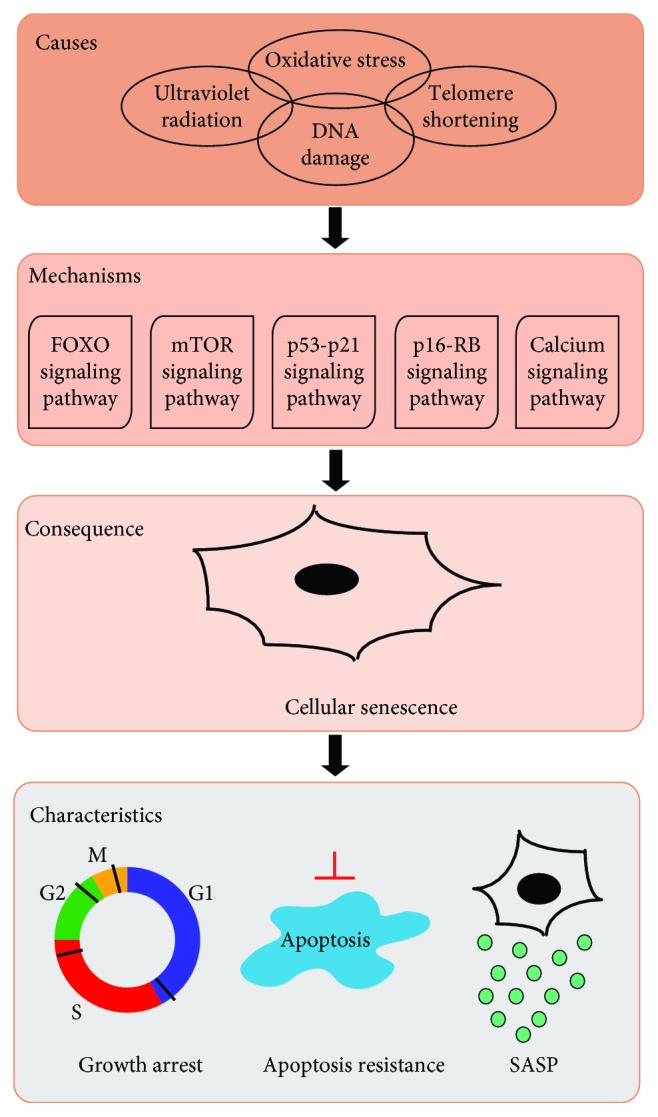
Age-related macular degeneration (AMD) is a blinding disease caused by multiple factors and is the primary cause of vision loss in the elderly. The morbidity of AMD increases every year. Currently, there is no effective treatment option for AMD. Intravitreal injection of antivascular endothelial growth factor (anti-VEGF) is currently the most widely used therapy, but it only aims at neovascularization, which is an intermediate pathological phenomenon of wet AMD, not at the etiological treatment. Anti-VEGF therapy can only temporarily delay the degeneration process of wet AMD, and AMD is easy to relapse after drug withdrawal. Therefore, it is urgent to deepen our understanding of the pathophysiological processes underlying AMD and to identify integrated or new strategies for AMD prevention and treatment. Recent studies have found that autophagy dysfunction in retinal pigment epithelial (RPE) cells, cellular senescence, and abnormal immune-inflammatory responses play key roles in the pathogenesis of AMD. For many age-related diseases, the main focus is currently the clearing of senescent cells (SNCs) as an antiaging treatment, thereby delaying diseases. However, in AMD, there is no relevant antiaging application. This review will discuss the pathogenesis of AMD and how interactions among RPE autophagy dysfunction, cellular senescence, and abnormal immune-inflammatory responses are involved in AMD, and it will summarize the three antiaging strategies that have been developed, with the aim of providing important information for the integrated prevention and treatment of AMD and laying the ground work for the application of antiaging strategies in AMD treatment.
年龄相关性黄斑变性(AMD)是一种由多种因素引起的致盲性疾病,是老年人视力丧失的主要原因。AMD 的发病率逐年增加。目前,AMD 尚无有效的治疗方法。玻璃体内注射抗血管内皮生长因子(anti-VEGF)是目前应用最广泛的治疗方法,但它仅针对新生血管,这是湿性 AMD 的中间病理现象,而不是病因治疗。抗 VEGF 治疗只能暂时延缓湿性 AMD 的退行性过程,AMD 在停药后容易复发。因此,迫切需要加深对 AMD 病理生理过程的理解,并寻找 AMD 预防和治疗的综合或新策略。最近的研究发现,视网膜色素上皮(RPE)细胞自噬功能障碍、细胞衰老和异常免疫炎症反应在 AMD 的发病机制中起关键作用。对于许多与年龄相关的疾病,目前的主要重点是清除衰老细胞(SNCs)作为抗衰老治疗,从而延缓疾病。然而,在 AMD 中,没有相关的抗衰老应用。本文综述了 AMD 的发病机制以及 RPE 自噬功能障碍、细胞衰老和异常免疫炎症反应之间的相互作用如何参与 AMD,并总结了已开发的三种抗衰老策略,以期为 AMD 的综合防治提供重要信息,并为抗衰老策略在 AMD 治疗中的应用奠定基础。