Zhu Jiaxin, Zhang Tiantian, Li Jiahao, Lin Junming, Liang Wenhua, Huang Wenjie, Wan Ning, Jiang Jie
College of Pharmacy, Jinan University, Guangzhou, China.
The First Affiliated Hospital of Jinan University, Guangzhou, China.
Front Pharmacol. 2019 Jun 14;10:673. doi: 10.3389/fphar.2019.00673. eCollection 2019.
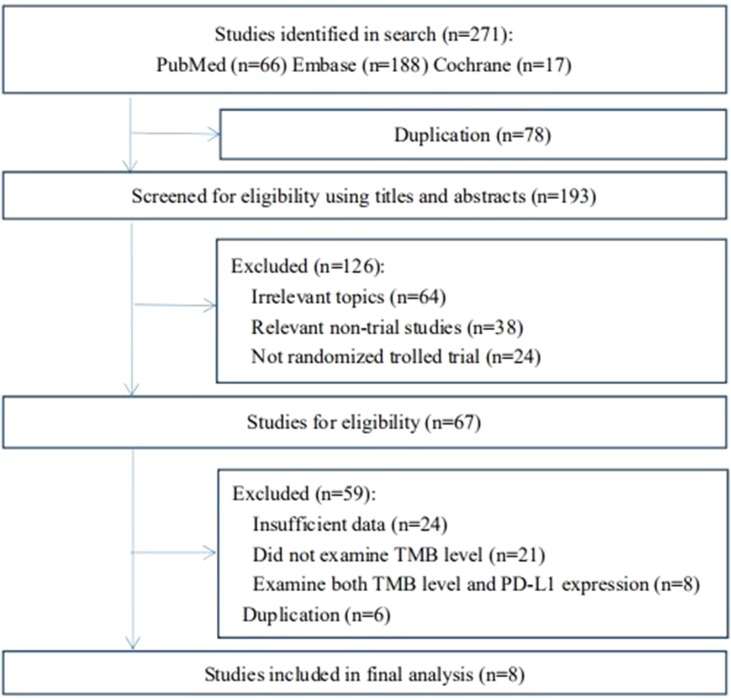
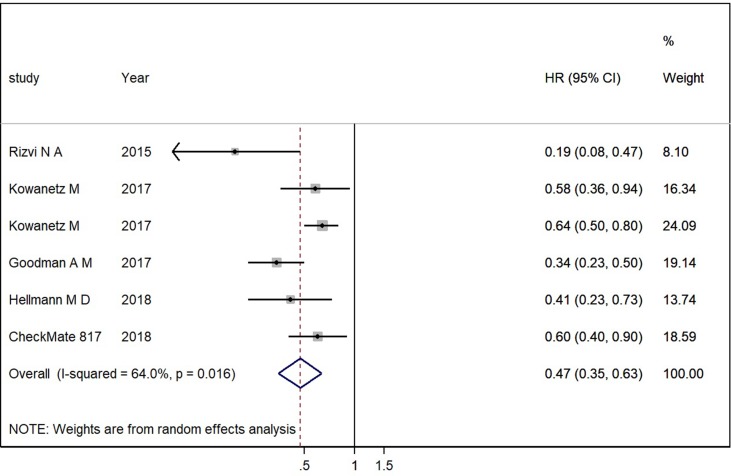
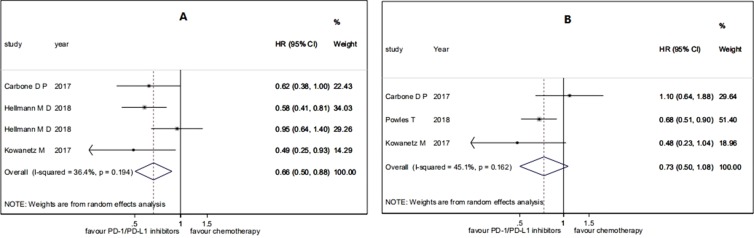
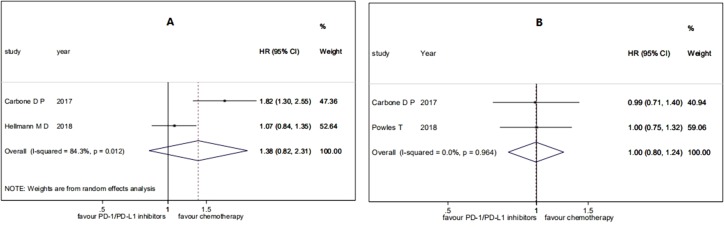
Programmed cell death 1 (PD-1) or programmed cell death ligand 1 (PD-L1) inhibitions are being strongly recommended for the treatment of various cancers, while the efficacy of PD-1/PD-L1 inhibitions varies from individuals. It is urgent to explore some biomarkers to screen the most appropriate cancer patients. Tumor mutation burden (TMB) as a potential alternative has been drawing more and more attention. Therefore, we conducted a meta-analysis to quantitatively explore the association between TMB and outcomes of PD-1/PD-L1 inhibitions. We searched eligible studies that evaluated the association between TMB and the outcomes of PD-1/PD-L1 inhibitions from PubMed, Embase, and Cochrane database up to October 2018. The primary endpoints were the progression-free survival (PFS) and the overall survival (OS) in patients with high TMB or low TMB. The pooled hazard ratios (HR) for PFS and OS were performed by Stata. In this analysis, a total of 2,661 patients from eight studies were included. Comparing PD-1/PD-L1 inhibitions to chemotherapy, the pooled HR for PFS and OS in patients with high TMB was 0.66 [95% confidence interval (CI) 0.50 to 0.88; = 0.004] and 0.73 (95% CI 0.50 to 1.08; = 0.114), respectively, while the pooled HR for PFS and OS in patients with low TMB was 1.38 (95% CI 0.82 to 2.31; = 0.229) and 1.00 (95% CI 0.80 to 1.24; = 0.970), respectively. Meanwhile, comparing patients with high TMB to patients with low TMB, the pooled HR for PFS in patients treated with PD-1/PD-L1 inhibitions was 0.47 (95% CI 0.35 to 0.63; = 0.000). Patients with high TMB showed significant benefits from PD-1/PD-L1 inhibitions compared to patients with low TMB. Despite the present technical and practical barriers, TMB may be a preferable biomarker to optimize the efficacy of PD-1/PD-L1 inhibitions.
强烈推荐使用程序性细胞死亡蛋白1(PD - 1)或程序性细胞死亡配体1(PD - L1)抑制剂来治疗各种癌症,然而PD - 1/PD - L1抑制剂的疗效因个体而异。迫切需要探索一些生物标志物来筛选最合适的癌症患者。肿瘤突变负荷(TMB)作为一种潜在的替代标志物越来越受到关注。因此,我们进行了一项荟萃分析,以定量探索TMB与PD - 1/PD - L1抑制剂治疗结果之间的关联。我们在截至2018年10月的PubMed、Embase和Cochrane数据库中搜索了评估TMB与PD - 1/PD - L1抑制剂治疗结果之间关联的符合条件的研究。主要终点是高TMB或低TMB患者的无进展生存期(PFS)和总生存期(OS)。PFS和OS的合并风险比(HR)通过Stata进行计算。在该分析中,纳入了来自八项研究的共2661名患者。将PD - 1/PD - L1抑制剂与化疗进行比较,高TMB患者PFS和OS的合并HR分别为0.66 [95%置信区间(CI)0.50至0.88;P = 0.004]和0.73(95%CI 0.50至1.08;P = 0.114),而低TMB患者PFS和OS的合并HR分别为1.38(95%CI 0.82至2.31;P = 0.229)和1.00(95%CI 0.80至1.24;P = 0.970)。同时,将高TMB患者与低TMB患者进行比较,接受PD - 1/PD - L1抑制剂治疗患者的PFS合并HR为0.47(95%CI 0.35至0.63;P = 0.000)。与低TMB患者相比,高TMB患者从PD - 1/PD - L1抑制剂治疗中显示出显著益处。尽管存在当前的技术和实际障碍,TMB可能是优化PD - 1/PD - L1抑制剂疗效的一种更优生物标志物。