Ni Junjun, Xu Li, Li Wei, Zheng Chunmei, Wu Lijun
Department of Medicinal Chemistry and Natural Medicine Chemistry, College of Pharmacy, Harbin Medical University, Harbin, Heilongjiang 150081, P.R. China.
Beijing Harmony Health Medical Diagnostics Co., Ltd., Beijing 101111, P.R. China.
Exp Ther Med. 2019 Jul;18(1):188-198. doi: 10.3892/etm.2019.7533. Epub 2019 Apr 30.
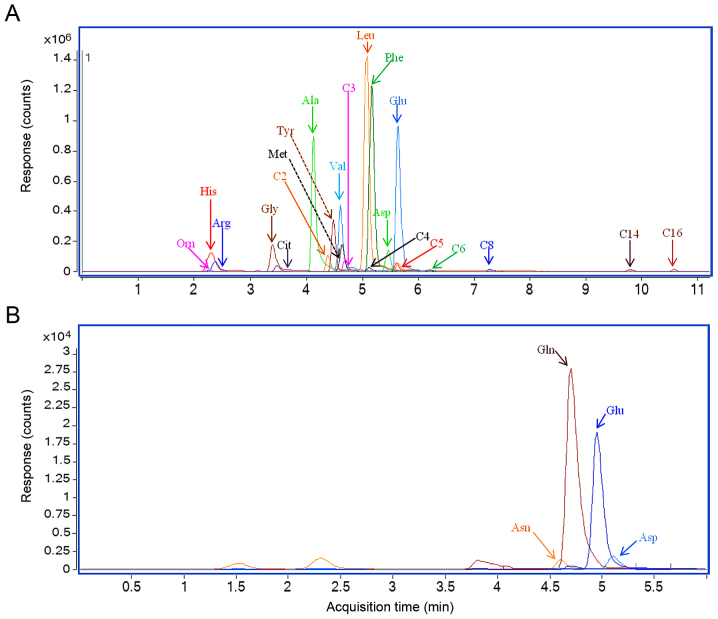
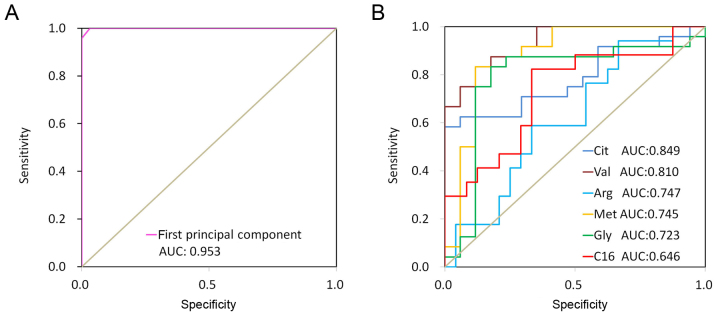
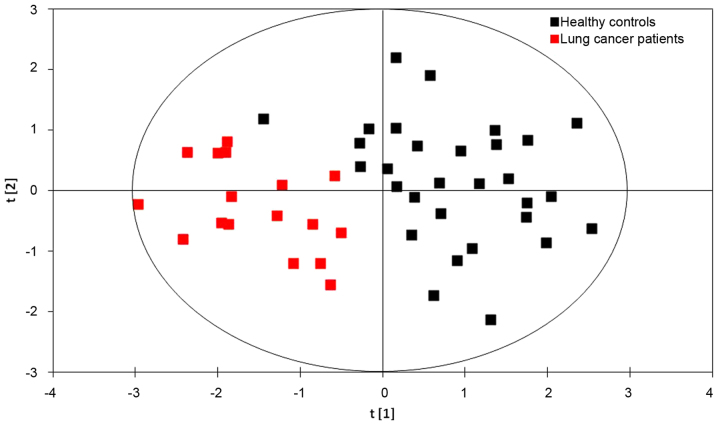
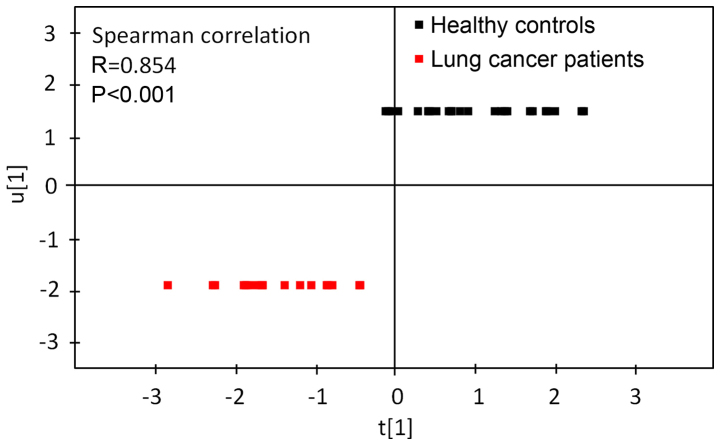
Lung cancer is one of the most prevalent types of cancer, but accurate diagnosis remains a challenge. The aim of the present study was to create a model using amino acids and acylcarnitines for lung cancer screening. Serum samples were obtained from two groups of patients with lung cancer recruited in 2015 (including 40 patients and 100 matched controls) and 2017 (including 17 patients and 30 matched controls). Using a metabolomics method, 21 metabolites (13 types of amino acids and 8 types of acylcarnitines) were measured using liquid chromatography-tandem mass spectrometry. Data (from the 2015 and 2017 data sets) were analysed using a Mann-Whitney U test, Student's t-test, Welch's F test, receiver-operator characteristic curve or logistic regression in order to investigate the potential biomarkers. Six metabolites (glycine, valine, methionine, citrulline, arginine and C16-carnitine) were indicated to be involved in distinguishing patients with lung cancer from healthy controls. The six discriminating metabolites from the 2017 data set were further analysed using Partial least squares-discriminant analysis (PLS-DA). The PLS-DA model was verified using Spearman's correlation analysis and receiver operating characteristic curve analysis. These results demonstrated that the PLS-DA model using the six metabolites (glycine, valine, methionine, citrulline, arginine and C16-carnitine) had a strong ability to identify lung cancer. Therefore, the PLS-DA model using glycine, valine, methionine, citrulline, arginine and C16-carnitine may become a novel screening tool in patients with lung cancer.
肺癌是最常见的癌症类型之一,但准确诊断仍然是一项挑战。本研究的目的是创建一个使用氨基酸和酰基肉碱进行肺癌筛查的模型。从2015年招募的两组肺癌患者(包括40例患者和100例匹配对照)和2017年招募的两组肺癌患者(包括17例患者和30例匹配对照)中获取血清样本。采用代谢组学方法,使用液相色谱-串联质谱法测量21种代谢物(13种氨基酸和8种酰基肉碱)。使用曼-惠特尼U检验、学生t检验、韦尔奇F检验、受试者工作特征曲线或逻辑回归分析(来自2015年和2017年数据集的)数据,以研究潜在的生物标志物。六种代谢物(甘氨酸、缬氨酸、蛋氨酸、瓜氨酸、精氨酸和C16-肉碱)被表明参与区分肺癌患者和健康对照。使用偏最小二乘判别分析(PLS-DA)对2017年数据集中的六种鉴别代谢物进行进一步分析。使用斯皮尔曼相关分析和受试者工作特征曲线分析对PLS-DA模型进行验证。这些结果表明,使用六种代谢物(甘氨酸、缬氨酸、蛋氨酸、瓜氨酸、精氨酸和C16-肉碱)的PLS-DA模型具有很强的识别肺癌的能力。因此,使用甘氨酸、缬氨酸、蛋氨酸、瓜氨酸、精氨酸和C16-肉碱的PLS-DA模型可能成为肺癌患者的一种新型筛查工具。