Andersen L, Nyeland M E, Nyberg F
LEO Pharma A/S, Industriparken 55, DK-2750, Ballerup, Denmark.
Medical Evidence and Observational Research, Global Medical Affairs, AstraZeneca, SE-431 83, Mölndal, Sweden.
Br J Dermatol. 2020 Apr;182(4):1007-1016. doi: 10.1111/bjd.18296. Epub 2019 Sep 8.
Atopic dermatitis (AD) is associated with high disease burden, with a significant physical and social impact. However, the association between disease severity and burden of disease, with work productivity and daily activities being one aspect, has not been well characterized.
To investigate the impact of disease severity on work productivity and daily activities among adults with AD in Europe (France, Germany and the U.K.) and the U.S.A.
The survey panel participants for this cross-sectional internet-based survey on AD were sourced from the population-based National Health and Wellness Survey (Europe 2016, U.S.A. 2015 and 2016). AD severity was determined by Patient-Oriented Scoring Atopic Dermatitis (PO-SCORAD). Work productivity and work activity impairment were assessed using the Work Productivity and Activity Impairment (WPAI) - Specific Health Problem questionnaire for AD.
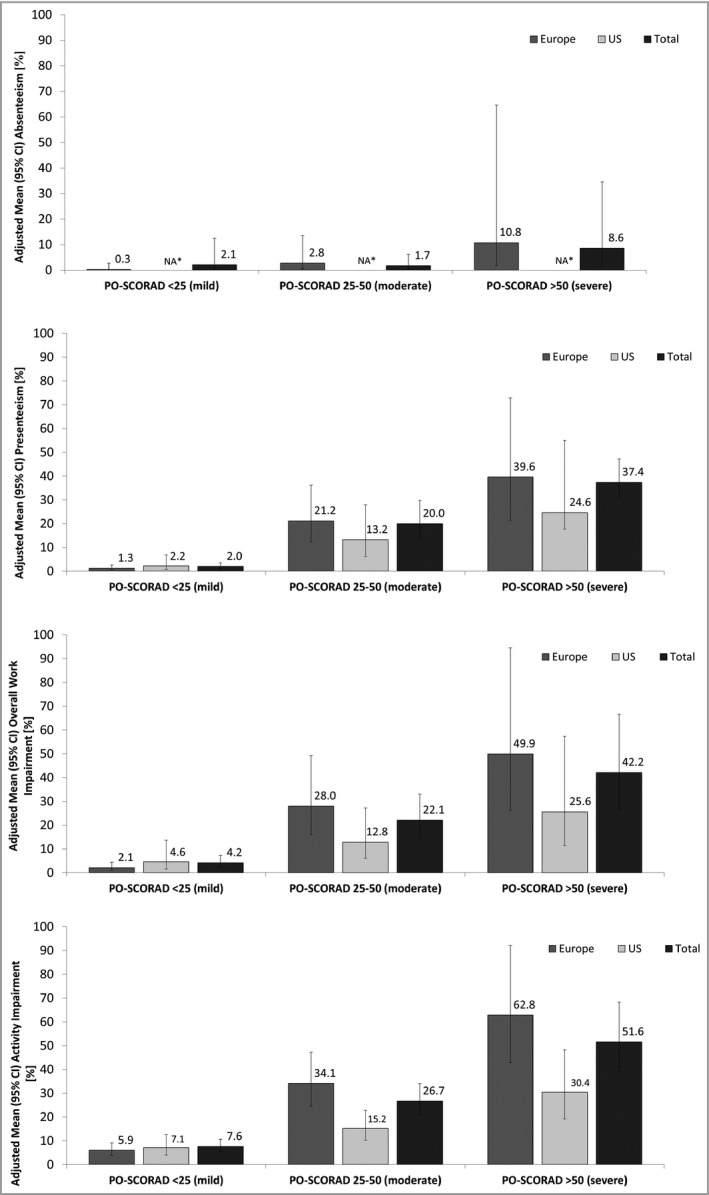
The study survey was completed by 1098 respondents with moderate-to-severe AD and 134 with mild AD. Overall, the negative impact on work productivity (all WPAI items) was suggested to increase with increasing AD severity (PO-SCORAD) at the regional level (Europe and U.S.A.) and in the total sample. For overall work impairment due to AD, respondents with mild AD reported a mean of 2·4 h per week of potential work productivity lost, respondents with moderate AD 9·6 h and respondents with severe AD 19·0 h.
Higher AD severity was associated with a greater negative impact on work productivity in adults. This impact is a burden not only for the patient but also for society and may provide incentives for treatment optimization and more effective management of AD. What's already known about this topic? Atopic dermatitis (AD) is associated with a high disease burden. AD has a negative impact on several aspects of health-related quality of life, one of which is work productivity. What does this study add? By using a population of participants with AD recruited from the National Health and Wellness Survey, which collects broad and representative data from the general population, survey data could be obtained from U.S. and European populations of patients with AD. The present study suggests an increasingly negative impact on work productivity with increasing severity of AD. The data indicate no regional differences in the impact of AD severity on work productivity.
特应性皮炎(AD)与高疾病负担相关,对身体和社会有重大影响。然而,疾病严重程度与疾病负担之间的关联,其中工作生产力和日常活动是一个方面,尚未得到充分描述。
调查疾病严重程度对欧洲(法国、德国和英国)和美国成年AD患者工作生产力和日常活动的影响。
本次基于互联网的AD横断面调查的参与人员来自基于人群的国民健康与生活调查(欧洲2016年、美国2015年和2016年)。AD严重程度由患者导向的特应性皮炎评分(PO-SCORAD)确定。使用针对AD的工作生产力和活动障碍(WPAI)-特定健康问题问卷评估工作生产力和工作活动障碍。
1098名中重度AD患者和134名轻度AD患者完成了研究调查。总体而言,在区域层面(欧洲和美国)以及总样本中,对工作生产力的负面影响(所有WPAI项目)被认为随着AD严重程度(PO-SCORAD)的增加而增加。对于因AD导致的总体工作障碍,轻度AD患者报告平均每周潜在工作生产力损失2.4小时,中度AD患者为9.6小时,重度AD患者为19.0小时。
AD严重程度越高,对成年人工作生产力的负面影响越大。这种影响不仅对患者是一种负担,对社会也是如此,可能会促使优化治疗和更有效地管理AD。关于这个主题已经知道了什么?特应性皮炎(AD)与高疾病负担相关。AD对健康相关生活质量的几个方面有负面影响,其中之一是工作生产力。这项研究增加了什么?通过使用从国民健康与生活调查中招募的AD患者群体,该调查从普通人群中收集广泛且具有代表性的数据,可以从美国和欧洲的AD患者群体中获得调查数据。本研究表明,随着AD严重程度的增加,对工作生产力的负面影响越来越大。数据表明AD严重程度对工作生产力的影响不存在区域差异。