Gooderham Melinda, Guttman-Yassky Emma, Igawa Ken, Kabashima Kenji, Esfandiari Ehsanollah, Rylands Angela J, Williams Angela, Nixon Annabel, Dent Jennifer E, Simpson Eric
SKiN Centre for Dermatology, Queen's University and Probity Medical Research, 775 Monaghan Road, Peterborough, ON, Canada.
Icahn School of Medicine at Mount Sinai, Mount Sinai, USA.
Dermatol Ther (Heidelb). 2024 Dec;14(12):3351-3366. doi: 10.1007/s13555-024-01303-z. Epub 2024 Nov 12.
In adults with moderate-to-severe atopic dermatitis (AD), rocatinlimab demonstrated significant and progressive improvement in clinical measures of disease severity compared with placebo. This post hoc analysis of a phase 2b study was undertaken to understand the disease burden and to assess the impact of rocatinlimab on patient-reported outcomes (PROs).
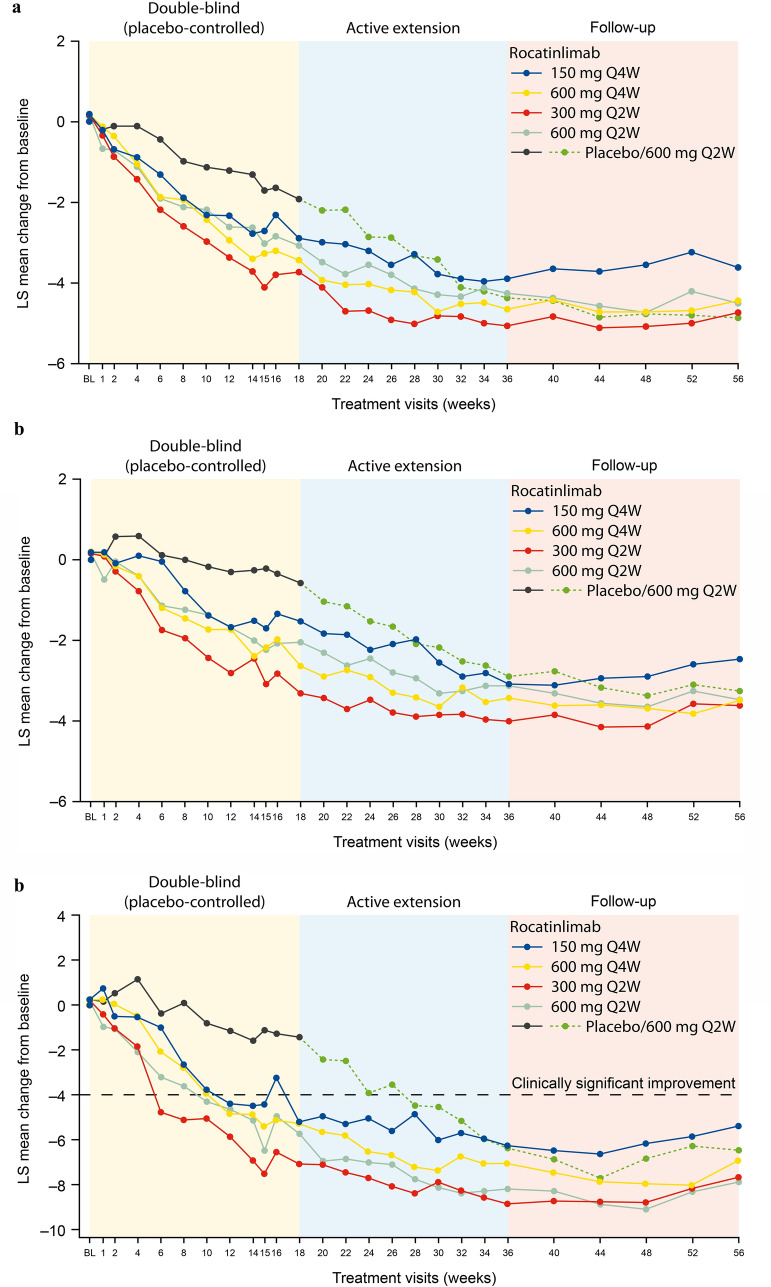
This analysis used baseline data from a multicenter, randomized, double-blind study of adults with moderate-to-severe AD, who completed a Worst Pruritus numerical rating scale (NRS), Sleep Disturbance NRS, and the Dermatology Life Quality Index (DLQI). A mixed model for repeated measures was used to estimate changes in PRO scores from baseline; scores were also compared with clinically meaningful change benchmarks.
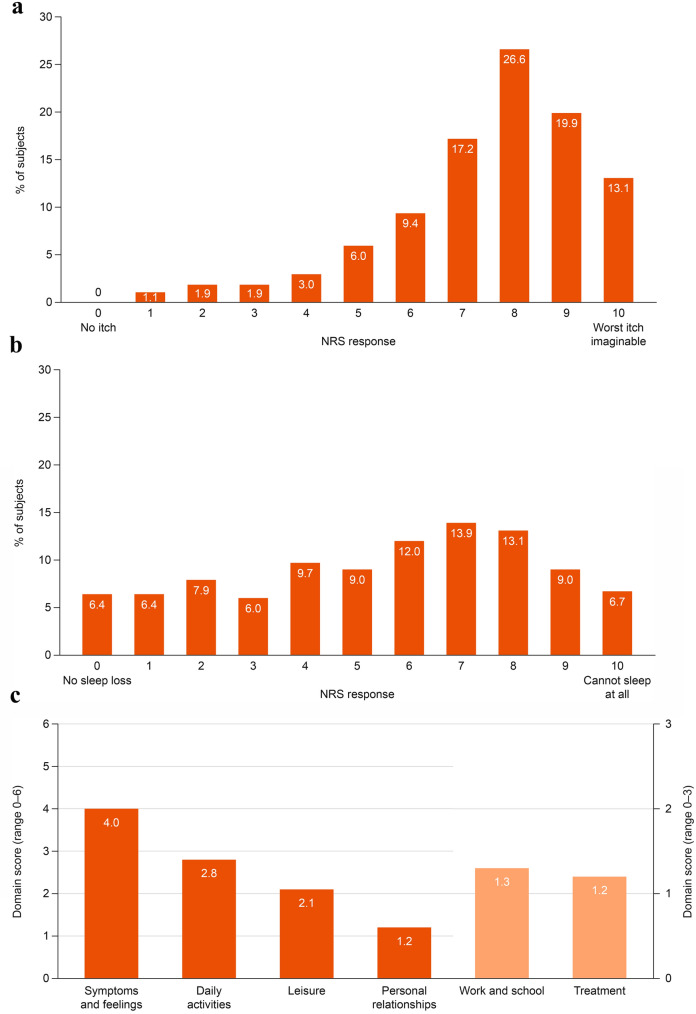
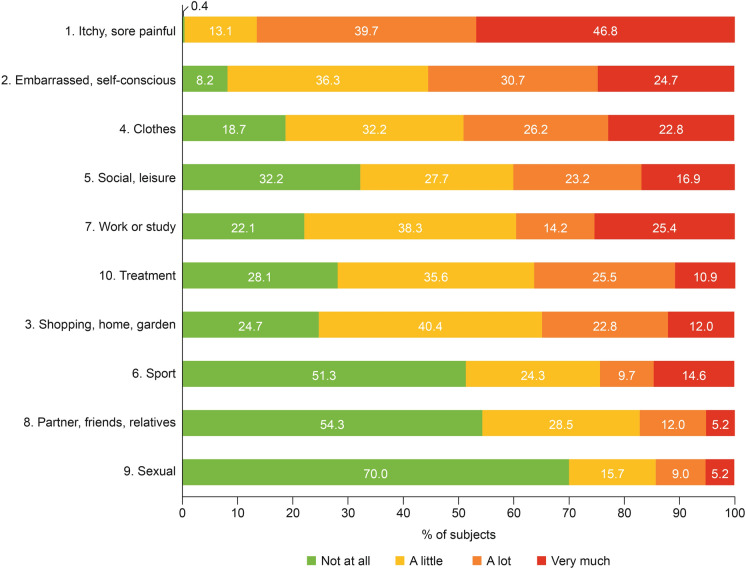
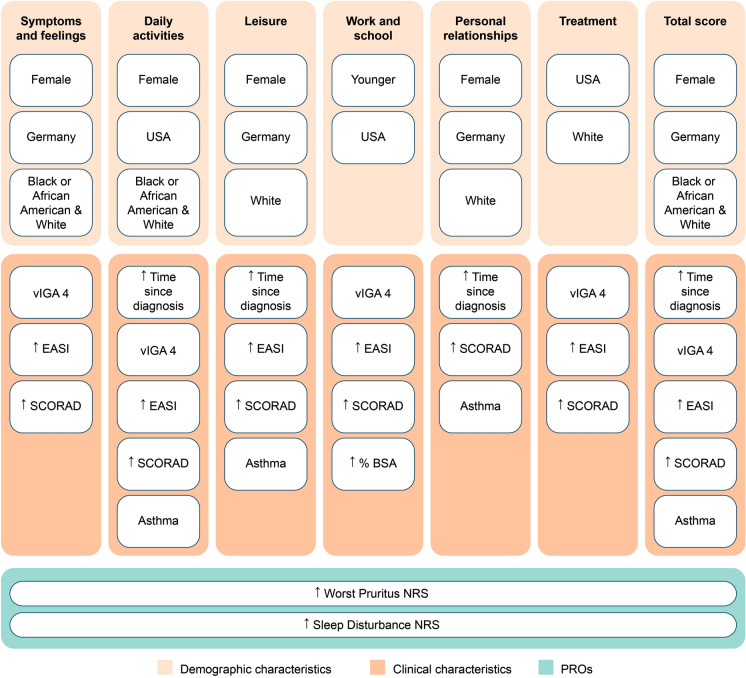
The analysis included 267 subjects, mean (SD) age 37.9 (14.7) years, 40.8% female; 55.1% grade 3 and 44.9% grade 4 Investigator Global Assessment for AD. Mean (SD) scores were: Worst Pruritus NRS 7.5 (1.9), Sleep Disturbance NRS 5.5 (2.9), DLQI total score 12.6 (7.1). Worst Pruritus and Sleep NRS scores had low positive correlations with SCORing AD (SCORAD) score (r = 0.44, r = 0.45 respectively) and negligible correlations with Eczema Area and Severity Index (EASI) score and area affected (r < 0.30). DLQI score varied by sex, study country, race, age, longer disease duration, disease severity (EASI and SCORAD), presence of asthma, and Worst Pruritus NRS, Sleep disturbance NRS, and DLQI scores. Rocatinlimab showed benefit on all three PROs, with significant improvements from baseline at the end of the double-blind period (week 18) and active treatment extension (week 36). Benefits were maintained over 20 weeks' post-treatment follow-up. The benefit of rocatinlimab treatment on PROs is rapid and maintained for at least 20 weeks following treatment completion.
This analysis demonstrates the importance of characterizing the burden of moderate-to-severe AD from the patient's perspective, alongside clinical disease measures, to develop a fuller picture of treatment benefit.
ClinicalTrials.gov identifier, NCT03703102.
在中度至重度特应性皮炎(AD)成人患者中,与安慰剂相比,罗卡替尼单抗在疾病严重程度的临床指标方面显示出显著且持续的改善。本2b期研究的事后分析旨在了解疾病负担,并评估罗卡替尼单抗对患者报告结局(PROs)的影响。
本分析使用了一项针对中度至重度AD成人患者的多中心、随机、双盲研究的基线数据,这些患者完成了最严重瘙痒数字评定量表(NRS)、睡眠障碍NRS和皮肤病生活质量指数(DLQI)。采用重复测量混合模型来估计PRO评分相对于基线的变化;评分还与具有临床意义的变化基准进行了比较。
分析纳入了267名受试者,平均(标准差)年龄为37.9(14.7)岁,女性占40.8%;55.1%为3级,44.9%为4级研究者对AD的整体评估。平均(标准差)评分如下:最严重瘙痒NRS为7.5(1.9),睡眠障碍NRS为5.5(2.9),DLQI总分12.6(7.1)。最严重瘙痒和睡眠NRS评分与特应性皮炎评分(SCORAD)评分呈低度正相关(分别为r = 0.44,r = 0.45),与湿疹面积和严重程度指数(EASI)评分及受累面积的相关性可忽略不计(r < 0.30)。DLQI评分因性别、研究国家、种族、年龄、病程较长、疾病严重程度(EASI和SCORAD)、哮喘的存在以及最严重瘙痒NRS、睡眠障碍NRS和DLQI评分而有所不同。罗卡替尼单抗在所有三项PROs上均显示出益处,在双盲期结束时(第18周)和活性治疗延长期(第36周)相对于基线有显著改善。在治疗后20周的随访中益处得以维持。罗卡替尼单抗治疗对PROs的益处迅速,且在治疗完成后至少维持20周。
本分析表明,从中度至重度AD患者的角度描述疾病负担,以及结合临床疾病指标,对于更全面地了解治疗益处具有重要意义。
ClinicalTrials.gov标识符,NCT03703102。