Panitchote Anupol, Mehkri Omar, Hastings Andrei, Hanane Tarik, Demirjian Sevag, Torbic Heather, Mireles-Cabodevila Eduardo, Krishnan Sudhir, Duggal Abhijit
Department of Critical Care, Respiratory Institute, Cleveland Clinic, Cleveland, OH, USA.
Division of Critical Care Medicine, Department of Medicine, Faculty of Medicine, Khon Kaen University, Khon Kaen, Thailand.
Ann Intensive Care. 2019 Jul 1;9(1):74. doi: 10.1186/s13613-019-0552-5.
Acute kidney injury (AKI) is the most frequent extra-pulmonary organ failure in acute respiratory distress syndrome (ARDS). The objective of this study was to assess the factors associated with the development and severity of AKI in patients with ARDS.
This is a retrospective cohort study of ARDS patients without acute or chronic kidney disease prior to the onset of ARDS over a 7-year period (2010-2017). AKI and severity of AKI were defined according to the Kidney Disease Improving Global Outcomes 2012 guidelines.
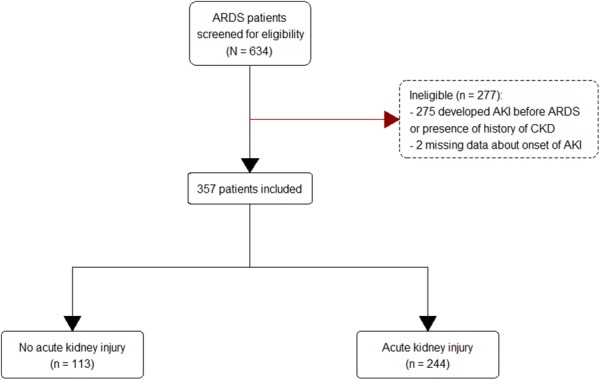
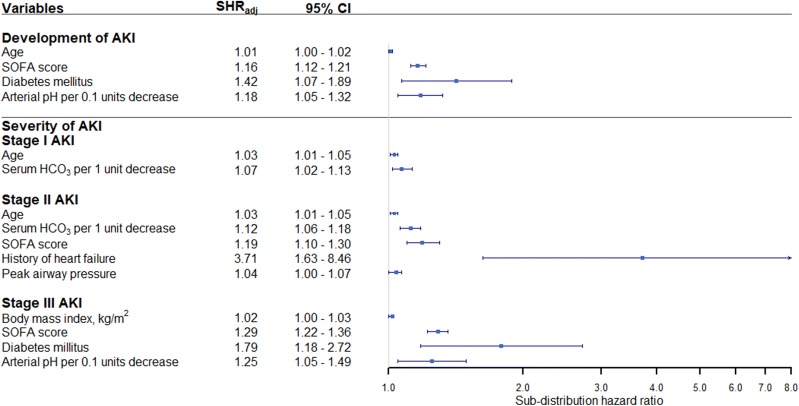
Of the 634 ARDS patients, 357 patients met study criteria. A total of 244 (68.3%) patients developed AKI after ARDS onset: 60 (24.6%) had stage I AKI, 66 (27%) had stage II AKI, and 118 (48.4%) had stage III AKI. The median time of AKI onset for stage I AKI was 2 days (interquartile range, 1.5-5.5) while stage II and III AKI was 4 days. On multivariable analysis, factors associated with development of AKI were age [subdistribution hazard ratio (SHR) 1.01, 95% confidence interval (CI) 1.00-1.02], SOFA score (SHR 1.16, 95%CI 1.12-1.21), a history of diabetes mellitus (DM) (SHR 1.42, 95%CI 1.07-1.89), and arterial pH on day 1 of ARDS (SHR per 0.1 units decrease was 1.18, 95%CI 1.05-1.32). In severity of AKI, stage I AKI was associated with age (SHR 1.03, 95%CI 1.01-1.05) and serum bicarbonate on day 1 of ARDS (SHR 1.07, 95%CI 1.02-1.13). Stage II AKI was associated with age (SHR 1.03, 95%CI 1.01-1.05), serum bicarbonate on day 1 (SHR 1.12, 95%CI 1.06-1.18), SOFA score (SHR 1.19, 95%CI 1.10-1.30), history of heart failure (SHR 3.71, 95%CI 1.63-8.46), and peak airway pressure (SHR 1.04, 95%CI 1.00-1.07). Stage III AKI was associated with a higher BMI (SHR 1.02, 95%CI 1.00-1.03), a history of DM (SHR 1.79, 95%CI 1.18-2.72), SOFA score (SHR 1.29, 95%CI 1.22-1.36), and arterial pH on day 1 (SHR per 0.1 units decrease was 1.25, 95%CI 1.05-1.49).
Age, a higher severity of illness, a history of diabetes, and acidosis were associated with development of AKI in ARDS patients. Severity of AKI was further associated with BMI, history of heart failure, and peak airway pressure.
急性肾损伤(AKI)是急性呼吸窘迫综合征(ARDS)中最常见的肺外器官功能衰竭。本研究的目的是评估ARDS患者发生AKI及其严重程度的相关因素。
这是一项回顾性队列研究,研究对象为在7年期间(2010 - 2017年)ARDS发病前无急性或慢性肾脏疾病的ARDS患者。AKI及其严重程度根据2012年改善全球肾脏病预后组织(KDIGO)指南进行定义。
634例ARDS患者中,357例符合研究标准。共有244例(68.3%)患者在ARDS发病后发生AKI:60例(24.6%)为I期AKI,66例(27%)为II期AKI,118例(48.4%)为III期AKI。I期AKI发病的中位时间为2天(四分位间距,1.5 - 5.5天),而II期和III期AKI为4天。多变量分析显示,与AKI发生相关的因素有年龄[亚分布风险比(SHR)1.01,95%置信区间(CI)1.00 - 1.02]、序贯器官衰竭评估(SOFA)评分(SHR 1.16,95%CI 1.12 - 1.21)、糖尿病(DM)病史(SHR 1.42,95%CI 1.07 - 1.89)以及ARDS第1天的动脉血pH值(每降低0.1个单位的SHR为1.18,95%CI 1.05 - 1.32)。在AKI严重程度方面,I期AKI与年龄(SHR 1.03,95%CI 1.01 - 1.05)和ARDS第1天的血清碳酸氢盐水平(SHR 1.07,95%CI 1.02 - 1.13)相关。II期AKI与年龄(SHR 1.03,95%CI 1.01 - 1.05)、第1天的血清碳酸氢盐水平(SHR 1.12,95%CI 1.06 - 1.18)、SOFA评分(SHR 1.19,95%CI 1.10 - 1.30)、心力衰竭病史(SHR 3.71,95%CI 1.63 - 8.46)以及气道峰压(SHR 1.04,95%CI 1.00 - 1.07)相关。III期AKI与较高的体重指数(BMI)(SHR 1.02,95%CI 1.00 - 1.03)、DM病史(SHR 1.79,95%CI 1.18 -