Vector-Borne Diseases Unit, PNG Institute of Medical Research, P.O. Box 378, Madang, 511, Madang Province, Papua New Guinea.
School of BioSciences, Bio21 Institute, The University of Melbourne, 30 Flemington Rd., Parkville, VIC, 3010, Australia.
Parasit Vectors. 2019 Jul 3;12(1):333. doi: 10.1186/s13071-019-3585-6.
Aedes aegypti and Ae. albopictus are important vectors of infectious diseases, especially those caused by arboviruses such as dengue, chikungunya and Zika. Aedes aegypti is very well adapted to urban environments, whereas Ae. albopictus inhabits more rural settings. Pyrethroid resistance is widespread in these vectors, but limited data exist from the Southwest Pacific Region, especially from Melanesia. While Aedes vector ecology is well documented in Australia, where incursion of Ae. albopictus and pyrethroid resistance have so far been prevented, almost nothing is known about Aedes populations in neighbouring Papua New Guinea (PNG). With pyrethroid resistance documented in parts of Indonesia but not in Australia, it is important to determine the distribution of susceptible and resistant Aedes populations in this region.
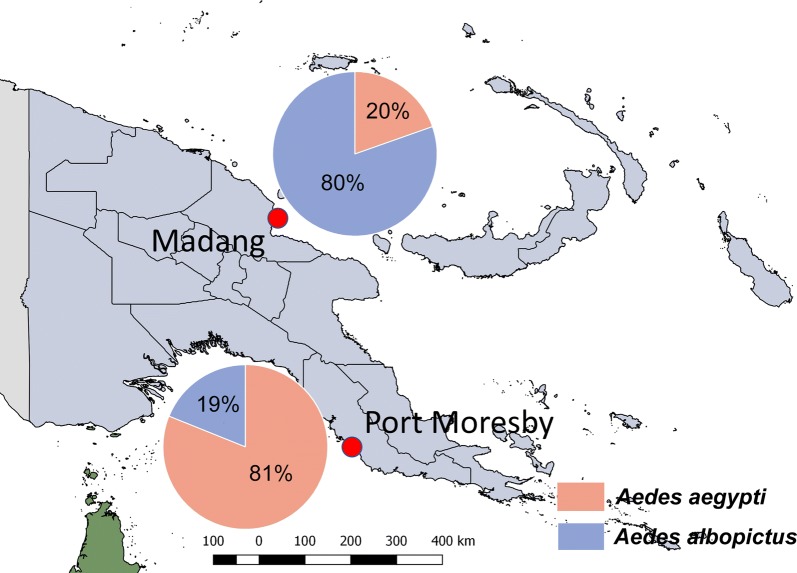
The present study was aimed at assessing Aedes populations for insecticide resistance in Madang and Port Moresby, located on the north and south coasts of PNG, respectively. Mosquitoes were collected using ovitraps and reared in an insectary. Standard WHO bioassays using insecticide-treated filter papers were conducted on a total of 253 Ae. aegypti and 768 Ae. albopictus adult mosquitoes. Subsets of samples from both species (55 Ae. aegypti and 48 Ae. albopictus) were screened for knockdown resistance mutations in the voltage-sensitive sodium channel (Vssc) gene, the target site of pyrethroid insecticides.
High levels of resistance against pyrethroids were identified in Ae. aegypti from Madang and Port Moresby. Aedes albopictus exhibited susceptibility to pyrethroids, but moderate levels of resistance to DDT. Mutations associated with pyrethroid resistance were detected in all Ae. aegypti samples screened. Some genotypes found in the present study had been observed previously in Indonesia. No Vssc mutations associated with pyrethroid resistance were found in the Ae. albopictus samples.
To our knowledge, this is the first report of pyrethroid resistance in Ae. aegypti mosquitoes in PNG. Interestingly, usage of insecticides in PNG is low, apart from long-lasting insecticidal nets distributed for malaria control. Further investigations on how these resistant Ae. aegypti mosquito populations arose in PNG and how they are being sustained are warranted.
埃及伊蚊和白纹伊蚊是重要的传染病媒介,特别是那些由虫媒病毒引起的疾病,如登革热、基孔肯雅热和寨卡热。埃及伊蚊非常适应城市环境,而白纹伊蚊则栖息在更多的农村环境中。拟除虫菊酯抗性在这些媒介中广泛存在,但来自西南太平洋地区,特别是美拉尼西亚的资料有限。虽然澳大利亚对埃及伊蚊的入侵和拟除虫菊酯的抗性有很好的记录,但几乎不知道巴布亚新几内亚(PNG)邻国的埃及伊蚊种群情况。虽然印度尼西亚部分地区已经记录到拟除虫菊酯抗性,但澳大利亚没有,因此确定该地区易感和抗性埃及伊蚊种群的分布非常重要。
本研究旨在评估位于巴布亚新几内亚北部沿海城市芒特哈根和南部沿海城市莫尔斯比港的埃及伊蚊和白纹伊蚊种群对杀虫剂的抗药性。使用诱卵器收集蚊子,并在昆虫饲养室中饲养。总共对 253 只埃及伊蚊和 768 只白纹伊蚊成蚊进行了使用杀虫剂处理过的滤纸的标准世界卫生组织生物测定。从这两个物种中抽取了一些样本(55 只埃及伊蚊和 48 只白纹伊蚊),对电压敏感钠通道(Vssc)基因中的击倒抗性突变进行了筛选,Vssc 基因是拟除虫菊酯杀虫剂的靶标。
在芒特哈根和莫尔斯比港的埃及伊蚊中发现了高水平的对拟除虫菊酯的抗性。白纹伊蚊对拟除虫菊酯表现出敏感性,但对滴滴涕有中度抗性。在所筛选的所有埃及伊蚊样本中都发现了与拟除虫菊酯抗性相关的突变。本研究中发现的一些基因型以前在印度尼西亚也有观察到。在白纹伊蚊样本中未发现与拟除虫菊酯抗性相关的 Vssc 突变。
据我们所知,这是首次在巴布亚新几内亚报告埃及伊蚊对拟除虫菊酯的抗性。有趣的是,除了为控制疟疾而分发的长效杀虫剂蚊帐外,巴布亚新几内亚的杀虫剂使用量很低。需要进一步调查这些具有抗性的埃及伊蚊种群是如何在巴布亚新几内亚产生的,以及它们是如何维持的。