Murdoch Children's Research Institute, Parkville, Victoria, Australia.
Department of Paediatrics, The University of Melbourne, Parkville, Victoria, Australia.
BMJ Open. 2019 Jul 4;9(Suppl 3):85-94. doi: 10.1136/bmjopen-2018-023196.
To describe the epidemiology and parent-child concordance of hearing, speech reception, vocabulary and language in Australian parent-child dyads at child age 11 to 12 years.
Population-based cross-sectional study (Child Health CheckPoint) nested within the Longitudinal Study of Australian Children.
Assessment centres in seven Australian cities and eight regional towns or home visits around Australia, February 2015 to March 2016.
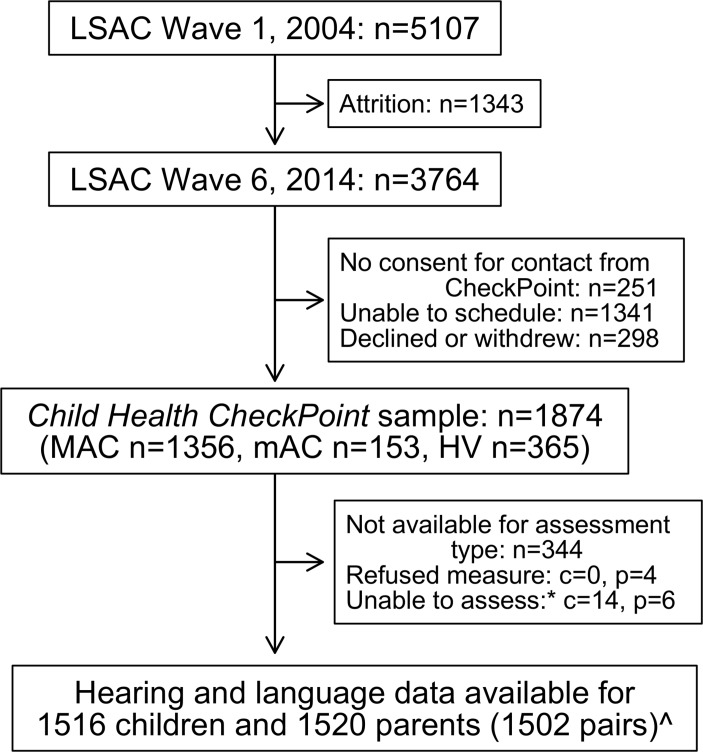
Of all participating CheckPoint families (n=1874), 1516 children (50% female) and 1520 parents (87% mothers, mean age 43.8 years) undertook at least one of four measurements of hearing and language.
Hearing threshold (better ear mean of 1, 2 and 4 kHz) from pure-tone audiometry, speech reception threshold, receptive vocabulary, expressive and receptive languages using a sentence repetition task. Parent-child concordance was examined using Pearson's correlation coefficients and adjusted linear regression models. Survey weights and methods accounted for Longitudinal Study of Australian Children's complex sampling and stratification.
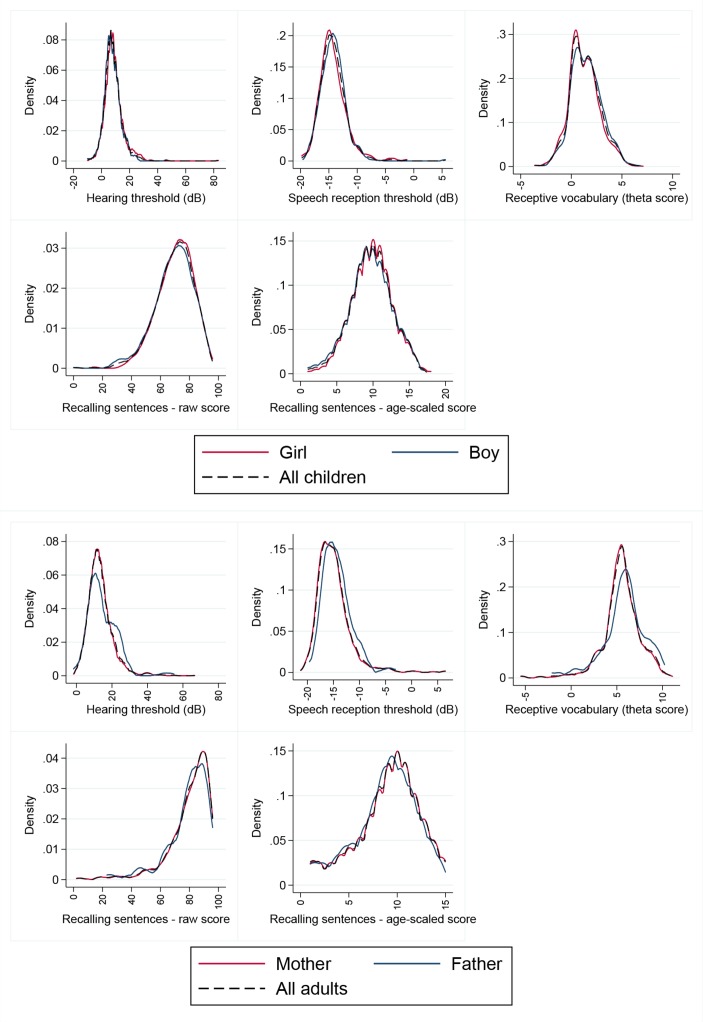
Children had a similar speech reception threshold to parents (children mean -14.3, SD 2.4; parents -14.9, SD 3.2 dB) but better hearing acuity (children 8.3, SD 6.3; parents 13.4, SD 7.0 decibels hearing level). Standardised sentence repetition scores were similar (children 9.8, SD 2.9; parents 9.1, SD 3.3) but, as expected, parents had superior receptive vocabularies. Parent-child correlations were higher for the cognitively-based language measures (vocabulary 0.31, 95% CI 0.26 to 0.36; sentence repetition 0.29, 95% CI 0.24 to 0.34) than the auditory measures (hearing 0.18, 95% CI 0.13 to 0.23; speech reception threshold 0.18, 95% CI 0.13 to 0.22). Mother-child and father-child concordances were similar for all measures.
We provide population reference values for multiple measures spanning auditory and verbal communication systems in children and mid-life adults. Concordance values aligned with previous twin studies and offspring studies in adults, in keeping with polygenic heritability that is modest for audition but around 60% for language by late childhood.
描述澳大利亚儿童 11 至 12 岁时听力、言语接受能力、词汇量和语言的流行病学和亲子一致性。
基于人群的横断面研究(儿童健康检查点)嵌套在澳大利亚儿童纵向研究中。
澳大利亚七个城市和八个地区城镇的评估中心或全国各地的家庭访问,2015 年 2 月至 2016 年 3 月。
所有参与检查点的家庭(n=1874)中,有 1516 名儿童(50%为女性)和 1520 名父母(87%为母亲,平均年龄为 43.8 岁)至少接受了四项听力和语言测量中的一项。
通过纯音听力计测量的听力阈值(较好耳 1、2 和 4 kHz 的平均值)、言语接受阈值、接受性词汇量、表达性和接受性语言使用句子重复任务。使用 Pearson 相关系数和调整后的线性回归模型检查亲子一致性。调查权重和方法考虑了澳大利亚儿童纵向研究的复杂抽样和分层。
与父母相比,儿童的言语接受能力相似(儿童平均-14.3,SD 2.4;父母-14.9,SD 3.2 dB),但听力灵敏度更高(儿童 8.3,SD 6.3;父母 13.4,SD 7.0 dB 听力水平)。标准化句子重复分数相似(儿童 9.8,SD 2.9;父母 9.1,SD 3.3),但接受性词汇量较高,这是意料之中的。认知语言测量的亲子相关性较高(词汇量为 0.31,95%置信区间为 0.26 至 0.36;句子重复为 0.29,95%置信区间为 0.24 至 0.34),而听觉测量的亲子相关性较低(听力为 0.18,95%置信区间为 0.13 至 0.23;言语接受阈值为 0.18,95%置信区间为 0.13 至 0.22)。所有指标的母婴和父子一致性相似。
我们提供了涵盖儿童和中年成年人听觉和言语交流系统的多项测量的人群参考值。一致性值与之前的双胞胎研究和成人后代研究一致,表明听力的多基因遗传率适中,但到儿童晚期,语言的遗传率约为 60%。