Division of Clinical Genetics, Department of Obstetrics and Gynecology, Feinberg School of Medicine of Northwestern University, Chicago, IL, USA.
Aspira Labs, Vermillion, Inc., Austin, TX, USA.
Adv Ther. 2019 Sep;36(9):2402-2413. doi: 10.1007/s12325-019-01010-8. Epub 2019 Jul 5.
Adnexal or pelvic mass is a finding that commonly raises suspicion for malignancy, especially for ovarian cancer. Proper identification prior to surgery would permit appropriate referral to a specialty center in cases likely to be ovarian cancer, as optimal outcomes in such cases are obtained when surgical staging and treatment are provided at the time of initial surgery.
We compared the screening capabilities of two in vitro diagnostic multivariate index assays (IVDMIAs), a new IVDMIA (second-generation multivariate index assay: MIA2G) and a currently used triage algorithm (Risk of Ovarian Malignancy Assay: ROMA).
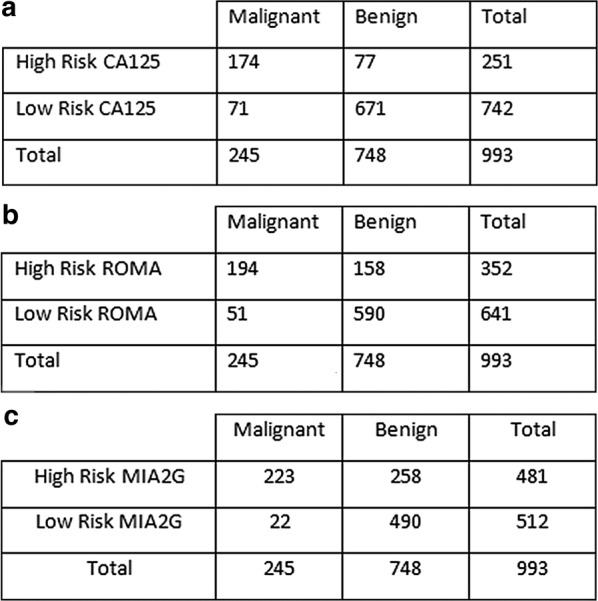
Among 245 subjects (24.7%) determined to have a malignancy, ROMA misclassified 51 malignancies (including 10 high-grade ovarian malignancies), whereas MIA2G misclassified 22 (including 5 high-grade ovarian malignancies). Early stage cancers were more frequently misclassified by ROMA (20 vs. 8 cases). The rate of "test-negative" malignancies was significantly higher for ROMA, while the rate of "test-positive" benign cases was significantly higher for MIA2G.
Triage algorithms play an important role in improving clinical outcomes for women presenting with an adnexal mass regardless of the eventual diagnosis. In this study, MIA2G was shown to correctly predict more cases of ovarian cancer than the ROMA algorithm.
Aspira Labs/Vermillion Inc.
附件或盆腔肿块是一种常见的恶性肿瘤可疑表现,尤其是卵巢癌。在手术前进行正确的识别,将有助于将可能为卵巢癌的病例适当转诊至专业中心,因为在这种情况下,当在初次手术时提供手术分期和治疗时,才能获得最佳的结果。
我们比较了两种体外诊断多变量指数检测(IVDMIAs)的筛查能力,一种是新的 IVDMIA(第二代多变量指数检测:MIA2G)和当前使用的分诊算法(卵巢恶性肿瘤风险检测:ROMA)。
在 245 名(24.7%)被确定为恶性肿瘤的患者中,ROMA 错误分类了 51 例恶性肿瘤(包括 10 例高级别卵巢恶性肿瘤),而 MIA2G 错误分类了 22 例(包括 5 例高级别卵巢恶性肿瘤)。早期癌症更常被 ROMA 错误分类(20 例与 8 例)。ROMA 的“阴性测试”恶性肿瘤率明显更高,而 MIA2G 的“阳性测试”良性病例率明显更高。
分诊算法在改善因附件肿块就诊的女性的临床结局方面发挥着重要作用,无论最终诊断如何。在这项研究中,与 ROMA 算法相比,MIA2G 被证明能够更正确地预测更多的卵巢癌病例。
Aspira Labs/Vermillion Inc.