Department of Clinical Genetics, Amsterdam University Medical Centres, Amsterdam, The Netherlands.
Department of Clinical Genetics, University Medical Centre Groningen, Groningen, The Netherlands.
BMJ Open. 2019 Jul 9;9(7):e025660. doi: 10.1136/bmjopen-2018-025660.
In current practice, probands are asked to inform relatives about the possibility of predictive DNA testing when a pathogenic variant causing an inherited cardiac condition (ICC) is identified. Previous research on the uptake of genetic counselling and predictive DNA testing in relatives suggests that not all relatives are sufficiently informed. We developed a randomised controlled trial to evaluate the effectiveness of a tailored approach in which probands decide together with the genetic counsellor which relatives they inform themselves and which relatives they prefer to have informed by the genetic counsellor. Here, we present the study protocol of this randomised controlled trial.
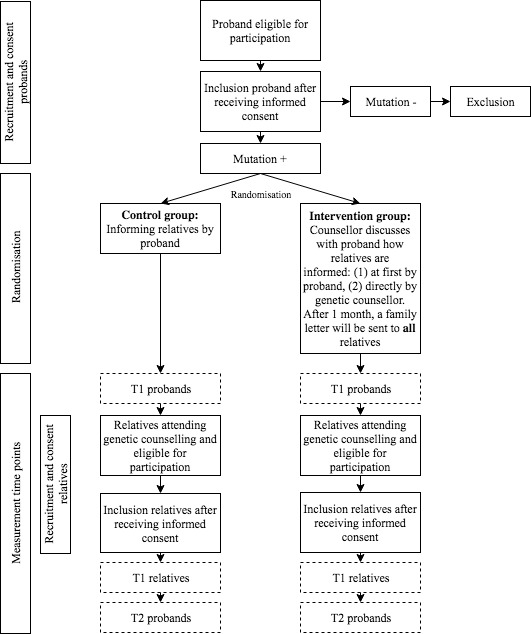
A multicentre randomised controlled trial with parallel-group design will be conducted in which an intervention group receiving the tailored approach will be compared with a control group receiving usual care. Adult probands diagnosed with an ICC in whom a likely pathogenic or pathogenic variant is identified will be randomly assigned to the intervention or control group (total sample: n=85 probands). Primary outcomes are uptake of genetic counselling and predictive DNA testing by relatives (total sample: n=340 relatives). Secondary outcomes are appreciation of the approach used and impact on familial and psychological functioning, which will be assessed using questionnaires. Relatives who attend genetic counselling will be asked to fill out a questionnaire as well.
Ethical approval was obtained from the Medical Ethical Committee of the Amsterdam University Medical Centres (MEC 2017-145), the Netherlands. All participants will provide informed consent prior to participation in the study. Results of the study on primary and secondary outcome measures will be published in peer-reviewed journals.
NTR6657; Pre-results.
在当前的实践中,当发现导致遗传性心脏疾病(ICC)的致病性变异时,会要求先证者告知亲属进行预测性 DNA 检测的可能性。先前关于亲属接受遗传咨询和预测性 DNA 检测的研究表明,并非所有亲属都得到了充分的告知。我们开展了一项随机对照试验,以评估一种定制方法的有效性,即先证者与遗传咨询师一起决定告知哪些亲属,并由遗传咨询师告知哪些亲属。在此,我们介绍了这项随机对照试验的研究方案。
将开展一项多中心、平行组设计的随机对照试验,其中接受定制方法的干预组将与接受常规护理的对照组进行比较。患有 ICC 且已确定可能致病性或致病性变异的成年先证者将被随机分配至干预组或对照组(总样本:n=85 例先证者)。主要结局是亲属接受遗传咨询和预测性 DNA 检测的情况(总样本:n=340 名亲属)。次要结局是评估所采用方法的认可度以及对家族和心理功能的影响,这将通过问卷调查进行评估。参加遗传咨询的亲属也将被要求填写一份问卷。
荷兰阿姆斯特丹大学医学中心医学伦理委员会(MEC 2017-145)已批准该伦理审查。所有参与者在参与研究之前都将提供知情同意。研究的初级和次级结果将发表在同行评议的期刊上。
NTR6657;预结果。