Roudijk R W, Taha K, Bourfiss M, Loh P, van den Heuvel L, Boonstra M J, van Lint F, van der Voorn S M, Te Riele A S J M, Bosman L P, Christiaans I, van Veen T A B, Remme C A, van den Berg M P, van Tintelen J P, Asselbergs F W
Netherlands Heart Institute, Utrecht, The Netherlands.
Department of Cardiology, Division Heart and Lungs, University Medical Centre Utrecht, Utrecht University, Utrecht, The Netherlands.
Neth Heart J. 2021 Jun;29(6):301-308. doi: 10.1007/s12471-021-01542-1. Epub 2021 Feb 2.
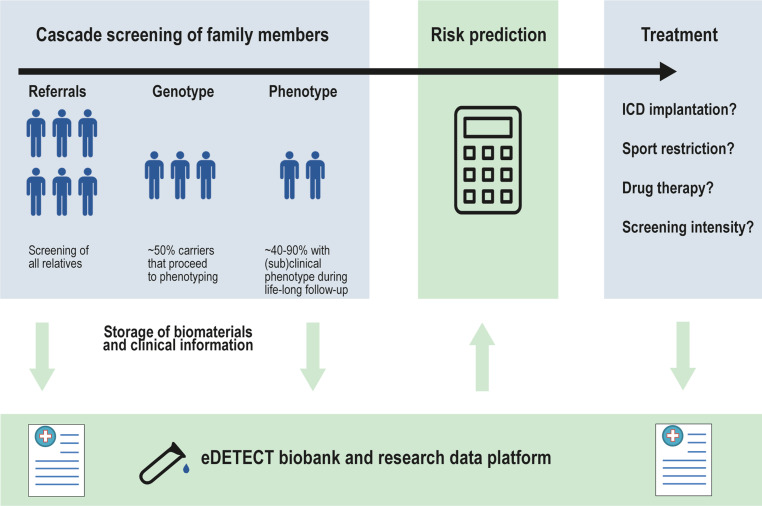
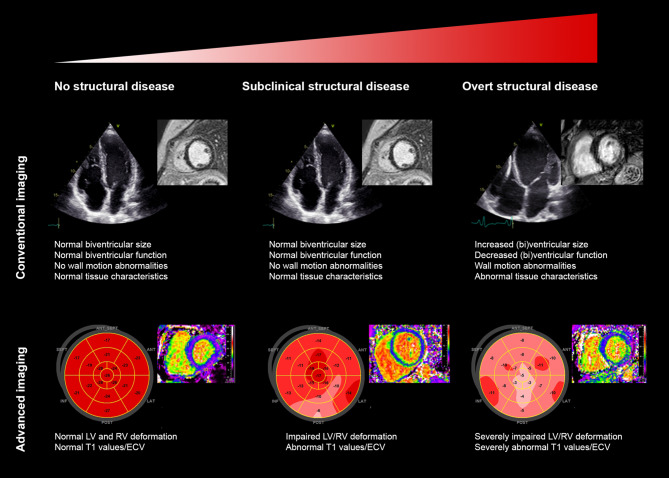
In relatives of index patients with dilated cardiomyopathy and arrhythmogenic cardiomyopathy, early detection of disease onset is essential to prevent sudden cardiac death and facilitate early treatment of heart failure. However, the optimal screening interval and combination of diagnostic techniques are unknown. The clinical course of disease in index patients and their relatives is variable due to incomplete and age-dependent penetrance. Several biomarkers, electrocardiographic and imaging (echocardiographic deformation imaging and cardiac magnetic resonance imaging) techniques are promising non-invasive methods for detection of subclinical cardiomyopathy. However, these techniques need optimisation and integration into clinical practice. Furthermore, determining the optimal interval and intensity of cascade screening may require a personalised approach. To address this, the CVON-eDETECT (early detection of disease in cardiomyopathy mutation carriers) consortium aims to integrate electronic health record data from long-term follow-up, diagnostic data sets, tissue and plasma samples in a multidisciplinary biobank environment to provide personalised risk stratification for heart failure and sudden cardiac death. Adequate risk stratification may lead to personalised screening, treatment and optimal timing of implantable cardioverter defibrillator implantation. In this article, we describe non-invasive diagnostic techniques used for detection of subclinical disease in relatives of index patients with dilated cardiomyopathy and arrhythmogenic cardiomyopathy.
在扩张型心肌病和致心律失常性心肌病先证者的亲属中,疾病发作的早期检测对于预防心源性猝死和促进心力衰竭的早期治疗至关重要。然而,最佳筛查间隔和诊断技术的组合尚不清楚。由于不完全和年龄依赖性外显率,先证者及其亲属的疾病临床过程存在差异。几种生物标志物、心电图和影像学(超声心动图变形成像和心脏磁共振成像)技术是检测亚临床心肌病的有前景的非侵入性方法。然而,这些技术需要优化并整合到临床实践中。此外,确定级联筛查的最佳间隔和强度可能需要个性化方法。为解决这一问题,CVON-eDETECT(心肌病突变携带者疾病的早期检测)联盟旨在在多学科生物样本库环境中整合长期随访的电子健康记录数据、诊断数据集、组织和血浆样本,以提供心力衰竭和心源性猝死的个性化风险分层。充分的风险分层可能会导致个性化筛查、治疗以及植入式心律转复除颤器植入的最佳时机。在本文中,我们描述了用于检测扩张型心肌病和致心律失常性心肌病先证者亲属中亚临床疾病的非侵入性诊断技术。