School of Medicine, University of Adelaide, Adelaide, SA, Australia.
Precision Medicine, South Australian Health and Medical Research Institute, Adelaide, SA, Australia.
Br J Cancer. 2019 Aug;121(4):293-302. doi: 10.1038/s41416-019-0509-3. Epub 2019 Jul 10.
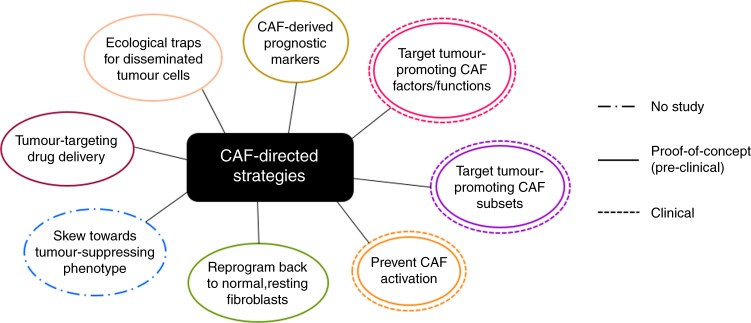
Cancer-associated fibroblasts (CAFs) were originally presumed to represent a homogeneous population uniformly driving tumorigenesis, united by their morphology and peritumoural location. Our understanding of CAFs has since been shaped by sophisticated in vitro and in vivo experiments, pathological association and, more recently, ablation, and it is now widely appreciated that CAFs form a group of highly heterogeneous cells with no single overarching marker. Studies have demonstrated that the CAF population contains different subtypes based on the expression of marker proteins with the capacity to promote or inhibit cancer, with their biological role as accomplices or adversaries dependent on many factors, including the cancer stage. So, while CAFs have been endlessly shown to promote the growth, survival and spread of tumours via improvements in functionality and an altered secretome, they are also capable of retarding tumorigenesis via largely unknown mechanisms. It is important to reconcile these disparate results so that the functions of, or factors produced by, tumour-promoting subtypes can be specifically targeted to improve cancer patient outcomes. This review will dissect out CAF complexity and CAF-directed cancer treatment strategies in order to provide a case for future, rational therapies.
癌症相关成纤维细胞(CAFs)最初被认为是一种均质群体,通过其形态和肿瘤周围位置统一驱动肿瘤发生。我们对 CAFs 的理解受到了复杂的体外和体内实验、病理关联以及最近的消融的影响,现在人们普遍认识到,CAFs 形成了一组高度异质的细胞,没有单一的主导标志物。研究表明,CAF 群体根据具有促进或抑制癌症能力的标记蛋白的表达包含不同的亚型,其作为同谋或对手的生物学作用取决于许多因素,包括癌症阶段。因此,虽然 CAFs 通过改善功能和改变的分泌组来促进肿瘤的生长、存活和扩散,但它们也能够通过很大程度上未知的机制抑制肿瘤发生。重要的是要调和这些不同的结果,以便可以针对促进肿瘤的亚型的功能或产生的因子进行特异性靶向,以改善癌症患者的预后。本综述将剖析 CAF 的复杂性和针对 CAF 的癌症治疗策略,为未来的合理治疗提供依据。