Zou Daoyang, Xin Xi, Xu Huangzhen, Xu Yunxian, Xu Tianwen
The Second Affiliated Hospital of Fujian Medical University, Quanzhou, China.
Ganzhou People's Hospital, Ganzhou, China.
Sci Rep. 2025 May 13;15(1):16550. doi: 10.1038/s41598-025-01185-x.
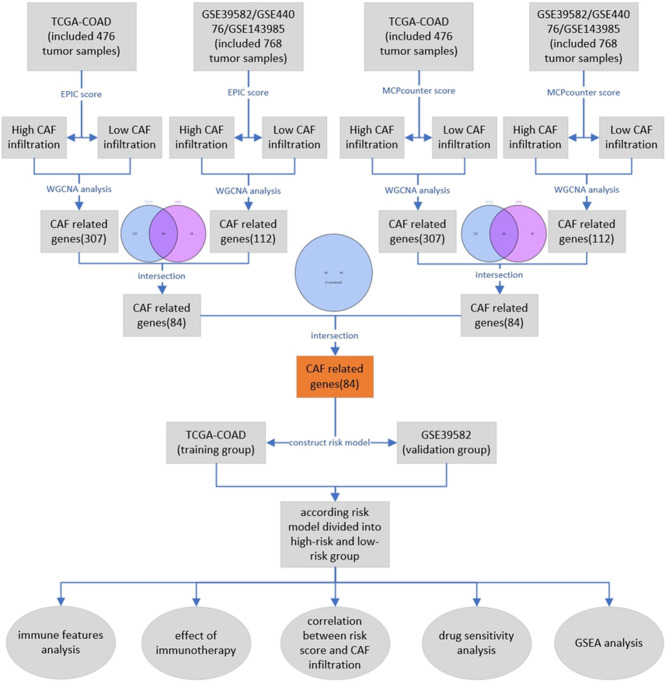
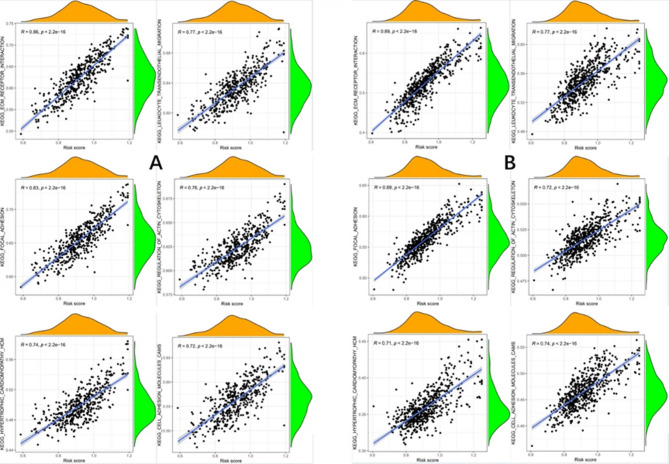
The efficacy of immune checkpoint inhibitors in colon cancer has been established, and there is an urgent need to identify new molecular markers for colon cancer immunotherapy to guide clinical decisions. Using the "EPIC" and "MCPcounter" R packages to conduct cancer-associated fibroblast (CAF) infiltration scoring on colon cancer samples from the TCGA database and the GEO database, the WGCNA analysis was performed on the two databases' samples based on the CAF infiltration scores to screen for CAF-related genes. LASSO regression analysis was used to construct a risk model with these genes. Comprehensive bioinformatics analysis was conducted on the constructed model to evaluate the stability of its prediction of CAF infiltration abundance and the stability of its prediction of immunotherapy efficacy. The newly constructed risk model could well reflect the abundance of CAF infiltration in colon cancer, with a correlation coefficient of 0.91 in the training cohort TCGA-COAD and 0.88 in the validation cohort GSE39582. GSEA analysis revealed that CAF is closely related to functions associated with extracellular matrix remodeling. The constructed risk model can predict the efficacy of immunotherapy in colon cancer well, with the high-risk group showing significantly poorer immunotherapy response than the low-risk group, with an expected effective rate of immunotherapy of 68 vs. 24% in the training group (P < 0.001) and 64 vs. 26% in the validation group (P < 0.001). The AUC value for predicting immunotherapy response by the risk model in the training group was 0.780 (95% CI 0.736-0.820), and in the validation group, the AUC value was 0.774 (95% CI 0.735-0.810). Drug sensitivity analysis showed that the expected chemotherapeutic effect in the low-risk group was superior to that in the high-risk group. CAF is associated with immunosuppression and drug resistance. Predicting the efficacy of immunotherapy in colon cancer based on the abundance of CAF infiltration is a feasible approach. For the high-risk population identified by our model, clinical consideration should be given to prioritizing non-immunotherapy approaches to avoid potential risks associated with immunotherapy.
免疫检查点抑制剂在结肠癌中的疗效已得到证实,因此迫切需要确定新的分子标志物用于结肠癌免疫治疗,以指导临床决策。利用“EPIC”和“MCPcounter”R包对来自TCGA数据库和GEO数据库的结肠癌样本进行癌症相关成纤维细胞(CAF)浸润评分,基于CAF浸润评分对两个数据库的样本进行加权基因共表达网络分析(WGCNA),以筛选CAF相关基因。使用LASSO回归分析用这些基因构建风险模型。对构建的模型进行综合生物信息学分析,以评估其对CAF浸润丰度预测的稳定性及其对免疫治疗疗效预测的稳定性。新构建的风险模型能够很好地反映结肠癌中CAF浸润的丰度,在训练队列TCGA-COAD中的相关系数为0.91,在验证队列GSE39582中的相关系数为0.88。基因集富集分析(GSEA)显示,CAF与细胞外基质重塑相关功能密切相关。构建的风险模型能够很好地预测结肠癌免疫治疗的疗效,高风险组的免疫治疗反应明显低于低风险组,训练组免疫治疗的预期有效率分别为68%和24%(P<0.001),验证组为64%和26%(P<0.001)。风险模型在训练组中预测免疫治疗反应的AUC值为0.780(95%CI 0.736-0.820),在验证组中,AUC值为0.774(95%CI 0.735-0.810)。药物敏感性分析表明,低风险组的预期化疗效果优于高风险组。CAF与免疫抑制和耐药性相关。基于CAF浸润丰度预测结肠癌免疫治疗疗效是一种可行的方法。对于我们模型识别出的高风险人群,临床应考虑优先采用非免疫治疗方法,以避免与免疫治疗相关的潜在风险。