Division of General Internal Medicine, Department of Medicine, Massachusetts General Hospital, Boston.
Harvard Medical School, Boston, Massachusetts.
JAMA Netw Open. 2019 Jul 3;2(7):e196789. doi: 10.1001/jamanetworkopen.2019.6789.
Nearly one-third of the 150 million US adults who are employed are obese. A workplace program that reduces employees' caloric intake could help prevent obesity.
To determine if implementation of a hospital workplace cafeteria healthy eating program was associated with reduction in calories purchased by employees over 2 years.
DESIGN, SETTING, AND PARTICIPANTS: A longitudinal cohort study of 5695 employees who purchased food with their employee identification card before and after implementation of a workplace cafeteria healthy eating program was conducted from December 1, 2009, to February 29, 2012, in a hospital in Boston, Massachusetts. Statistical analysis was conducted from April 6, 2018, to May 14, 2019.
After a 3-month baseline period, "traffic light" food labels (in which green indicates healthy, yellow indicates less healthy, and red indicates least healthy) and choice architecture (product placement) changes were implemented permanently.
Main outcomes were changes in calories of employees' purchases from baseline (December 1, 2009, to February 28, 2010) to the same quarter 1 year (December 1, 2010, to February 28, 2011) and 2 years (December 1, 2011, to February 29, 2012) later. Purchases were obtained from sales data linked to employee identification cards. The hypothesized association of estimated changes in daily calories consumed with employees' weight was calculated using a dynamic model of weight change. Analyses were adjusted for age, sex, race/ethnicity, and job type.
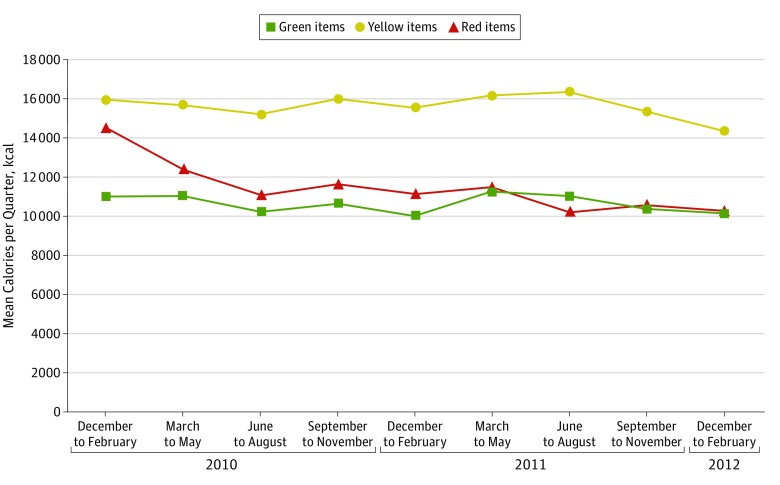
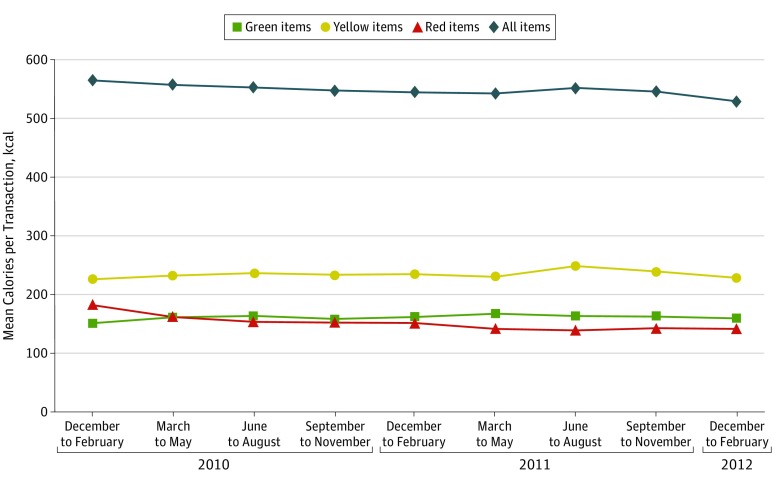
Among the 5695 employees in the study, 4057 were women and 1638 were men, and the mean (SD) age was 40 (12) years. Baseline purchases had a mean of 565 kcal per transaction (95% CI, 558-572 kcal) and decreased 19 kcal per transaction (95% CI, -23 to -15 kcal) at 1 year and 35 kcal per transaction (95% CI, -39 to -31 kcal) at 2 years (-6.2%; P < .001) relative to baseline. The largest reduction was from red-labeled items, decreasing 42 kcal per transaction at 2 years (95% CI, -45 to -39 kcal) from a mean of 183 kcal per transaction (95% CI, 177-188 kcal) at baseline (-23.0%; P < .001). Calories from green-labeled items increased 6 kcal per transaction (95% CI, 3-9 kcal) from a mean of 152 kcal per transaction (95% CI, 149-155 kcal) (4.0%; P < .001), and calories from yellow-labeled items did not change. Among frequent purchasers (≥36 transactions per quarter; n = 453), total kilocalories per quarter at baseline was 41 784, which, averaged over the entire follow-up, decreased a mean of 4275 kcal/quarter (95% CI, -5325 to -3224 kcal) over 2 years. Assuming no compensatory changes in diet or activity, this equated to a reduction of 47 kcal per day and estimated a 2.0-kg weight loss over 3 years.
A workplace cafeteria traffic light-labeling and choice architecture program was associated with a sustained decrease in calories purchased, particularly from unhealthy foods. Point-of-purchase programs could help improve dietary intake and prevent obesity in employees.
重要性:在美国 1.5 亿名在职成年人中,近三分之一的人体重肥胖。实施减少员工卡路里摄入量的工作场所计划可能有助于预防肥胖。
目的:确定医院工作场所自助餐厅健康饮食计划的实施是否与员工在两年内购买的卡路里减少有关。
设计、环境和参与者:从 2009 年 12 月 1 日至 2012 年 2 月 29 日,在马萨诸塞州波士顿的一家医院对 5695 名员工进行了一项纵向队列研究,这些员工在实施工作场所自助餐厅健康饮食计划之前和之后使用员工身份证购买食物。统计分析于 2018 年 4 月 6 日至 2019 年 5 月 14 日进行。
暴露情况:在为期 3 个月的基线期之后,永久性实施了“红绿灯”食品标签(其中绿色表示健康,黄色表示不太健康,红色表示最不健康)和选择架构(产品放置)的改变。
主要结果和措施:主要结果是员工从基线(2009 年 12 月 1 日至 2010 年 2 月 28 日)到同一季度 1 年(2010 年 12 月 1 日至 2011 年 2 月 28 日)和 2 年(2011 年 12 月 1 日至 2012 年 2 月 29 日)后的卡路里购买量的变化。购买量是从与员工身份证相关联的销售数据中获得的。使用体重变化的动态模型计算与员工体重相关的估计每日卡路里摄入量变化的假设关联。分析调整了年龄、性别、种族/民族和工作类型。
结果:在研究的 5695 名员工中,4057 名是女性,1638 名是男性,平均(SD)年龄为 40(12)岁。基线购买量的平均交易为 565 卡路里(95%CI,558-572 卡路里),与基线相比,第 1 年减少 19 卡路里/交易(95%CI,-23 至 -15 卡路里),第 2 年减少 35 卡路里/交易(95%CI,-39 至 -31 卡路里)(-6.2%;P < .001)。最大的降幅来自红色标签物品,与基线相比,第 2 年的交易减少了 42 卡路里(95%CI,-45 至 -39 卡路里),而基线时的平均交易为 183 卡路里(95%CI,177-188 卡路里)(-23.0%;P < .001)。绿色标签物品的卡路里增加了 6 卡路里/交易(95%CI,3-9 卡路里),从平均 152 卡路里/交易(95%CI,149-155 卡路里)(4.0%;P < .001),黄色标签物品的卡路里没有变化。在频繁购买者(≥每季度 36 笔交易;n = 453)中,基线时每季度的总卡路里为 41784 卡路里,平均而言,在整个随访期间,2 年内每季度平均减少 4275 卡路里(95%CI,-5325 至 -3224 卡路里)。假设饮食或活动没有补偿性变化,这相当于每天减少 47 卡路里,估计 3 年内体重减轻 2.0 公斤。
结论和相关性:工作场所自助餐厅的红绿灯标签和选择架构计划与卡路里购买量的持续减少有关,特别是与不健康食品有关。购买点计划可以帮助改善员工的饮食摄入,预防肥胖。