Friedman School of Nutrition Science and Policy, Tufts University, Boston, Massachusetts; Department of Medicine, Massachusetts General Hospital and Harvard Medical School, Boston, Massachusetts.
Friedman School of Nutrition Science and Policy, Tufts University, Boston, Massachusetts; Institute for Health Metrics and Evaluation, University of Washington, Seattle, Washington.
Am J Prev Med. 2019 Feb;56(2):300-314. doi: 10.1016/j.amepre.2018.09.024. Epub 2018 Dec 17.
The influence of food and beverage labeling (food labeling) on consumer behaviors, industry responses, and health outcomes is not well established.
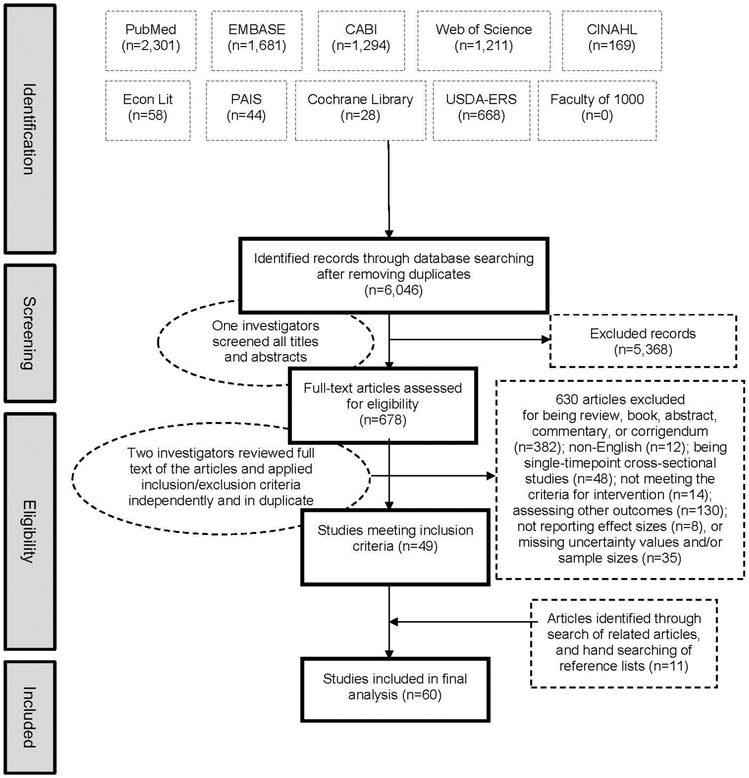
PRISMA (Preferred Reporting Items for Systematic Reviews and Meta-Analyses) guidelines were followed. Ten databases were searched in 2014 for studies published after 1990 evaluating food labeling and consumer purchases/orders, intakes, metabolic risk factors, and industry responses. Data extractions were performed independently and in duplicate. Studies were pooled using inverse-variance random effects meta-analysis. Heterogeneity was explored with I, stratified analyses, and meta-regression; and publication bias was assessed with funnel plots, Begg's tests, and Egger's tests. Analyses were completed in 2017.
From 6,232 articles, a total of 60 studies were identified, including 2 million observations across 111 intervention arms in 11 countries. Food labeling decreased consumer intakes of energy by 6.6% (95% CI= -8.8%, -4.4%, n=31), total fat by 10.6% (95% CI= -17.7%, -3.5%, n=13), and other unhealthy dietary options by 13.0% (95% CI= -25.7%, -0.2%, n=16), while increasing vegetable consumption by 13.5% (95% CI=2.4%, 24.6%, n=5). Evaluating industry responses, labeling decreased product contents of sodium by 8.9% (95% CI= -17.3%, -0.6%, n=4) and artificial trans fat by 64.3% (95% CI= -91.1%, -37.5%, n=3). No significant heterogeneity was identified by label placement or type, duration, labeled product, region, population, voluntary or legislative approaches, combined intervention components, study design, or quality. Evidence for publication bias was not identified.
From reviewing 60 intervention studies, food labeling reduces consumer dietary intake of selected nutrients and influences industry practices to reduce product contents of sodium and artificial trans fat.
食品和饮料标签(食品标签)对消费者行为、行业反应和健康结果的影响尚未得到充分证实。
遵循 PRISMA(系统评价和荟萃分析的首选报告项目)指南。2014 年,在 10 个数据库中搜索了 1990 年后评估食品标签和消费者购买/订单、摄入量、代谢风险因素以及行业反应的研究。数据提取由两人独立进行。使用逆方差随机效应荟萃分析对研究进行汇总。通过 I²、分层分析和元回归探索异质性;通过漏斗图、贝格检验和埃格检验评估发表偏倚。分析于 2017 年完成。
从 6232 篇文章中,共确定了 60 项研究,包括 11 个国家的 111 个干预组的 200 万项观察结果。食品标签使消费者的能量摄入减少了 6.6%(95%置信区间=-8.8%,-4.4%,n=31),总脂肪减少了 10.6%(95%置信区间=-17.7%,-3.5%,n=13),其他不健康饮食减少了 13.0%(95%置信区间=-25.7%,-0.2%,n=16),同时使蔬菜摄入量增加了 13.5%(95%置信区间=2.4%,24.6%,n=5)。评估行业反应时,标签使产品中的钠含量减少了 8.9%(95%置信区间=-17.3%,-0.6%,n=4),人工反式脂肪减少了 64.3%(95%置信区间=-91.1%,-37.5%,n=3)。标签位置或类型、持续时间、标记产品、区域、人群、自愿或立法方法、联合干预措施、研究设计或质量均未发现显著异质性。未发现发表偏倚的证据。
通过审查 60 项干预研究,食品标签减少了消费者对某些营养素的饮食摄入,并影响了行业减少产品中钠和人工反式脂肪含量的做法。