Instituto Nacional de Saúde, Maputo, Mozambique.
Universidade Eduardo Mondlane, Maputo, Mozambique.
PLoS One. 2019 Jul 10;14(7):e0219273. doi: 10.1371/journal.pone.0219273. eCollection 2019.
There is a paucity of primary data to understand the overall pattern of disease and injuries as well as related health-service utilization in resource-poor countries in Africa.
To generate reliable and robust data describing the pattern of emergency presentations attributable to communicable disease (CD), non-communicable disease (NCD) and injuries in three different regions of Mozambique.
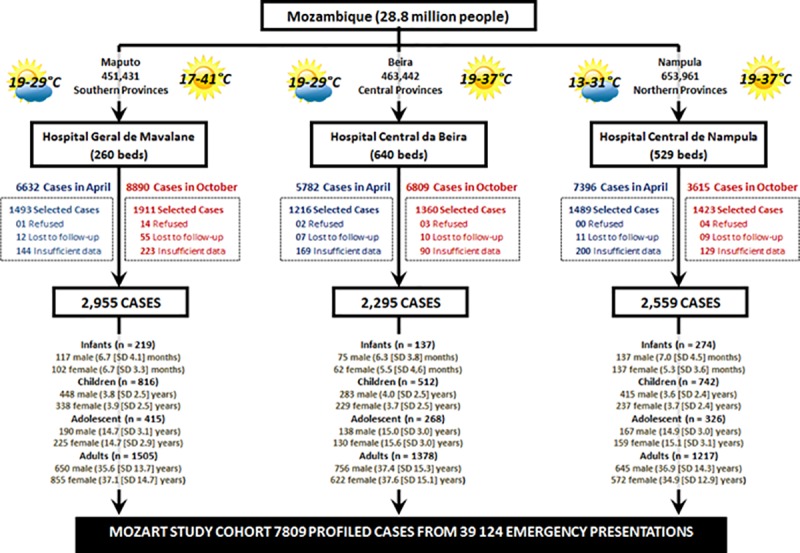
We undertook a pragmatic, prospective, multicentre surveillance study of individuals (all ages) presenting to the emergency departments of three hospitals in Southern (Maputo), Central (Beira) and Northern (Nampula) Mozambique. During 24-hour surveillance in the seasonally distinct months of April and October 2016/2017, we recorded data on 7,809 participants randomly selected from 39,124 emergency presentations to the three participating hospitals. Applying a pragmatic surveillance protocol, data were prospectively collected on the demography, clinical history, medical profile and treatment of study participants.
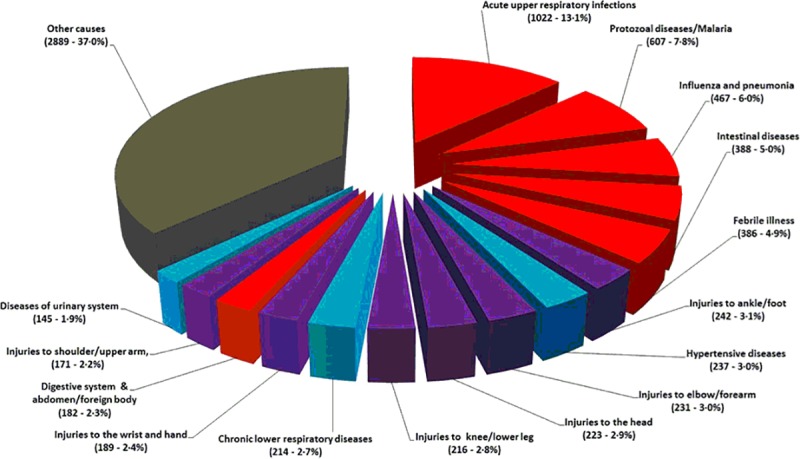
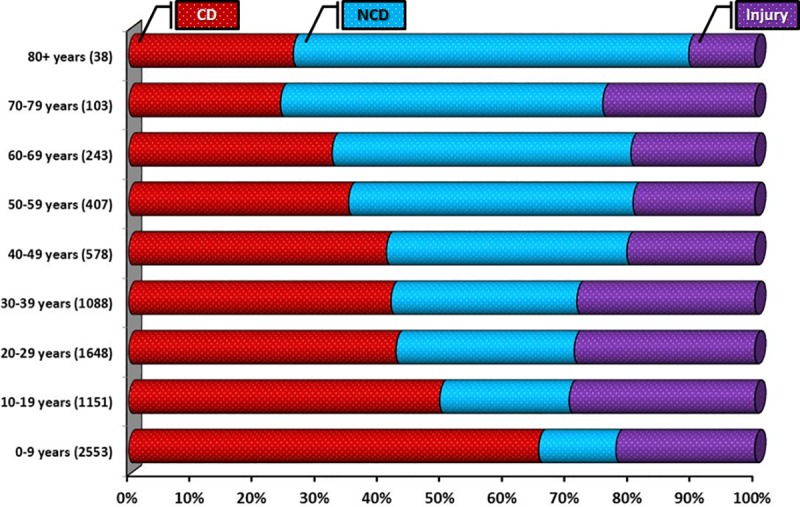
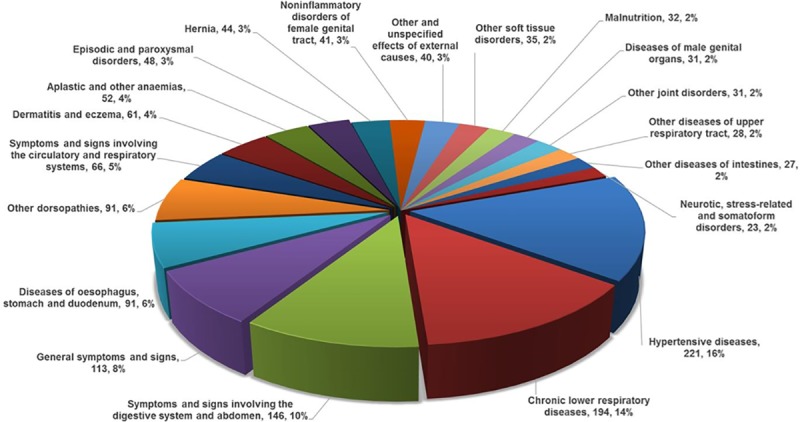
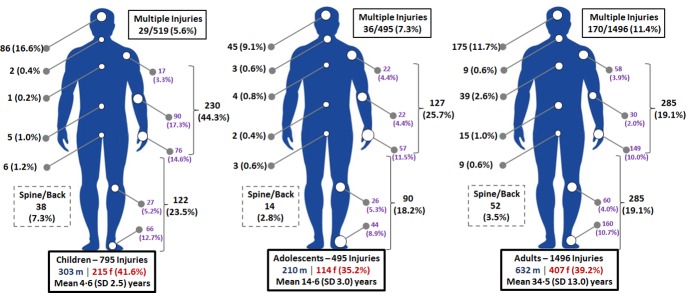
A total of 4,021 males and 3,788 (48.5%) females comprising 630 infants (8.1%), 2,070 children (26.5%), 1,009 adolescents (12.9%) and, 4,100 adults (52.5%) were studied. CD was the most common presentation (3,914 cases/50.1%) followed by NCD (1,963/25.1%) and injuries (1,932/24.7%). On an adjusted basis, CD was more prevalent in younger individuals (17.9±17.7 versus 26.6±19.2 years;p<0.001), females (51.7% versus 48.7%-OR 1.137, 95%CI 1.036-1.247;p = 0.007), the capital city of Maputo (59.6%) versus the more remote cities of Beira (42.8%-OR 0.532, 95%CI 0.476-0.594) and Nampula (45.8%-OR 0.538, 95%CI 0.480-0.603) and, during April (51.1% versus 49.3% for October-OR 1.142, 95%CI 1.041-1.253;p = 0.005). Conversely, NCD was progressively more prevalent in older individuals, females and in the regional city of Beira, whilst injuries were more prevalent in males (particularly adolescent/young men) and the northern city of Nampula. On a 24-hour basis, presentation patterns were unique to each hospital.
Applying highly pragmatic surveillance methods suited to the low-resource setting of Mozambique, these unique data provide critical insights into the differential pattern of CD, NCD and injury. Consequently, they highlight specific health priorities across different regions and seasons in Southern Africa.
在资源匮乏的非洲国家,缺乏初级数据来了解疾病和伤害的整体模式以及相关的卫生服务利用情况。
生成可靠和稳健的数据,描述在莫桑比克三个不同地区归因于传染病(CD)、非传染性疾病(NCD)和伤害的紧急情况的模式。
我们对莫桑比克南部(马普托)、中部(贝拉)和北部(楠普拉)三个医院急诊科就诊的 7809 名个体(所有年龄)进行了一项实用的、前瞻性的、多中心的监测研究。在 2016/2017 年 4 月和 10 月季节性不同的 24 小时监测期间,我们记录了来自三个参与医院 39124 例急诊就诊中随机选择的 7809 名参与者的数据。根据实用的监测方案,前瞻性地收集了研究参与者的人口统计学、临床病史、医学概况和治疗数据。
共研究了 4021 名男性和 3788 名(48.5%)女性,包括 630 名婴儿(8.1%)、2070 名儿童(26.5%)、1009 名青少年(12.9%)和 4100 名成年人(52.5%)。CD 是最常见的疾病(3914 例/50.1%),其次是 NCD(1963 例/25.1%)和伤害(1932 例/24.7%)。在调整的基础上,CD 在年轻个体中更为常见(17.9±17.7 岁与 26.6±19.2 岁;p<0.001),女性(51.7%与 48.7%-OR 1.137,95%CI 1.036-1.247;p = 0.007),首都马普托(59.6%)与更偏远的贝拉市(42.8%-OR 0.532,95%CI 0.476-0.594)和楠普拉市(45.8%-OR 0.538,95%CI 0.480-0.603)相比,4 月(51.1%与 10 月的 49.3%-OR 1.142,95%CI 1.041-1.253;p = 0.005)。相反,NCD 在年龄较大的个体、女性和贝拉地区城市中逐渐更为常见,而伤害在男性(特别是青少年/年轻男性)和北部城市楠普拉中更为常见。在 24 小时内,各医院的就诊模式具有独特性。
通过应用非常实用的适合莫桑比克低资源环境的监测方法,这些独特的数据提供了传染病、非传染病和伤害的差异化模式的关键见解。因此,它们突出了南部非洲不同地区和季节的具体卫生重点。