Ringo Aaron E, Aboge Gabriel O, Adjou Moumouni Paul F, Hun Lee Seung, Jirapattharasate Charoonluk, Liu Mingming, Gao Yang, Guo Huanping, Zheng Weiqing, Efstratiou Artemis, Galon Eloiza M, Li Jixu, Thekisoe Oriel, Inoue Noboru, Suzuki Hiroshi, Xuan Xuenan
National Research Center for Protozoan Diseases, Obihiro University of Agriculture and Veterinary Medicine.
Onderstepoort J Vet Res. 2019 Jun 13;86(1):e1-e8. doi: 10.4102/ojvr.v86i1.1630.
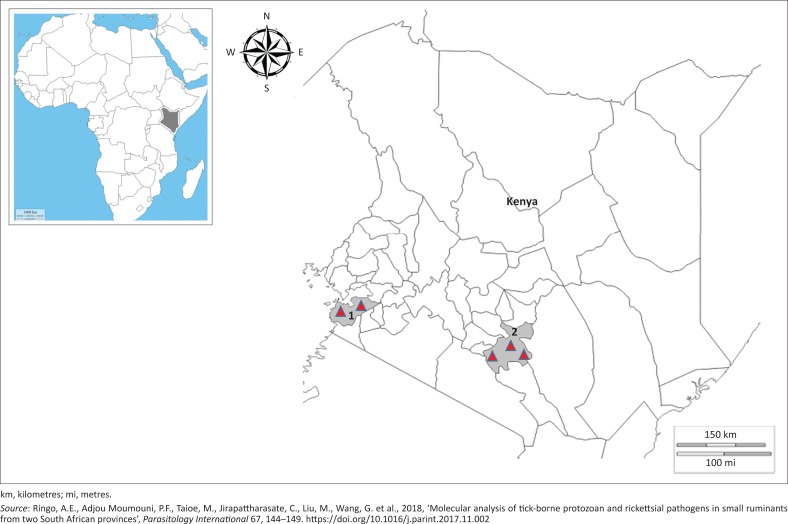
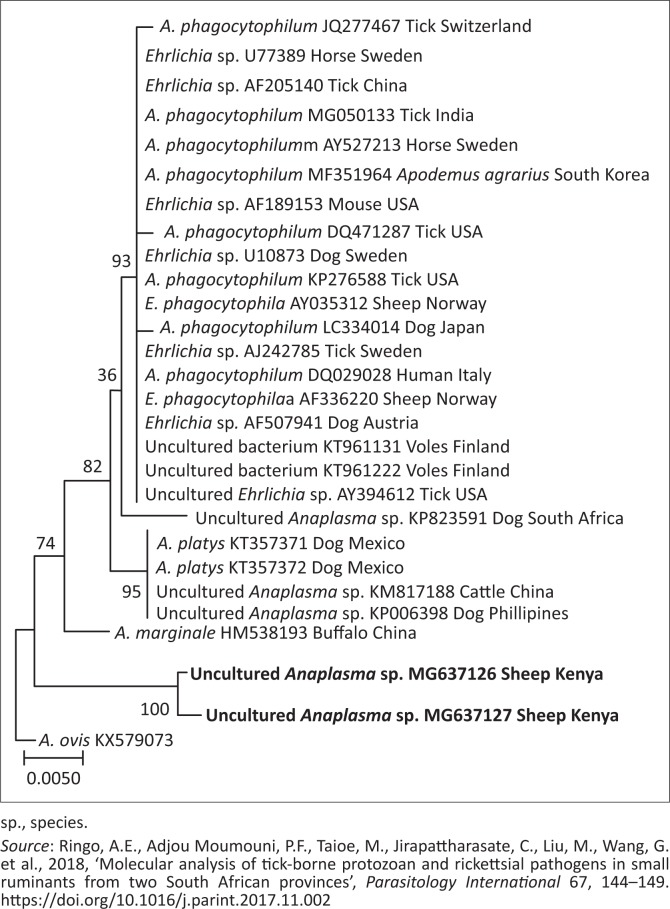
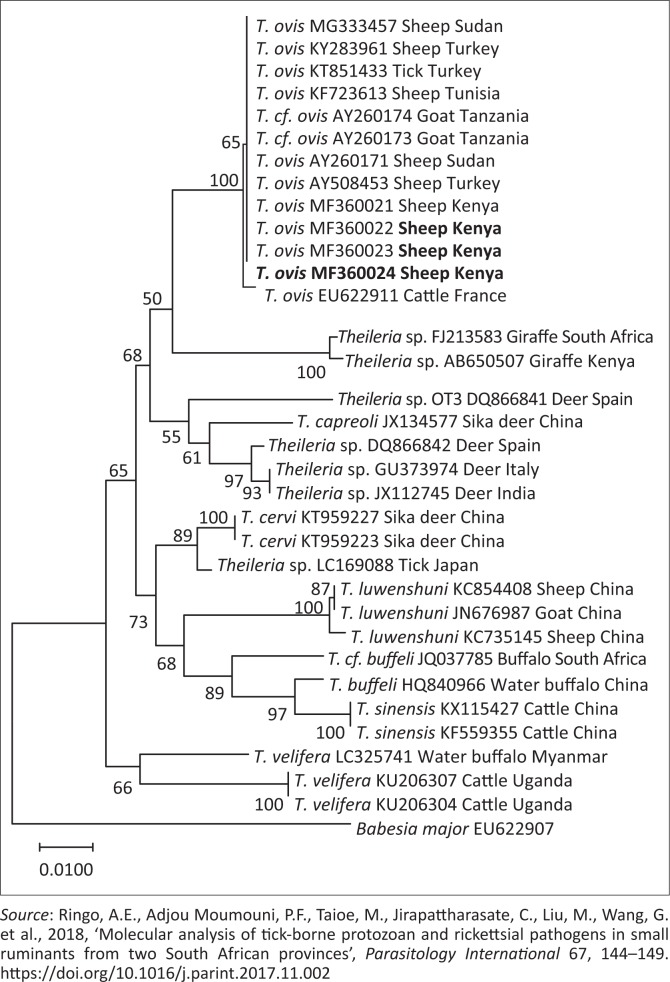
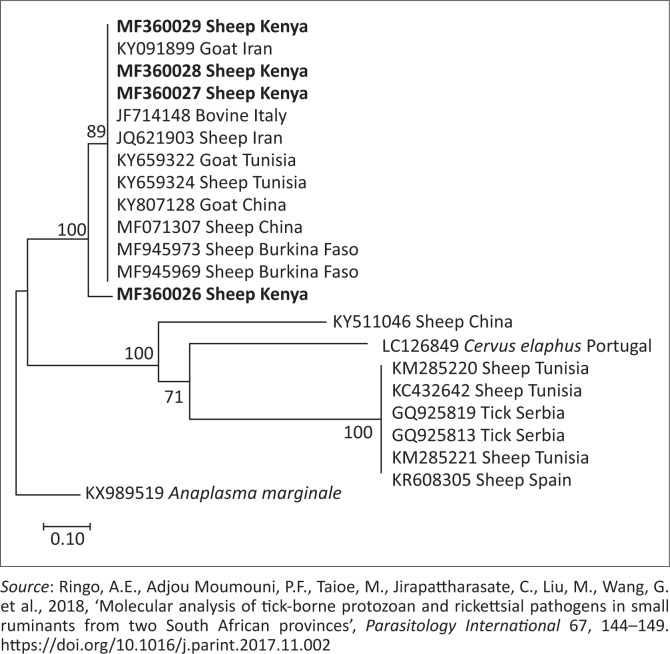
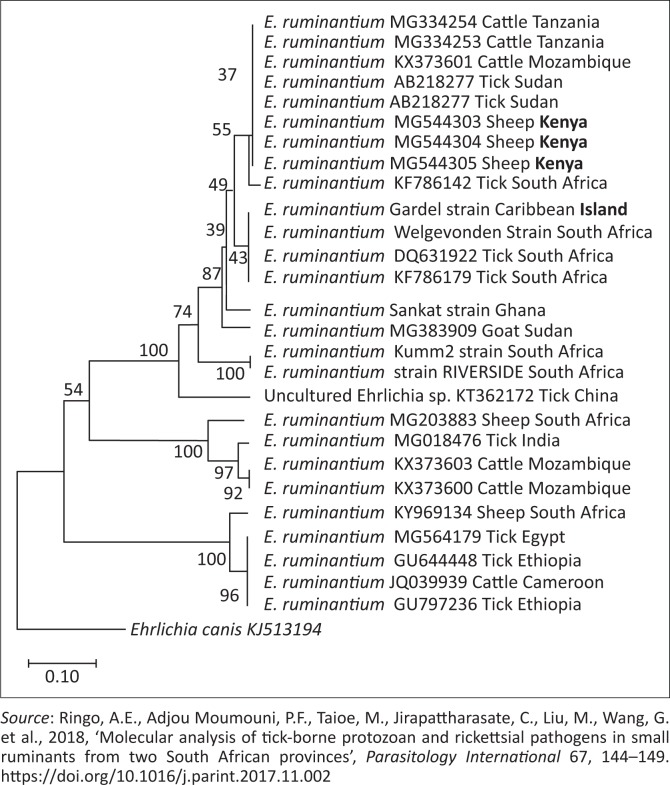
Tick-borne diseases (TBDs) caused by Theileria, Babesia, Anaplasma and Ehrlichia species are common in tropical and subtropical regions. In this study, we investigated the presence and genetic diversity of Theileria spp., Anaplasma ovis, B. ovis, E. ruminantium and Anaplasma spp. in sheep from the Machakos and Homa Bay counties of Kenya. In order to improve the diagnosis and control of ovine TBDs, a total of 76 blood samples from apparently healthy sheep were screened using a polymerase chain reaction (PCR). The assays were conducted using primers based on Theileria spp. 18S rRNA, Anaplasma ovis Major surface protein-4 (AoMSP4), B. ovis 18S rRNA, E. ruminantium pCS20 and Anaplasma spp. 16S rRNA. The overall infection rates for Theileria spp., A. ovis, E. ruminantium and Anaplasma spp. were 39/76 (51.3%), 26/76 (34.2%), 6/76 (7.9%) and 31/76 (40.8%), respectively. The overall co-infection was 47/76 (61.8%). All Theileria spp. positive samples were confirmed to be of Theileria ovis on sequencing. A phylogenetic analysis of the 18S rRNA gene sequences of T. ovis revealed that all isolates of this study clustered with T. ovis sequences extracted from the GenBank suggesting this gene is highly conserved. E. ruminantium pCS20 sequences were in the same clade on the phylogenetic tree. However, three AoMSP4 sequences from this study appeared in the same clade, while one sequence formed a separate branch revealing genetic divergence. The 16S rRNA sequencing revealed uncharacterised Anaplasma spp. and A. ovis. The phylogenetic analyses of the uncharacterised Anaplasma spp. revealed that the two sequences from this study appear in an independent clade from other sequences extracted from the GenBank. This study provides important information regarding the occurrence of tick-borne pathogens and their degree of genetic diversity among sheep in Kenya, which is useful for the diagnosis and control of TBDs.
由泰勒虫属、巴贝斯虫属、无形体属和埃立克体属物种引起的蜱传疾病(TBDs)在热带和亚热带地区很常见。在本研究中,我们调查了肯尼亚马查科斯县和霍马湾县绵羊中泰勒虫属、绵羊无形体、绵羊巴贝斯虫、反刍动物埃立克体和无形体属的存在情况及其遗传多样性。为了改善绵羊蜱传疾病的诊断和控制,使用聚合酶链反应(PCR)对76份来自外观健康绵羊的血液样本进行了筛查。检测使用基于泰勒虫属18S rRNA、绵羊无形体主要表面蛋白-4(AoMSP4)、绵羊巴贝斯虫18S rRNA、反刍动物埃立克体pCS20和无形体属16S rRNA的引物进行。泰勒虫属、绵羊无形体、反刍动物埃立克体和无形体属的总体感染率分别为39/76(51.3%)、26/76(34.2%)、6/76(7.9%)和31/76(40.8%)。总体共感染率为47/76(61.8%)。所有泰勒虫属阳性样本经测序确认均为绵羊泰勒虫。对绵羊泰勒虫18S rRNA基因序列的系统发育分析表明,本研究的所有分离株均与从GenBank中提取的绵羊泰勒虫序列聚类,表明该基因高度保守。反刍动物埃立克体pCS20序列在系统发育树上位于同一分支。然而,本研究中的三个AoMSP4序列出现在同一分支,而一个序列形成了一个单独的分支,显示出遗传差异。16S rRNA测序揭示了未鉴定的无形体属和绵羊无形体。对未鉴定的无形体属的系统发育分析表明,本研究的两个序列出现在一个独立的分支中,与从GenBank中提取的其他序列不同。本研究提供了关于肯尼亚绵羊中蜱传病原体的发生情况及其遗传多样性程度的重要信息,这对于蜱传疾病的诊断和控制非常有用。