1 Division of Cardiovascular Medicine Stanford University School of Medicine Stanford CA.
2 Palo Alto Foundation Research Institute Palo Alto CA.
J Am Heart Assoc. 2019 Jul 16;8(14):e011874. doi: 10.1161/JAHA.118.011874. Epub 2019 Jul 11.
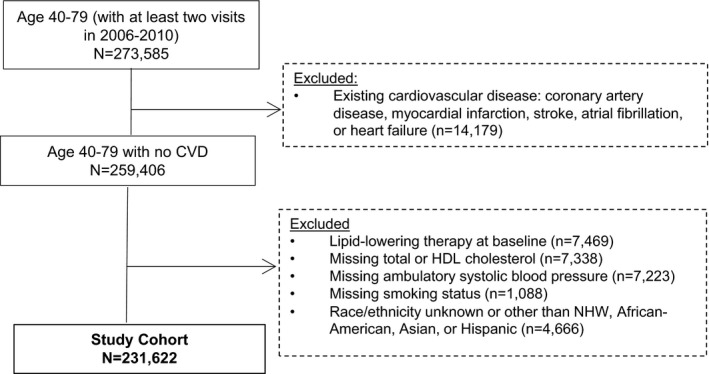
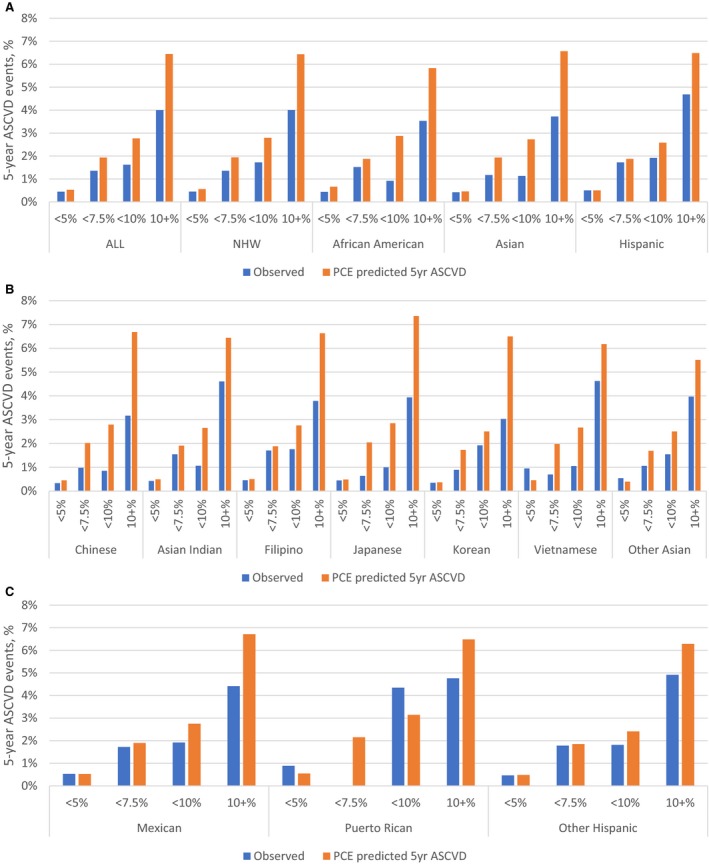
Background Risk assessment is the cornerstone for atherosclerotic cardiovascular disease ( ASCVD ) treatment decisions. The Pooled Cohort Equations ( PCE ) have not been validated in disaggregated Asian or Hispanic populations, who have heterogeneous cardiovascular risk and outcomes. Methods and Results We used electronic health record data from adults aged 40 to 79 years from a community-based, outpatient healthcare system in northern California between January 1, 2006 and December 31, 2015, without ASCVD and not on statins. We examined the calibration and discrimination of the PCE and recalibrated the equations for disaggregated race/ethnic subgroups. The cohort included 231 622 adults with a mean age of 53.1 (SD 9.7) years and 54.3% women. There were 56 130 Asian (Chinese, Asian Indian, Filipino, Japanese, Vietnamese, and other Asian) and 19 760 Hispanic (Mexican, Puerto Rican, and other Hispanic) patients. There were 2703 events (332 and 189 in Asian and Hispanic patients, respectively) during an average of 3.9 (SD 1.5) years of follow-up. The PCE overestimated risk for NHW s, African Americans, Asians, and Hispanics by 20% to 60%. The extent of overestimation of ASCVD risk varied by disaggregated racial/ethnic subgroups, with a predicted-to-observed ratio of ASCVD events ranging from 1.1 for Puerto Rican patients to 1.9 for Chinese patients. The PCE had adequate discrimination, although it varied significantly by race/ethnic subgroups (C-indices 0.66-0.83). Recalibration of the PCE did not significantly improve its performance. Conclusions Using electronic health record data from a large, real-world population, we found that the PCE generally overestimated ASCVD risk, with marked heterogeneity by disaggregated Asian and Hispanic subgroups.
背景
风险评估是动脉粥样硬化性心血管疾病(ASCVD)治疗决策的基石。Pooled Cohort Equations(PCE)尚未在亚组亚洲或西班牙裔人群中得到验证,这些人群的心血管风险和结局存在异质性。
方法和结果
我们使用了来自加利福尼亚州北部一个社区为基础的门诊医疗系统的 40 至 79 岁成年人的电子健康记录数据,这些人在研究期间没有 ASCVD 且未服用他汀类药物。我们检查了 PCE 的校准和区分度,并为细分的种族/族裔亚组重新校准了方程。该队列包括 231622 名平均年龄为 53.1(9.7)岁的成年人,其中 54.3%为女性。有 56130 名亚裔(中国人、印度裔、菲律宾人、日本人、越南人和其他亚裔)和 19760 名西班牙裔(墨西哥人、波多黎各人和其他西班牙裔)患者。在平均 3.9(1.5)年的随访中,有 2703 例事件(分别为亚裔和西班牙裔患者中的 332 例和 189 例)。PCE 高估了非西班牙裔白人、非裔美国人、亚洲人和西班牙裔人的风险,高估幅度为 20%至 60%。ASCVD 风险的高估程度因细分的种族/族裔亚组而异,预测到观察到的 ASCVD 事件比值范围从波多黎各患者的 1.1 到中国患者的 1.9。PCE 具有足够的区分度,尽管它因种族/族裔亚组而异(C 指数为 0.66-0.83)。重新校准 PCE 并不能显著提高其性能。
结论
使用来自大型真实世界人群的电子健康记录数据,我们发现 PCE 通常高估了 ASCVD 风险,并且在细分的亚裔和西班牙裔亚组中存在显著的异质性。