Public Health and Primary Care Department, Leiden University Medical Center, Leiden, Netherlands.
National eHealth Living Lab, University of Leiden, Leiden, Netherlands.
Respir Res. 2019 Jul 10;20(1):146. doi: 10.1186/s12931-019-1110-2.
Integrated disease management with self-management for Chronic Obstructive Pulmonary Disease (COPD) is effective to improve clinical outcomes. eHealth can improve patients' involvement to be able to accept and maintain a healthier lifestyle. Eventhough there is mixed evidence of the impact of eHealth on quality of life (QoL) in different settings.
The primary aim of the e-Vita-COPD-study was to investigate the effect of use of eHealth patient platforms on disease specific QoL of COPD patients.
We evaluated the impact of an eHealth platform on disease specific QoL measured with the clinical COPD questionnaire (CCQ), including subscales of symptoms, functional state and mental state. Interrupted time series (ITS) design was used to collect CCQ data at multiple time points. Multilevel linear regression modelling was used to compare trends in CCQ before and after the intervention.
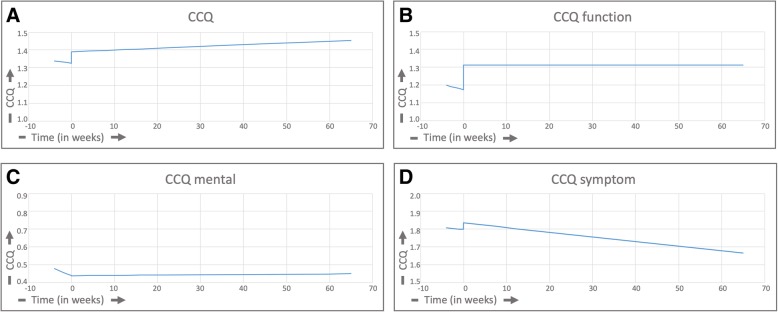
Of 742 invited COPD patients, 244 signed informed consent. For the analyses, we only included patients who actually used the eHealth platform (n = 123). The decrease of CCQ-symptoms was 0.20% before the intervention and 0.27% after the intervention; this difference in slopes was statistically significant (P = 0.027). The decrease of CCQ-mental was 0.97% before the intervention and after the intervention there was an increase of 0.017%; this difference was statistically significant (P = 0.01). No significant difference was found in the slopes of CCQ (P = 0.12) and CCQ-function (P = 0.11) before and after the intervention.
The e-Vita eHealth platform had a potential beneficial impact on the CCQ-symptoms of COPD patients, but not on functional state. The CCQ-mental state remained stable after the intervention, but this was a deterioration compared to the improving situation before the start of the eHealth platform. Therefore, health care providers should be aware that, although symptoms improve, there might be a slight increase in anxiety and depression after introducing an eHealth intervention to support self-management.
Our study is registered in the Dutch Trial Register (national registration of clinical trails, mandatory for publication) with number NTR4098 and can be found at http://www.trialregister.nl/trial/3936 . Date registered: 2013-07-31. First participant: 2014-01-01.
慢性阻塞性肺疾病(COPD)的综合疾病管理和自我管理可以有效改善临床结果。电子健康可以提高患者的参与度,使其能够接受并维持更健康的生活方式。尽管在不同环境下,电子健康对生活质量(QoL)的影响存在混合证据。
e-Vita-COPD 研究的主要目的是调查使用电子健康患者平台对 COPD 患者特定疾病生活质量的影响。
我们评估了电子健康平台对疾病特异性 QoL 的影响,使用临床 COPD 问卷(CCQ)进行测量,包括症状、功能状态和精神状态的亚量表。使用中断时间序列(ITS)设计在多个时间点收集 CCQ 数据。使用多水平线性回归模型比较干预前后 CCQ 的趋势。
在 742 名受邀的 COPD 患者中,有 244 人签署了知情同意书。在分析中,我们仅包括实际使用电子健康平台的患者(n=123)。在干预前,CCQ-症状的下降幅度为 0.20%,在干预后为 0.27%;斜率的这种差异具有统计学意义(P=0.027)。CCQ-精神的下降幅度在干预前为 0.97%,而在干预后增加了 0.017%;这种差异具有统计学意义(P=0.01)。在干预前后,CCQ(P=0.12)和 CCQ-功能(P=0.11)的斜率无显著差异。
e-Vita 电子健康平台对 COPD 患者的 CCQ-症状有潜在的有益影响,但对功能状态没有影响。CCQ-精神状态在干预后保持稳定,但与干预前的改善情况相比,这是一种恶化。因此,医疗保健提供者应该意识到,尽管症状有所改善,但在引入电子健康干预以支持自我管理后,焦虑和抑郁可能会略有增加。
我们的研究在荷兰试验注册处(临床试验的国家注册处,必须出版)注册,注册号为 NTR4098,可在 http://www.trialregister.nl/trial/3936 找到。注册日期:2013 年 7 月 31 日。第一个参与者:2014 年 1 月 1 日。