Allergy and Immunology Unit, Istituti Clinici Scientifici Maugeri, IRCCS, Pavia, Italy.
Division of Pulmonary Rehabilitation, Istituti Clinici Scientifici Maugeri, IRCCS, Tradate, Italy and Department of Medicine and Surgery, Respiratory Diseases, University of Insubria, Varese-Como, Italy.
Respir Res. 2019 Jul 10;20(1):145. doi: 10.1186/s12931-019-1111-1.
Airway eosinophilic inflammation is a characteristic of asthmatic patients and of a sub group of COPD subjects. Blood eosinophils are deemed as a good surrogate marker of sputum eosinophilic inflammation; however, controversial data have been published particularly in COPD. The aim of our study was to compare blood and sputum eosinophils in COPD and asthmatic patients in "real life".
Sputum was induced in stable patients with COPD or asthma with hypertonic saline solution and blood eosinophils were evaluated. Frequency of comorbidities was recorded. Correlations were performed stratifying patients by disease and comorbidities.
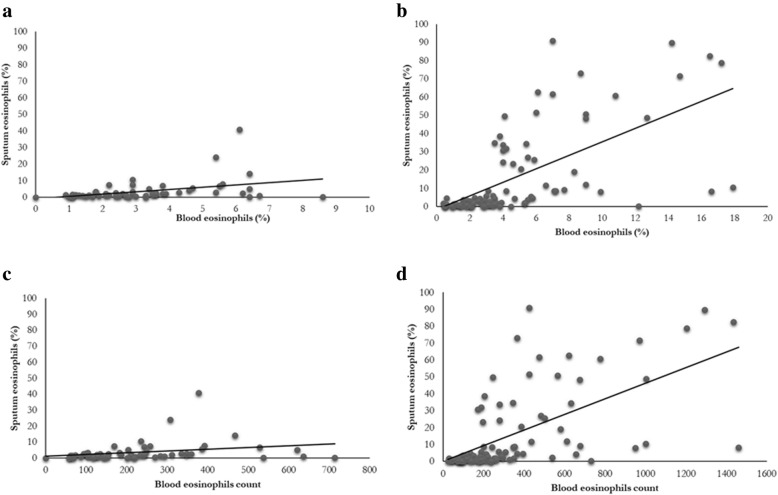
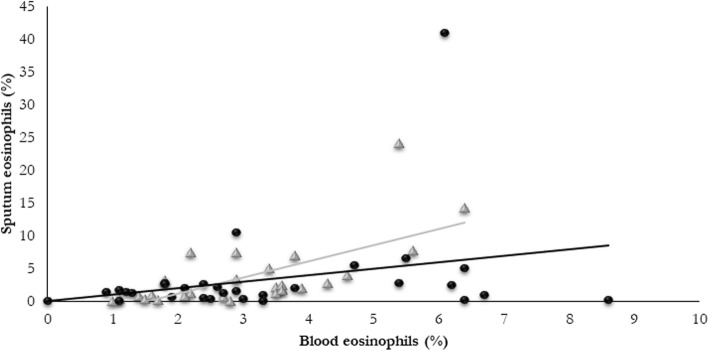
146 patients, 57 with COPD and 89 with asthma were evaluated. Blood and sputum eosinophils expressed as percentages were correlated in COPD (rho = 0.40; p = 0.004), but the entity of correlation was lower compared with asthmatic subjects (rho = 0.71; p < 0.0001). When blood eosinophils were expressed as counts the correlation was slightly lower than when expressed as percentages in COPD (rho = 0.35; p = 0.01) and in asthmatic patients (rho = 0.68; p < 0.0001). In COPD patients older than 73 years or with blood eosinophils higher than the median value (210.6 eos/μl), or co-diagnosed with hypertension, ischemic heart disease or atrial fibrillation no correlation between blood and sputum eosinophils was found. However, the effect of ischemic heart disease and atrial fibrillation could be driven by hypertension since most of these patients have this comorbidity.
Blood eosinophils correlated with sputum eosinophils to a lesser degree in COPD than in asthmatic patients. Older age, high blood eosinophils and hypertension affected the correlation between blood and sputum eosinophils, more studies are needed to evaluate the role of other cardiac comobidities.
气道嗜酸性粒细胞炎症是哮喘患者和部分 COPD 患者的特征。血液嗜酸性粒细胞被认为是痰嗜酸性粒细胞炎症的良好替代标志物;然而,特别是在 COPD 中,已经发表了一些有争议的数据。我们研究的目的是在“真实生活”中比较 COPD 和哮喘患者的血液和痰液嗜酸性粒细胞。
对稳定期 COPD 或哮喘患者用高渗盐水诱导痰液,并评估血液嗜酸性粒细胞。记录合并症的频率。对疾病和合并症进行分层后进行相关性分析。
共评估了 146 例患者,其中 57 例为 COPD,89 例为哮喘。COPD 患者的血液和痰液嗜酸性粒细胞百分比呈正相关(rho=0.40;p=0.004),但相关性程度低于哮喘患者(rho=0.71;p<0.0001)。当血液嗜酸性粒细胞以计数表示时,与以百分比表示时相比,COPD 患者(rho=0.35;p=0.01)和哮喘患者(rho=0.68;p<0.0001)的相关性略低。在年龄大于 73 岁或血液嗜酸性粒细胞高于中位数(210.6 个/μl)的 COPD 患者中,或合并高血压、缺血性心脏病或心房颤动的患者中,血液和痰液嗜酸性粒细胞之间无相关性。然而,缺血性心脏病和心房颤动的影响可能是由高血压引起的,因为大多数这些患者都有这种合并症。
与哮喘患者相比,血液嗜酸性粒细胞与 COPD 患者的痰液嗜酸性粒细胞的相关性较低。年龄较大、血液嗜酸性粒细胞较高和高血压会影响血液和痰液嗜酸性粒细胞之间的相关性,需要进一步研究以评估其他心脏合并症的作用。