van Wyk Linda, Boers Kim E, van Wassenaer-Leemhuis Aleid G, van der Post Joris A M, Bremer Henk A, Delemarre Friso M C, Gordijn Sanne J, Bloemenkamp Kitty W M, Roumen Frans J M E, Porath Martina, van Lith Jan M M, Mol Ben W J, le Cessie Saskia, Scherjon Sicco A
Departments of Obstetrics, Leiden University Medical Centre, Leiden, Netherlands.
Department of Obstetrics, University Medical Centre Groningen, Groningen, Netherlands.
Front Endocrinol (Lausanne). 2019 Jun 20;10:274. doi: 10.3389/fendo.2019.00274. eCollection 2019.
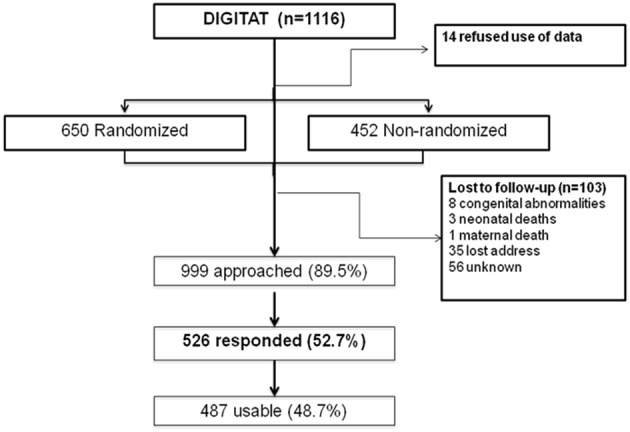
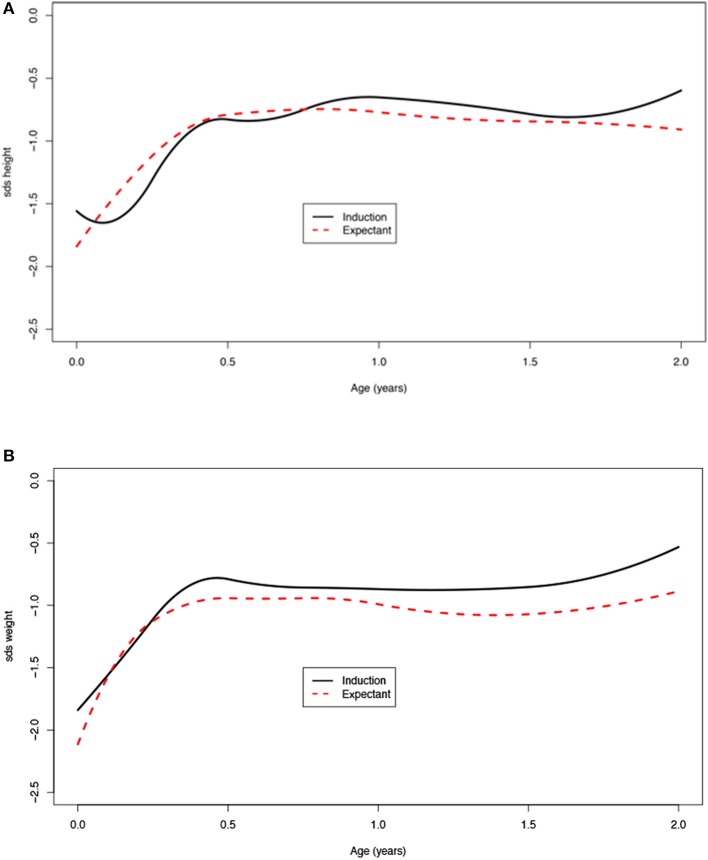
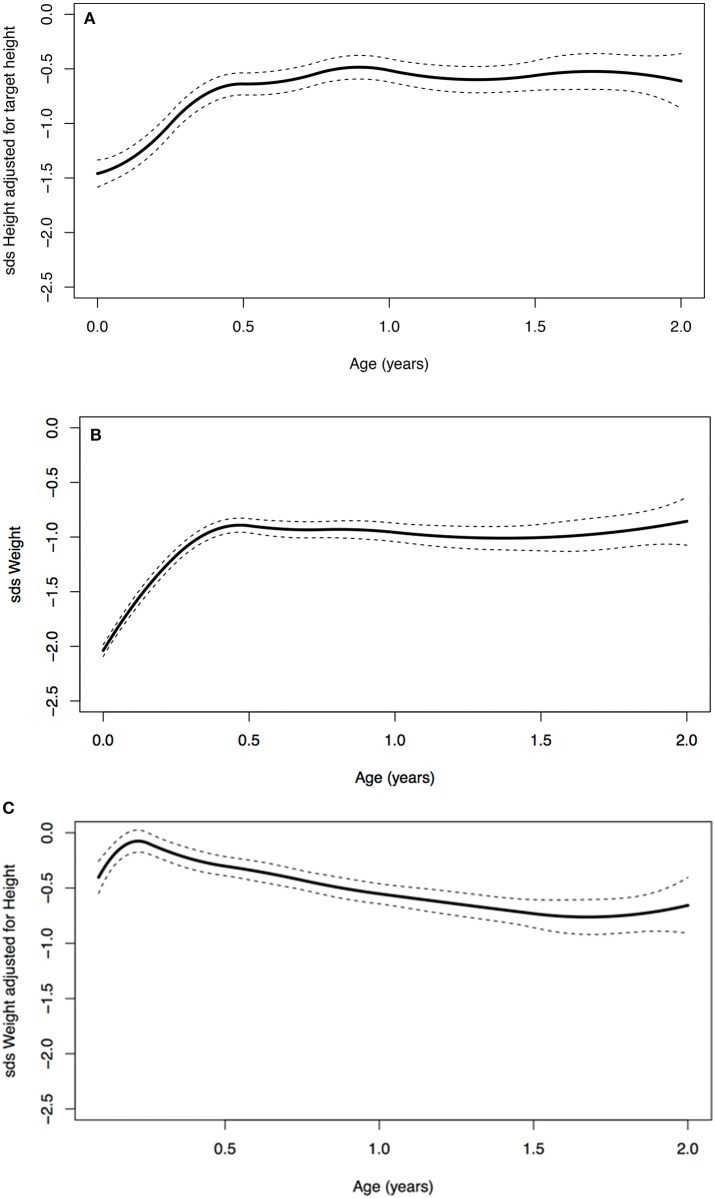
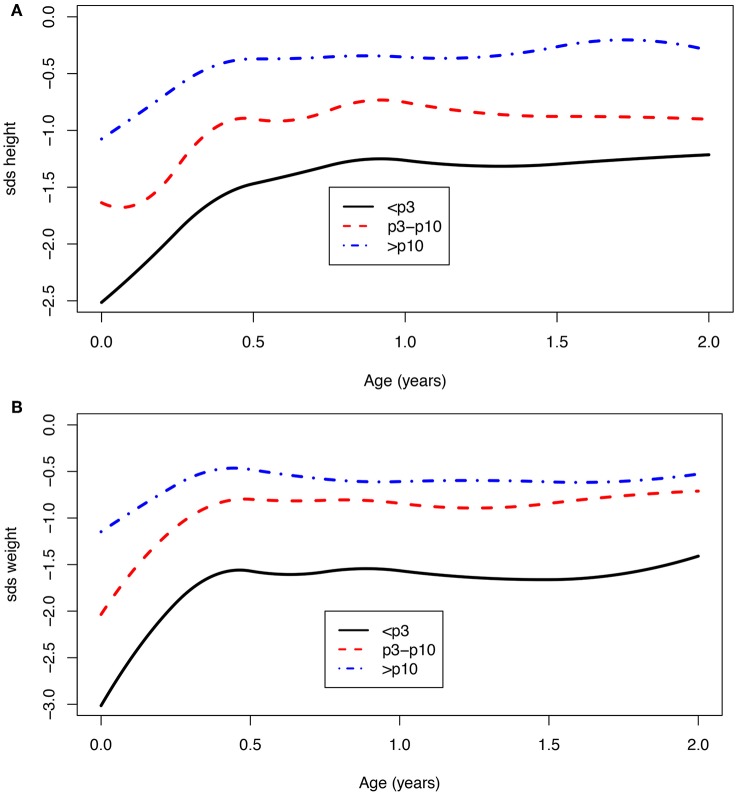
The aim of this study was to study growth patterns of children born after suspected fetal growth restriction (FGR) at term and to compare the effect of induction of labor (IoL) and expectant management (EM), also in relation to neurodevelopmental and behavioral outcome at age 2. We performed a 2 years' follow-up of growth of children included in the Disproportionate Intrauterine Growth Restriction Trial at Term (DIGITAT) study, a Randomized Controlled Trial (RCT) comparing IoL with EM in pregnancies with suspected FGR at term. We collected data on child growth until the age of 2 years. Standard deviation scores (SDSs) for height and weight were calculated at different ages. We assessed the effects of IoL compared with EM and the effects of a birth weight below or above the 3rd or 10th centile on catch-up growth. Target height SDSs were calculated using the height of both parents. We found a significant increase in SDS in the first 2 years. Children born after EM showed more catch-up growth in the first month [height: mean difference -0.7 (95% CI: 0.2; 1.3)] and weight [mean difference -0.5 (95% CI: 0.3; 0.7)]. Children born with a birth weight below the 3rd and 10th centiles showed more catch-up growth after 1 year [mean difference -0.8 SDS (95% CI: -1.1; -0.5)] and after 2 years [mean difference -0.7 SDS (95% CI: -1.2; -0.2)] as compared to children with a birth weight above the 3rd and 10th centiles. SDS at birth had the strongest effect on adverse neurodevelopmental outcome at 2 years of age. After FGR at term, postnatal catch-up growth is generally present and associated with the degree of FGR. Obstetric management in FGR influences postnatal growth. Longer-term follow-up is therefore needed and should be directed at growth and physical health. www.ClinicalTrials.gov, identifier SRCTN10363217.
本研究旨在探讨足月疑似胎儿生长受限(FGR)出生儿童的生长模式,并比较引产(IoL)和期待管理(EM)的效果,同时研究其与2岁时神经发育和行为结局的关系。我们对足月不成比例宫内生长受限试验(DIGITAT)研究中的儿童进行了为期2年的生长随访,该研究是一项随机对照试验(RCT),比较了足月疑似FGR妊娠中IoL与EM的效果。我们收集了儿童至2岁时的生长数据。计算了不同年龄时身高和体重的标准差分数(SDS)。我们评估了IoL与EM相比的效果,以及出生体重低于或高于第3或第10百分位数对追赶生长的影响。使用父母双方的身高计算目标身高SDS。我们发现前两年SDS显著增加。EM后出生的儿童在第一个月身高[平均差异-0.7(95%CI:0.2;-1.3)]和体重[平均差异-0.5(95%CI:0.3;0.7)]方面显示出更多的追赶生长。出生体重低于第3和第10百分位数的儿童在1年后[平均差异-0.8 SDS(95%CI:-1.1;-0.5)]和2年后[平均差异-0.7 SDS(95%CI:-1.2;-0.2)]比出生体重高于第3和第10百分位数的儿童显示出更多的追赶生长。出生时的SDS对2岁时不良神经发育结局的影响最强。足月FGR后,出生后追赶生长普遍存在且与FGR程度相关。FGR中的产科管理会影响出生后生长。因此需要进行长期随访,且应针对生长和身体健康。ClinicalTrials.gov,标识符SRCTN10363217。