Seibert Ryan G, Winter Michael R, Cabral Howard J, Wolf Michael S, Curtis Laura M, Paasche-Orlow Michael K
Health Lit Res Pract. 2019 Jan 18;3(1):e9-e18. doi: 10.3928/24748307-20181113-01. eCollection 2019 Jan.
Health literacy and socioeconomic status (SES) are associated with both race/ethnicity and asthma outcomes. The extent to which health literacy and SES mediate racial/ethnic asthma disparities is less clear.
To determine if health literacy and SES mediate racial/ethnic asthma disparities using advanced mediation analyses.
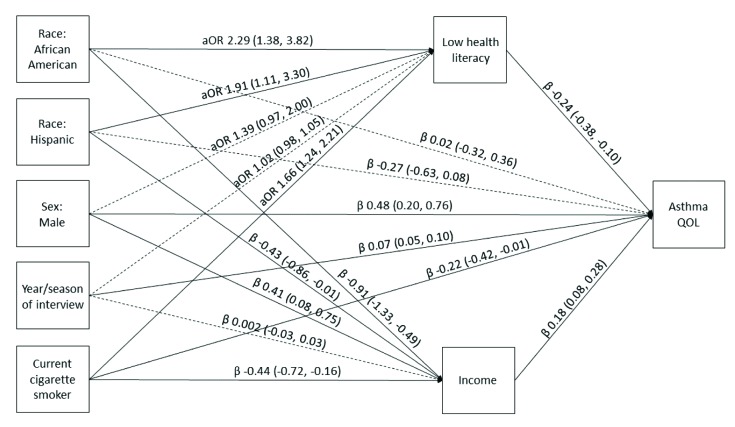
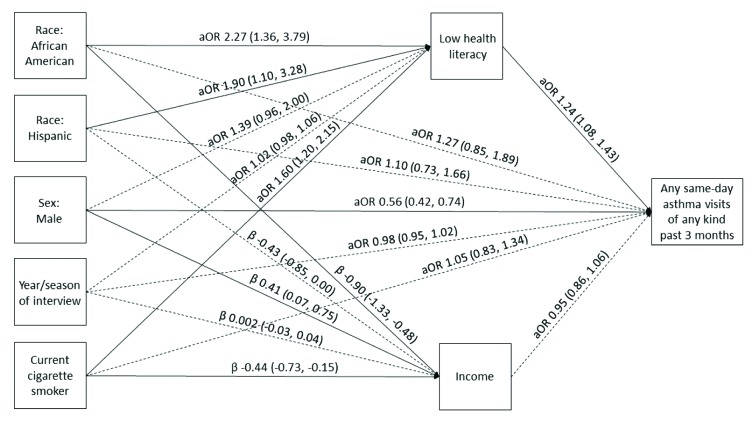
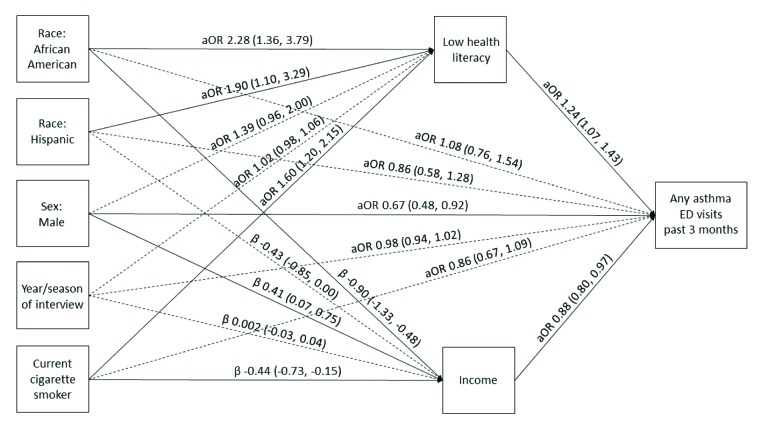
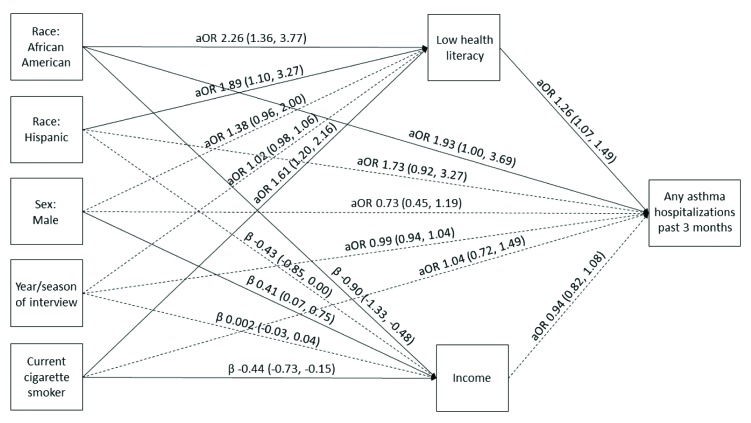
A secondary analysis was performed using a Chicago-based longitudinal cohort study conducted from 2004 to 2007 involving 342 adults age 18 to 41 years with persistent asthma. Phone interviews were conducted every 3 months assessing asthma quality of life (AQOL; scored 1-7, with 7 being the highest) and asthma-related health care use measures. Structural equation models assessed mediation of race/ethnicity effects on AQOL and health care use through health literacy and SES. Covariates in the best-fit model included sex, year and season of interview, and cigarette smoking.
The study sample was 77.8% female, 57.3% African American/non-Hispanic, and 28.7% Hispanic. Race/ethnicity was significantly associated with AQOL and asthma-related emergency department (ED) visits, but only indirectly, through the effects of health literacy and income. Compared with White/non-Hispanics, African American/non-Hispanics and Hispanics had significantly higher odds of low health literacy and lower income. Low health literacy was associated with significantly lower AQOL scores (β = -0.24, 95% confidence interval (CI) [-0.38, -0.10]) and higher odds of an ED visit (adjusted odds ratio = 1.24, 95% CI [1.07, 1.43]). Increasing income was associated with significantly higher AQOL scores (β = 0.18, 95% CI [0.08, 0.28]) and lower odds of an ED visit (adjusted odds ratio = 0.88, 95% CI [0.80, 0.97]).
The relationships between race/ethnicity and several asthma outcomes were mediated by health literacy and income. Interventions to improve racial/ethnic asthma disparities should target health literacy and income barriers. .
Using advanced statistical methods, this study suggests racial/ethnic differences in several asthma outcomes are largely due to effects of health literacy and income. Interventions to improve racial/ethnic asthma disparities should target health literacy and income barriers.
健康素养和社会经济地位(SES)与种族/民族及哮喘结局均相关。健康素养和SES在种族/民族哮喘差异中所起的中介作用程度尚不清楚。
使用先进的中介分析方法确定健康素养和SES是否介导种族/民族哮喘差异。
对一项基于芝加哥的纵向队列研究进行二次分析,该研究于2004年至2007年开展,纳入342名年龄在18至41岁之间的持续性哮喘成年患者。每3个月进行一次电话访谈,评估哮喘生活质量(AQOL;评分1 - 7,7分为最高分)和哮喘相关医疗保健使用情况。结构方程模型评估种族/民族对AQOL和医疗保健使用的影响通过健康素养和SES的中介作用。最佳拟合模型中的协变量包括性别、访谈年份和季节以及吸烟情况。
研究样本中77.8%为女性,57.3%为非西班牙裔非洲裔美国人,28.7%为西班牙裔。种族/民族与AQOL及哮喘相关的急诊科就诊显著相关,但仅通过健康素养和收入的影响间接相关。与非西班牙裔白人相比,非西班牙裔非洲裔美国人和西班牙裔健康素养低及收入低的几率显著更高。健康素养低与AQOL得分显著更低(β = -0.24,95%置信区间(CI)[-0.38, -0.10])及急诊科就诊几率更高(调整优势比 = 1.24,95% CI [1.07, 1.43])相关。收入增加与AQOL得分显著更高(β = 0.18,95% CI [0.08, 0.28])及急诊科就诊几率更低(调整优势比 = 0.88,95% CI [0.80, 0.97])相关。
种族/民族与多种哮喘结局之间的关系由健康素养和收入介导。改善种族/民族哮喘差异的干预措施应针对健康素养和收入障碍。
使用先进的统计方法,本研究表明多种哮喘结局中的种族/民族差异很大程度上归因于健康素养和收入的影响。改善种族/民族哮喘差异的干预措施应针对健康素养和收入障碍。