College of Agriculture, Arkansas State University, Jonesboro, Arkansas, United States of America.
Cooperative Extension Service, University of Arkansas System Division of Agriculture, Little Rock, Arkansas, United States of America.
PLoS One. 2019 Jul 11;14(7):e0219199. doi: 10.1371/journal.pone.0219199. eCollection 2019.
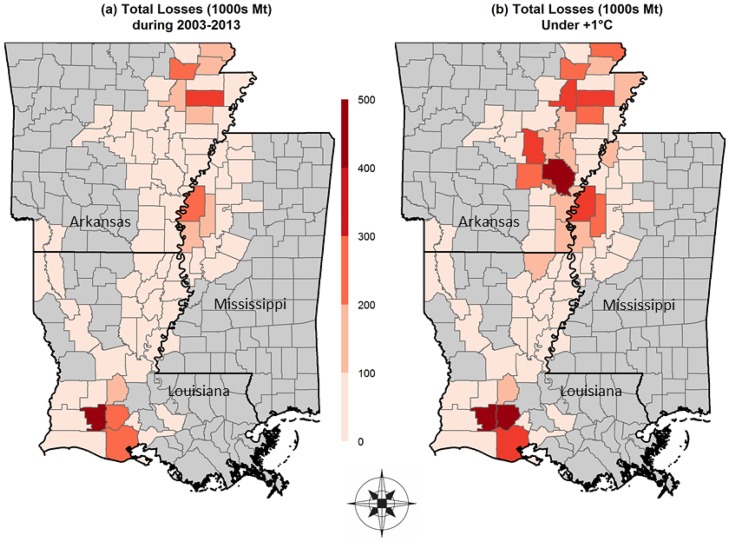
Bacterial Panicle Blight (BPB), caused by Burkholderia glumae, is a bacterial disease in rice (Oryza sativa) that reduces rice yield and quality for producers and consequently creates higher market prices for consumers. BPB is caused by the simultaneous occurrence of high daily minimum temperatures (22°C) and relative humidity (77%), which may increase under the current scenario of global warming. This study hypothesized that the economic damage from warming may cause an increase in economic losses, though at a decreasing rate per degree. Thus, this study estimates the yield losses associated with BPB occurrences at the county level in the Mid-South United States (US) for annual rice production in 2003-2013 and under +1-3°C warming scenarios using daily weather information with appropriate thresholds. From the estimated losses, the total production potential of a BPB-resistant rice was quantified using a spatial equilibrium trade model to further estimate market welfare changes with the counterfactual scenario that all US county-level rice production were BPB resistant. Results from the study indicate that the alleviation of BPB would represent a $69 million USD increase in consumer surplus in the US and a concomitant increase in rice production that would feed an additional 1.46 million people annually assuming a global average consumption of 54 Kg per person. Under the 1°C warming scenario, BPB occurrences and production losses would cause price increases for rice and subsequently result in a $112 million USD annual decrease in consumer surplus in the US and a loss of production equivalent to feeding 2.17 million people. Under a 3°C warming scenario, production losses due to BPB cause an annual reduction of $204 million USD in consumer surplus in the US, and a loss in production sufficient to feed 3.98 million people a year. As global warming intensifies, BPB could become a more common and formidable rice disease to combat, and breeding for BPB resistance would be the primary line-of-defense as currently no effective chemical options are available. The results of this study inform agriculturalists, policymakers, and economists about the value of BPB-resistance in the international rice market and also help support efforts to focus future breeding toward climate change impact resilience.
细菌性穗枯病(BPB)由恶臭假单胞菌引起,是一种水稻细菌性疾病,会降低生产者的水稻产量和质量,从而导致消费者支付更高的市场价格。BPB 是由每日最低温度(22°C)和相对湿度(77%)同时升高引起的,而在全球变暖的当前情况下,这种情况可能会增加。本研究假设,由于变暖导致的经济损失可能会导致经济损失增加,尽管每度损失的速率会降低。因此,本研究使用适当阈值的每日天气信息,在美国中南部各县(美国)对 2003-2013 年的年度水稻生产进行了细菌性穗枯病发生相关的产量损失估计,并在+1-3°C 的变暖情景下进行了估计。从估计的损失中,使用空间均衡贸易模型量化了一种抗细菌性穗枯病的水稻的总生产潜力,以进一步估计在所有美国县一级的水稻生产都具有抗细菌性穗枯病的反事实情景下的市场福利变化。研究结果表明,缓解细菌性穗枯病将代表美国消费者剩余增加 6900 万美元,并且假设全球平均每人消耗 54 公斤,则每年将增加额外的 146 万人的水稻产量。在 1°C 的变暖情景下,细菌性穗枯病的发生和产量损失将导致大米价格上涨,从而导致美国每年消费者剩余减少 1.12 亿美元,产量损失相当于每年养活 217 万人。在 3°C 的变暖情景下,由于细菌性穗枯病导致的产量损失,美国每年的消费者剩余减少 2.04 亿美元,产量损失足以每年养活 398 万人。随着全球变暖的加剧,细菌性穗枯病可能成为一种更常见和更具威胁性的水稻疾病,而培育对细菌性穗枯病的抗性将是主要的防御手段,因为目前没有有效的化学防治方法。本研究的结果使农业学家、政策制定者和经济学家了解了国际水稻市场中抗细菌性穗枯病的价值,也有助于支持未来将培育重点转向应对气候变化影响的韧性。