Ansari Mohd Nazam, Ganaie Majid A, Rehman Najeeb Ur, Alharthy Khalid M, Khan Tajdar H, Imam Faisal, Ansari Mushtaq A, Al-Harbi Naif O, Jan Basit L, Sheikh Ishfaq A, Hamad Abubaker M
Department of Pharmacology, College of Pharmacy, Prince Sattam Bin Abdulaziz University, Al-Kharj, Saudi Arabia.
Department of Pharmacology and Toxicology, College of Pharmacy, King Saud University, Riyadh, Saudi Arabia.
Saudi Pharm J. 2019 Jul;27(5):673-681. doi: 10.1016/j.jsps.2019.04.002. Epub 2019 Apr 2.
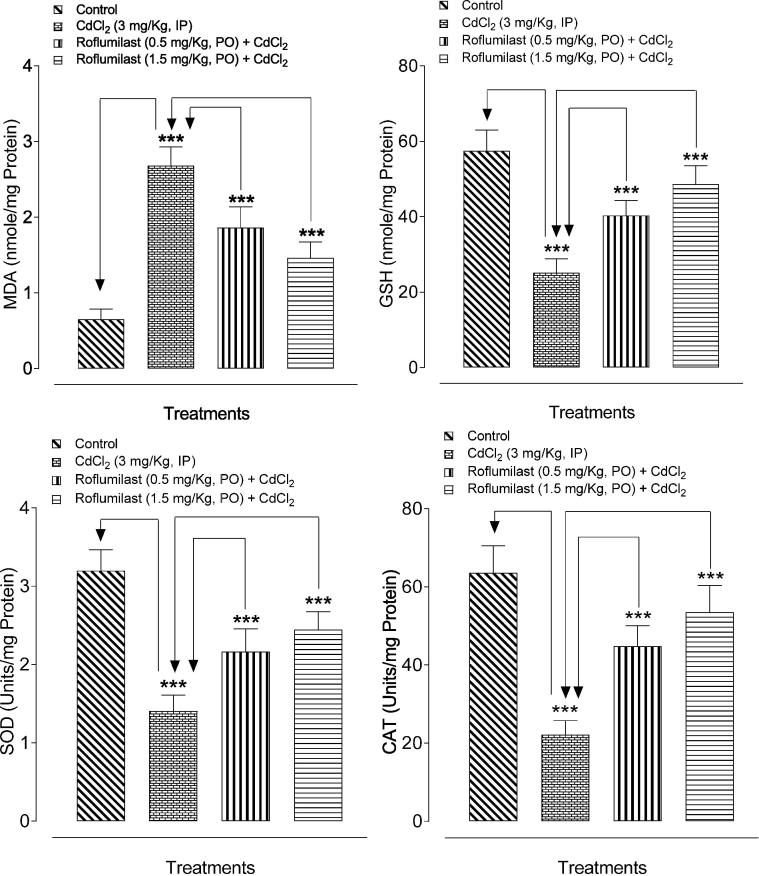
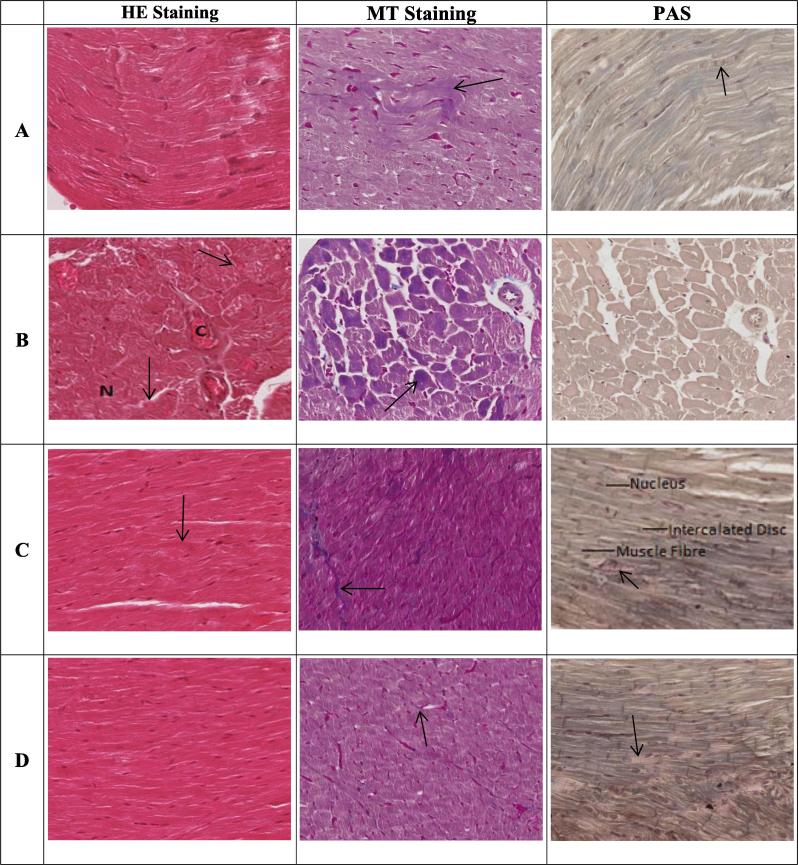
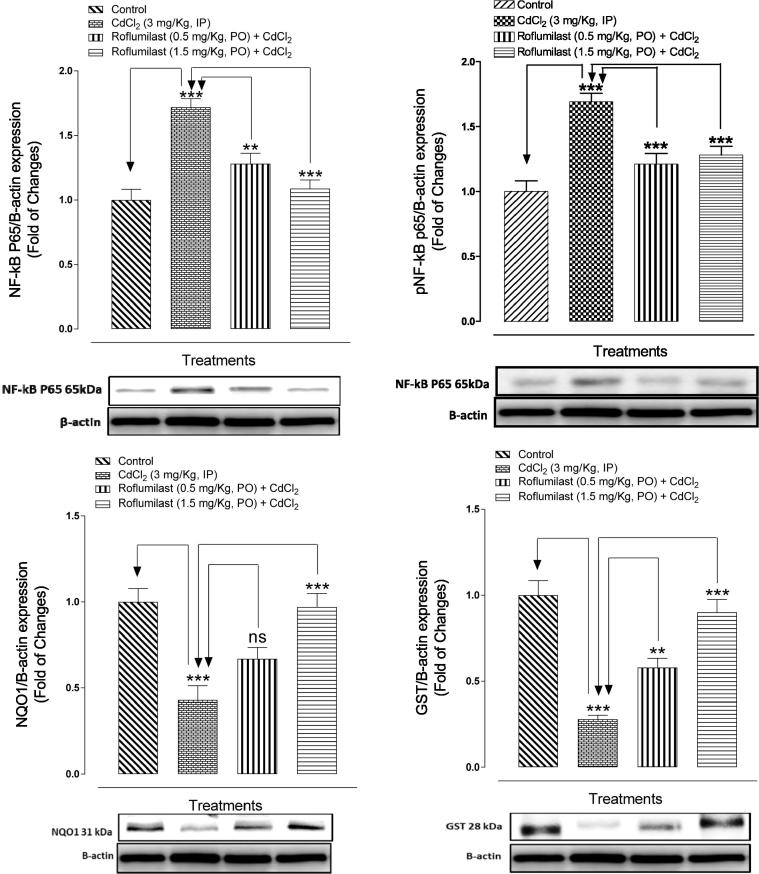
Cadmium (Cd), a potent cardiotoxic environmental heavy metal, induces oxidative stress and membrane disturbances in cardiac myocytes. Phosphodiesterase (PDEs) retards the positive inotropic effects of β-adrenoceptor activation by decreasing levels of cAMP via degradation. Hence, PDE inhibitors sensitize the heart to catecholamine and are therefore, used as positive inotropic agents. The present study was designed to probe the potential attenuating effects of the selective PDE4 inhibitor (Roflumilast, ROF), on cardiac biomarkers, lipid profile, lipid peroxidation products, antioxidant status and histology of cardiac tissues against Cd-induced cardiotoxicity in rats. Rats were randomly distributed into four different groups: group 1, served as the normal control group. Group 2, served as the toxic control group and were administered Cd (3 mg/kg, i.p.) for next 7 days. Groups 3 and 4, served as treatment groups that received Cd with concomitant oral administration of ROF doses (0.5 and 1.5 mg/kg), respectively for 7 days. Serum samples of toxic control group rats resulted in significant ( < 0.001) increase in lactate dehydrogenase (LDH), creatine phosphokinase (CPK), total cholesterol (TC), triglycerides (TG) and low density lipoproteins (LDL) levels with concomitant decrease in high density lipoproteins (HDL) levels in serum which were found reversed with both of ROF treatment groups. Cd also causes significant increased ( < 0.001) in myocardial malondialdehyde (MDA) contents while cardiac glutathione (GSH) level, superoxide dismutase (SOD) and catalase (CAT) enzyme activities were found decreased whereas both doses of ROF, significantly reversed these oxidative stress markers and antioxidant enzymes. Cardiotoxicity induced by Cd also resulted in enhanced expression of non-phosphorylated and phosphorylated form of NF-κB p65 and decreased expression of glutathione-S-transferase (GST) and NQO1 which were found reversed with ROF treatments, comparable to normal control group. Histopathological changes were also improved by ROF administration as compared to Cd treated rats alone. In conclusion, Roflumilast exhibited attenuating effect against Cd-induced cardiac toxicity.
镉(Cd)是一种具有心脏毒性的环境重金属,可诱导心肌细胞产生氧化应激和膜紊乱。磷酸二酯酶(PDEs)通过降解降低环磷酸腺苷(cAMP)水平,从而延缓β - 肾上腺素能受体激活的正性肌力作用。因此,PDE抑制剂可使心脏对儿茶酚胺敏感,故而用作正性肌力药物。本研究旨在探究选择性PDE4抑制剂(罗氟司特,ROF)对大鼠镉诱导的心脏毒性在心脏生物标志物、血脂谱、脂质过氧化产物、抗氧化状态及心脏组织病理学方面的潜在减轻作用。大鼠被随机分为四组:第1组为正常对照组。第2组为毒性对照组,连续7天腹腔注射Cd(3 mg/kg)。第3组和第4组为治疗组,分别在连续7天腹腔注射Cd的同时口服ROF剂量(0.5和1.5 mg/kg)。毒性对照组大鼠血清样本中乳酸脱氢酶(LDH)、肌酸磷酸激酶(CPK)、总胆固醇(TC)、甘油三酯(TG)和低密度脂蛋白(LDL)水平显著升高(<0.001),同时血清高密度脂蛋白(HDL)水平降低,而这两种情况在两个ROF治疗组中均得到逆转。Cd还导致心肌丙二醛(MDA)含量显著增加(<0.001),而心脏谷胱甘肽(GSH)水平、超氧化物歧化酶(SOD)和过氧化氢酶(CAT)活性降低,而两种剂量的ROF均显著逆转了这些氧化应激标志物和抗氧化酶。Cd诱导的心脏毒性还导致非磷酸化和磷酸化形式的核因子κB p65(NF - κB p65)表达增强,谷胱甘肽 - S - 转移酶(GST)和醌氧化还原酶1(NQO1)表达降低,而ROF治疗可使其逆转,与正常对照组相当。与单独接受Cd治疗的大鼠相比,ROF给药也改善了组织病理学变化。总之,罗氟司特对Cd诱导的心脏毒性具有减轻作用。