Koch Evan M, Schweizer Rena M, Schweizer Teia M, Stahler Daniel R, Smith Douglas W, Wayne Robert K, Novembre John
Department of Ecology and Evolution, University of Chicago, Chicago, IL.
Division of Biological Sciences, University of Montana, Missoula, MT.
Mol Biol Evol. 2019 Nov 1;36(11):2536-2547. doi: 10.1093/molbev/msz159.
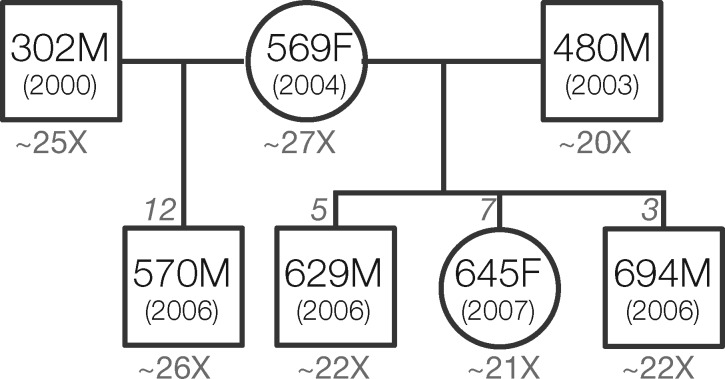
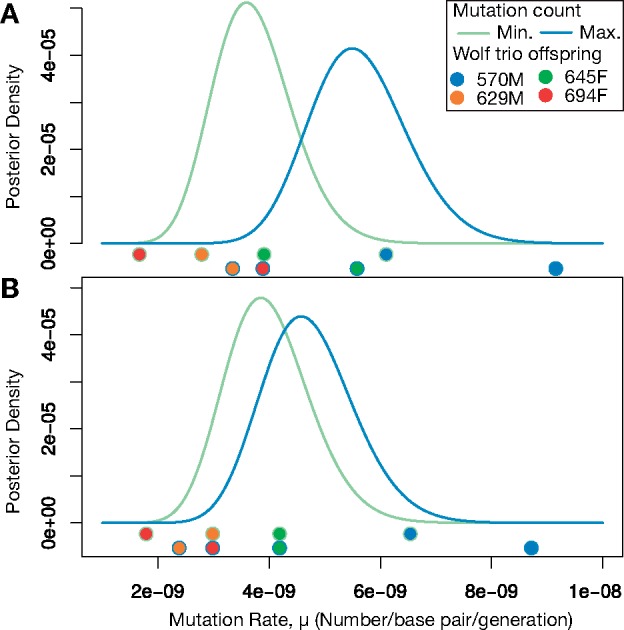
Knowledge of mutation rates is crucial for calibrating population genetics models of demographic history in units of years. However, mutation rates remain challenging to estimate because of the need to identify extremely rare events. We estimated the nuclear mutation rate in wolves by identifying de novo mutations in a pedigree of seven wolves. Putative de novo mutations were discovered by whole-genome sequencing and were verified by Sanger sequencing of parents and offspring. Using stringent filters and an estimate of the false negative rate in the remaining observable genome, we obtain an estimate of ∼4.5 × 10⁻⁹ per base pair per generation and provide conservative bounds between 2.6 × 10⁻⁹ and 7.1 × 10⁻⁹. Although our estimate is consistent with recent mutation rate estimates from ancient DNA (4.0 × 10⁻⁹ and 3.0-4.5 × 10⁻⁹), it suggests a wider possible range. We also examined the consequences of our rate and the accompanying interval for dating several critical events in canid demographic history. For example, applying our full range of rates to coalescent models of dog and wolf demographic history implies a wide set of possible divergence times between the ancestral populations of dogs and extant Eurasian wolves (16,000-64,000 years ago) although our point estimate indicates a date between 25,000 and 33,000 years ago. Aside from one study in mice, ours provides the only direct mammalian mutation rate outside of primates and is likely to be vital to future investigations of mutation rate evolution.
突变率的知识对于以年为单位校准人口统计学历史的群体遗传学模型至关重要。然而,由于需要识别极其罕见的事件,突变率的估计仍然具有挑战性。我们通过在一个由七只狼组成的谱系中识别新生突变来估计狼的核突变率。通过全基因组测序发现了推定的新生突变,并通过对父母和后代的桑格测序进行了验证。使用严格的筛选标准和对剩余可观察基因组中假阴性率的估计,我们得出每代每碱基对约4.5×10⁻⁹的估计值,并给出了2.6×10⁻⁹至7.1×10⁻⁹的保守范围。尽管我们的估计与最近古代DNA的突变率估计值(4.0×10⁻⁹和3.0 - 4.5×10⁻⁹)一致,但它表明了一个更宽的可能范围。我们还研究了我们的突变率以及相关区间对犬科动物人口统计学历史中几个关键事件进行年代测定的影响。例如,将我们的全部突变率应用于狗和狼的人口统计学历史的溯祖模型,意味着狗的祖先种群与现存欧亚狼之间有一系列广泛的可能分歧时间(16,000 - 64,000年前),尽管我们的点估计表明是在25,000至33,000年前之间。除了一项对小鼠的研究外,我们的研究提供了灵长类动物之外唯一直接的哺乳动物突变率估计,并且可能对未来突变率进化的研究至关重要。