Department of Medicine, Mayo Clinic, Rochester, MN, USA.
Division of Infectious Diseases, Department of Medicine, Mayo Clinic, Rochester, MN, USA.
Infection. 2019 Dec;47(6):1047-1053. doi: 10.1007/s15010-019-01339-w. Epub 2019 Jul 11.
The most recent version of the Infectious Diseases Society of America guidelines for the treatment of methicillin-resistant Staphylococcus aureus infections states that a single set of negative blood cultures is sufficient to demonstrate clearance of bacteremia. However, S. aureus might exhibit fluctuating blood culture positivity, labeled as "the skip phenomenon". Our objectives were to determine the prevalence of the skip phenomenon in a cohort of hospitalized patients with S. aureus bacteremia and to determine the associated clinical variables.
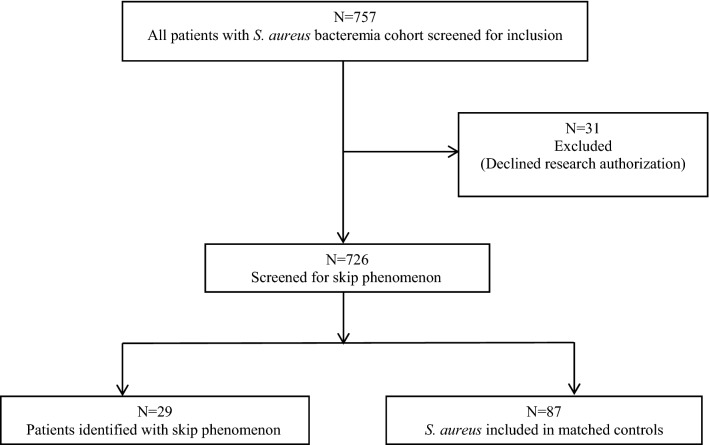
We conducted a nested case-control study, using a previous cohort of 757 adult inpatients between July 2006 and June 2011 with ≥ 3 days of S. aureus bacteremia. Each case of S. aureus bacteremia with the skip phenomenon was matched to 2 to 4 controls based on age, gender, and duration of bacteremia. The association of clinical characteristics with the skip phenomenon was analyzed via conditional logistic regression.
Of the 757 patients in the cohort, 29 (4%) had the skip phenomenon. 26 (90%) patients in the cases group were male. The median age was 69.4 years (interquartile range [IQR] 58.7 to 80.3). Although an attempt to match for the duration of bacteremia was done, there was a statistically longer duration in patients with cases as compared to that in controls (median [IQR], 10 [7-12] days, vs 8 [6-10] days; P = 0.015). Accordingly, duration of bacteremia was adjusted for in regression models. Notably, 26 (90%) patients in the case group were receiving chronic immunosuppressive therapy, as compared to 69 (79%) patients in the control group (P = 0.427).
Our findings prompt consideration of a practice chance to obtain serial negative blood cultures to ensure clearance of bacteremia among patients with S. aureus bacteremia.
美国传染病学会最新版耐甲氧西林金黄色葡萄球菌感染治疗指南指出,只需进行一次血培养阴性即可证明菌血症清除。然而,金黄色葡萄球菌可能会出现血培养阳性波动,即“跳过现象”。我们的目的是确定金黄色葡萄球菌菌血症住院患者中“跳过现象”的流行率,并确定相关的临床变量。
我们进行了一项嵌套病例对照研究,使用了 2006 年 7 月至 2011 年 6 月期间的 757 例住院成年患者的队列,这些患者的金黄色葡萄球菌菌血症持续时间≥3 天。每个“跳过现象”的金黄色葡萄球菌菌血症病例都根据年龄、性别和菌血症持续时间与 2 到 4 个对照进行匹配。通过条件逻辑回归分析临床特征与“跳过现象”的相关性。
在该队列的 757 例患者中,有 29 例(4%)出现了“跳过现象”。病例组中 26 例(90%)患者为男性。中位年龄为 69.4 岁(四分位距[IQR],58.7 至 80.3)。尽管尝试对菌血症持续时间进行匹配,但病例组的菌血症持续时间明显长于对照组(中位数[IQR],10[7-12]天,vs 8[6-10]天;P=0.015)。因此,在回归模型中调整了菌血症持续时间。值得注意的是,与对照组的 69 例(79%)相比,病例组中有 26 例(90%)患者正在接受慢性免疫抑制治疗(P=0.427)。
我们的研究结果提示,金黄色葡萄球菌菌血症患者需要进行连续的阴性血培养以确保菌血症清除。