Graduate Institute of Neural Regenerative Medicine, College of Medical Science and Technology, Taipei Medical University, Taipei, Taiwan.
Ph.D. Program for Neural Regenerative Medicine, College of Medical Science and Technology, Taipei Medical University and National Health Research Institutes, Taipei, Taiwan.
J Neuroinflammation. 2019 Jul 12;16(1):146. doi: 10.1186/s12974-019-1535-z.
The small population of glioma stem-like cells (GSCs) contributes to tumor initiation, malignancy, and recurrence in glioblastoma. However, the maintenance of GSC properties in the tumor microenvironment remains unclear. In glioma, non-neoplastic cells create an inflammatory environment and subsequently mediate tumor progression and maintenance. Transcriptional factor CCAAT/enhancer-binding protein delta (CEBPD) is suggested to regulate various genes responsive to inflammatory cytokines, thus prompting us to investigate its role in regulating GSCs stemness after inflammatory stimulation.
Stemness properties were analyzed by using spheroid formation. Oncomine and TCGA bioinformatic databases were used to analyze gene expression. Western blotting, quantitative real-time polymerase chain reaction, luciferase reporter assay, and chromatin immunoprecipitation assay were used to analyze proteins and gene transcript levels. The glioma tissue microarrays were used for CEBPD and PDGFA expression by immunohistochemistry staining.
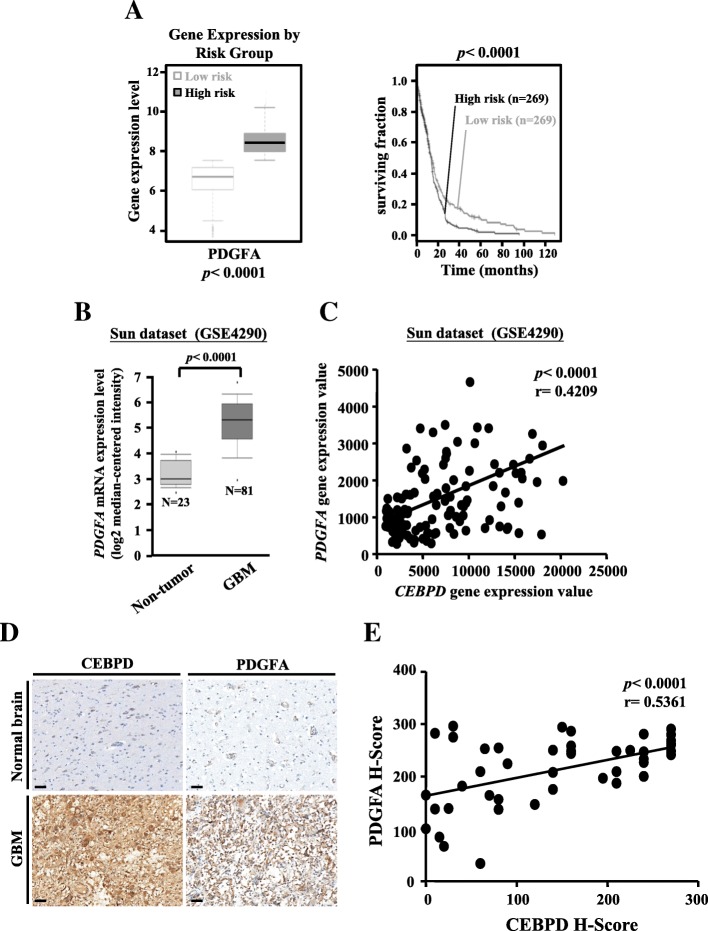
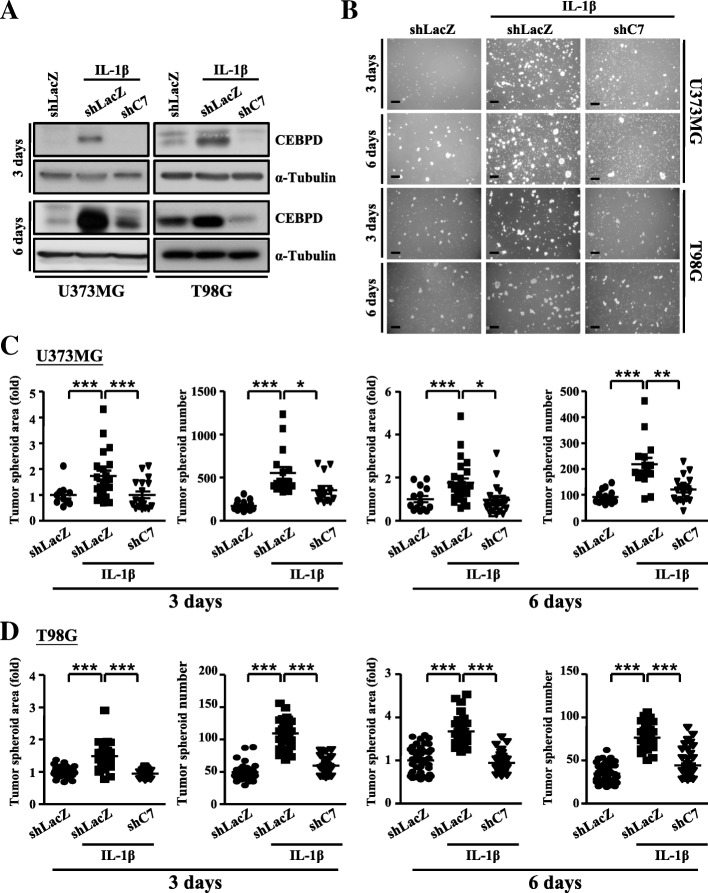
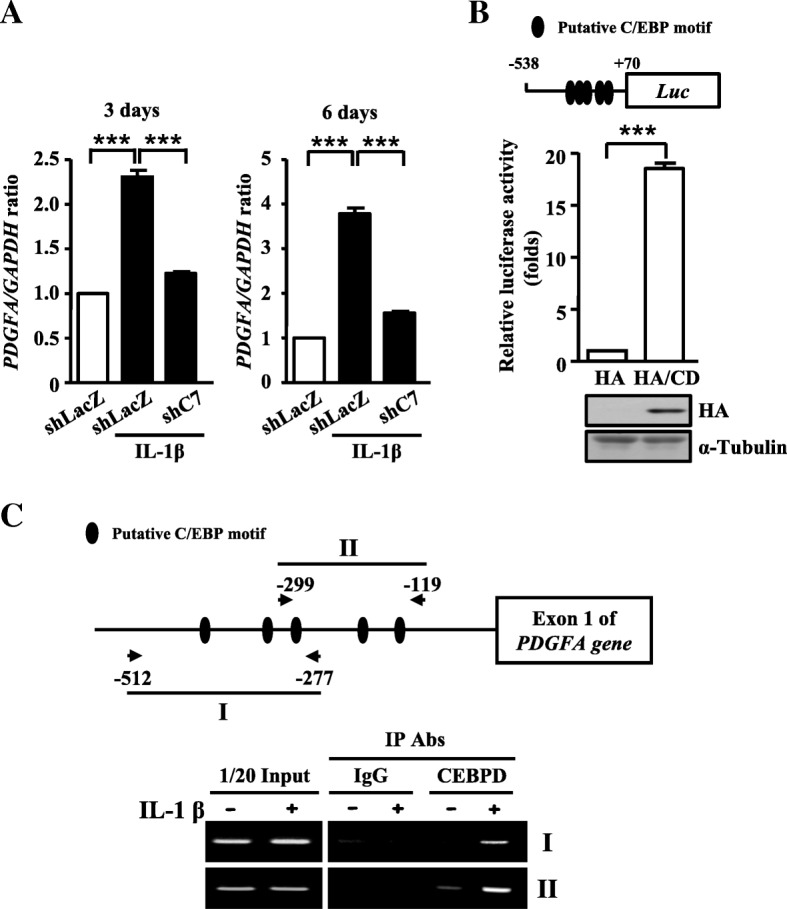
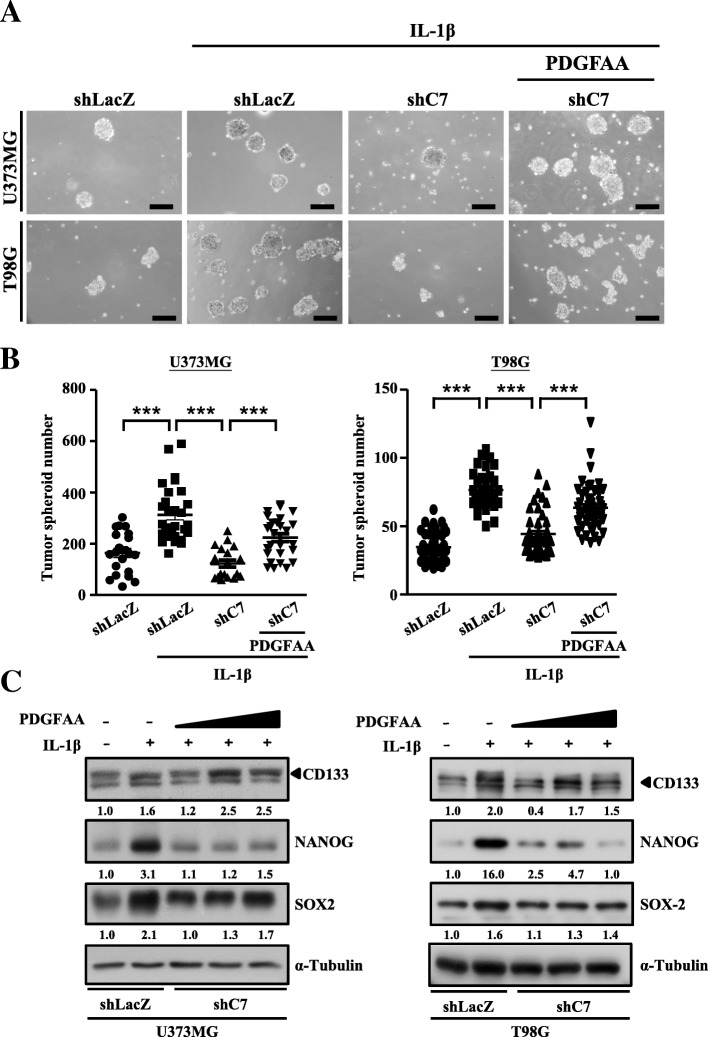
We first found that IL-1β promotes glioma spheroid formation and is associated with elevated CEBPD expression. Using microarray analysis, platelet-derived growth factor subunit A (PDGFA) was confirmed as a CEBPD-regulated gene that mediates IL-1β-enhanced GSCs self-renewal. Further analysis of the genomic database and tissue array revealed that the expression levels between CEBPD and PDGFA were coincident in glioma patient samples.
This is the first report showing the activation of PDGFA expression by CEBPD through IL-1β treatment and a novel CEBPD function in maintaining the self-renewal feature of GSCs.
少部分神经胶质瘤干细胞(GSCs)有助于神经胶质瘤的起始、恶性肿瘤形成和复发。然而,GSCs 特性在肿瘤微环境中的维持尚不清楚。在神经胶质瘤中,非肿瘤细胞会产生炎症环境,进而介导肿瘤的进展和维持。CCAAT/增强子结合蛋白δ(CEBPD)转录因子被认为可调节对炎性细胞因子有反应的各种基因,这促使我们研究其在炎性刺激后调节 GSCs 干性的作用。
通过球体形成分析来分析干性特征。Oncomine 和 TCGA 生物信息学数据库用于分析基因表达。Western blot、定量实时聚合酶链反应、荧光素酶报告基因检测和染色质免疫沉淀检测用于分析蛋白和基因转录水平。使用免疫组织化学染色分析胶质瘤组织微阵列中 CEBPD 和 PDGFA 的表达。
我们首先发现 IL-1β 促进神经胶质瘤球体形成,并与 CEBPD 表达升高相关。通过微阵列分析,血小板衍生生长因子亚单位 A(PDGFA)被确认为 CEBPD 调节的基因,介导 IL-1β 增强 GSCs 自我更新。对基因组数据库和组织阵列的进一步分析表明,CEBPD 和 PDGFA 的表达水平在神经胶质瘤患者样本中一致。
这是首次报道 CEBPD 通过 IL-1β 处理激活 PDGFA 表达,并发现 CEBPD 在维持 GSCs 自我更新特征方面的新功能。