Center for Gerontology and Healthcare Research, Brown University School of Public Health, Providence, Rhode Island.
Department of Health Services, Policy, and Practice, Brown University School of Public Health, Providence, Rhode Island.
J Am Geriatr Soc. 2019 Oct;67(10):2134-2138. doi: 10.1111/jgs.16069. Epub 2019 Jul 13.
BACKGROUND/OBJECTIVES: Most people with Alzheimer disease and related dementias will experience agitated and/or aggressive behaviors during the later stages of the disease. These behaviors cause significant stress for people living with dementia and their caregivers, including nursing home (NH) staff. Addressing these behaviors without the use of chemical restraints is a growing focus of policy makers and professional organizations. Unfortunately, evidence for nonpharmacological strategies for addressing dementia-related behaviors is lacking.
Six-month, preintervention-postintervention pilot study.
US NHs (n = 4).
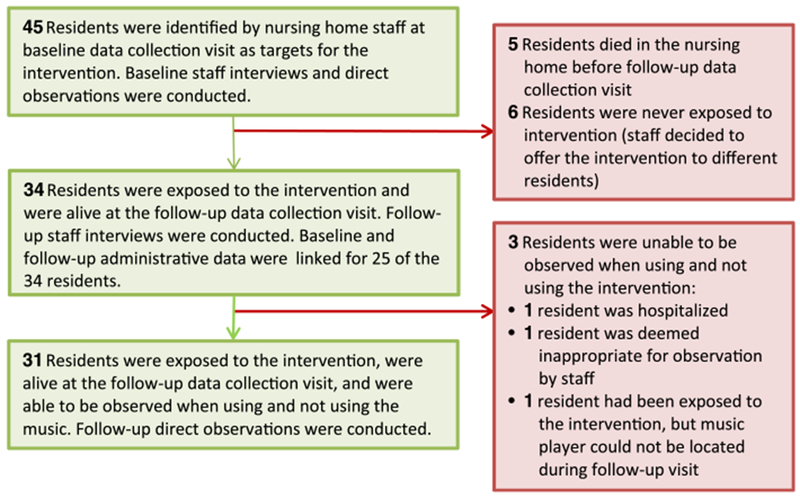
Residents with advanced dementia (n = 45).
Music & Memory, an individualized music program in which the music a resident preferred when she/he was young is delivered at early signs of agitation, using a personal music player.
Dementia-related behaviors for the same residents were measured three ways: (1) observationally using the Agitation Behavior Mapping Instrument (ABMI); (2) staff report using the Cohen-Mansfield Agitation Inventory (CMAI); and (3) administratively using the Minimum Data Set-Aggressive Behavior Scale (MDS-ABS).
ABMI score was 4.1 (SD = 3.0) preintervention while not listening to the music, 4.4 (SD = 2.3) postintervention while not listening to the music, and 1.6 (SD = 1.5) postintervention while listening to music (P < .01). CMAI score was 61.2 (SD = 16.3) preintervention and 51.2 (SD = 16.1) postintervention (P < .01). MDS-ABS score was 0.8 (SD = 1.6) preintervention and 0.7 (SD = 1.4) postintervention (P = .59).
Direct observations were most likely to capture behavioral responses, followed by staff interviews. Nursing-home based, pragmatic trials that rely solely on available administrative data may fail to detect effects of nonpharmaceutical interventions on behaviors. Findings are relevant to evaluations of nonpharmaceutical strategies for addressing behaviors in NHs, and will inform a large, National Institute on Aging-funded pragmatic trial beginning spring 2019. J Am Geriatr Soc 67:2134-2138, 2019.
背景/目的:大多数患有阿尔茨海默病和相关痴呆症的人在疾病后期会出现激越和/或攻击性行为。这些行为给痴呆症患者及其护理人员,包括养老院(NH)工作人员带来了巨大压力。在不使用化学约束的情况下解决这些行为是政策制定者和专业组织日益关注的焦点。不幸的是,缺乏针对与痴呆相关行为的非药物策略的证据。
为期 6 个月的干预前-干预后试点研究。
美国 NH(n = 4)。
患有晚期痴呆症的居民(n = 45)。
音乐与记忆,这是一种个性化音乐计划,当居民出现激越的早期迹象时,使用个人音乐播放器播放他们年轻时喜欢的音乐。
对同一居民的痴呆相关行为进行了三种方式的测量:(1)使用激越行为映射工具(ABMI)进行观察;(2)使用科恩-曼斯菲尔德激越量表(CMAI)进行员工报告;(3)使用最低数据集-攻击性行为量表(MDS-ABS)进行行政评估。
ABMI 评分在未听音乐时为 4.1(SD = 3.0),在未听音乐时为 4.4(SD = 2.3),在听音乐时为 1.6(SD = 1.5)(P <.01)。CMAI 评分在未听音乐时为 61.2(SD = 16.3),在听音乐时为 51.2(SD = 16.1)(P <.01)。MDS-ABS 评分在未听音乐时为 0.8(SD = 1.6),在听音乐时为 0.7(SD = 1.4)(P =.59)。
直接观察最有可能捕捉到行为反应,其次是员工访谈。完全依赖现有行政数据的基于 NH 的实用试验可能无法检测出非药物干预对行为的影响。研究结果与 NH 中针对行为的非药物策略评估相关,并将为 2019 年春季开始的一项由美国国家老龄化研究所资助的大型实用试验提供信息。美国老年学会杂志 67:2134-2138,2019。