Wada Kenshiro, Bunya Naofumi, Kakizaki Ryuichiro, Kasai Takehiko, Uemura Shuji, Harada Keisuke, Narimatsu Eichi
Department of Emergency Medicine Sapporo Medical University Hokkaido Japan.
Emergency Department Hakodate Municipal Hospital Hokkaido Japan.
Acute Med Surg. 2019 Mar 21;6(3):301-304. doi: 10.1002/ams2.407. eCollection 2019 Jul.
Indications for using veno-arterial extracorporeal membrane oxygenation (V-A ECMO) in sepsis cases remain unclear.
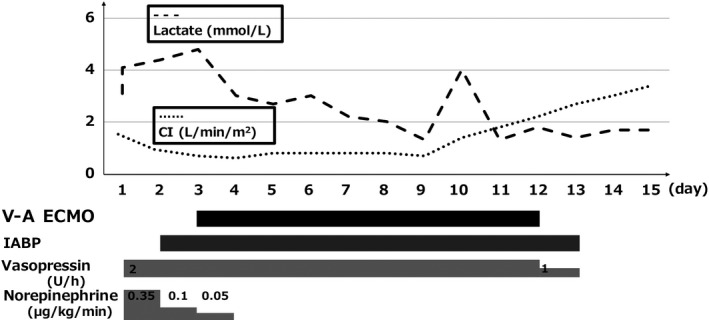
A 66-year-old man with pre-existing chronic heart failure developed severe pneumonia resulting in refractory septic shock. He was diagnosed with septic cardiomyopathy based on depressed left ventricular ejection fraction and a dilated left ventricle based on a transthoracic echocardiogram. We initiated V-A ECMO on day 3 because the shock did not respond to conventional therapy. The patient's hemodynamics improved, and his infection was reduced. He recovered fully and was discharged on day 107 with his cardiac function restored to its baseline.
Septic cardiomyopathy is a form of reversible myocardial dysfunction. Veno-arterial extracorporeal membrane oxygenation should be considered for septic cardiomyopathy with intractable circulatory failure. Pre-existing chronic heart failure is not a contraindication for VA-ECMO.
在脓毒症病例中使用静脉-动脉体外膜肺氧合(V-A ECMO)的指征仍不明确。
一名66岁患有慢性心力衰竭的男性发生严重肺炎,导致难治性感染性休克。根据经胸超声心动图显示的左心室射血分数降低和左心室扩张,他被诊断为感染性心肌病。由于休克对传统治疗无反应,我们在第3天启动了V-A ECMO。患者的血流动力学得到改善,感染减轻。他完全康复,于第107天出院,心脏功能恢复到基线水平。
感染性心肌病是一种可逆性心肌功能障碍的形式。对于伴有顽固性循环衰竭的感染性心肌病,应考虑使用静脉-动脉体外膜肺氧合。既往存在的慢性心力衰竭不是VA-ECMO的禁忌证。