Department of Radiology and Medical Imaging, University of Virginia, Charlottesville, VA, United States of America. Equal contribution.
Phys Med Biol. 2019 Aug 21;64(16):165010. doi: 10.1088/1361-6560/ab3238.
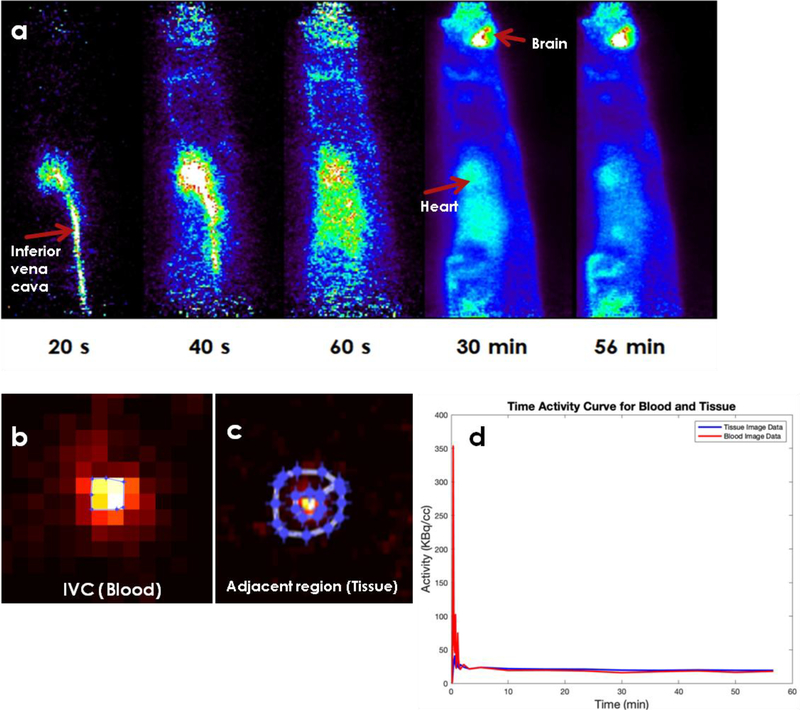
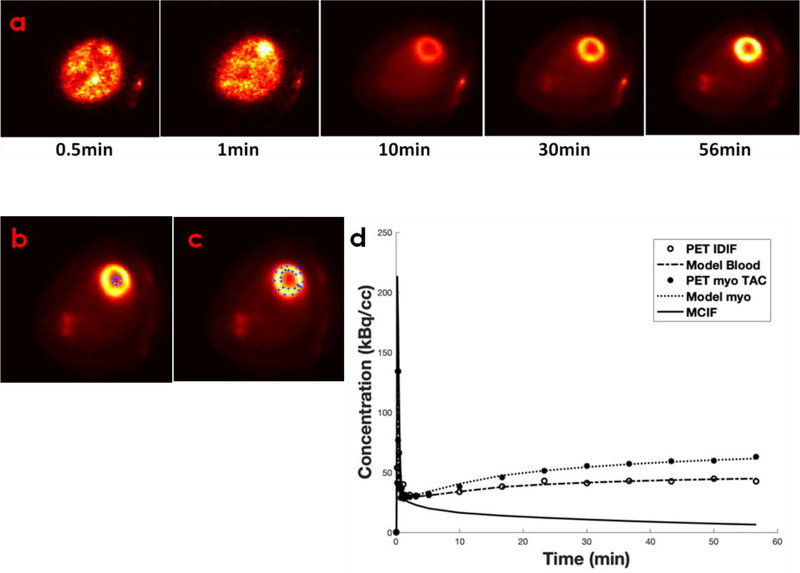
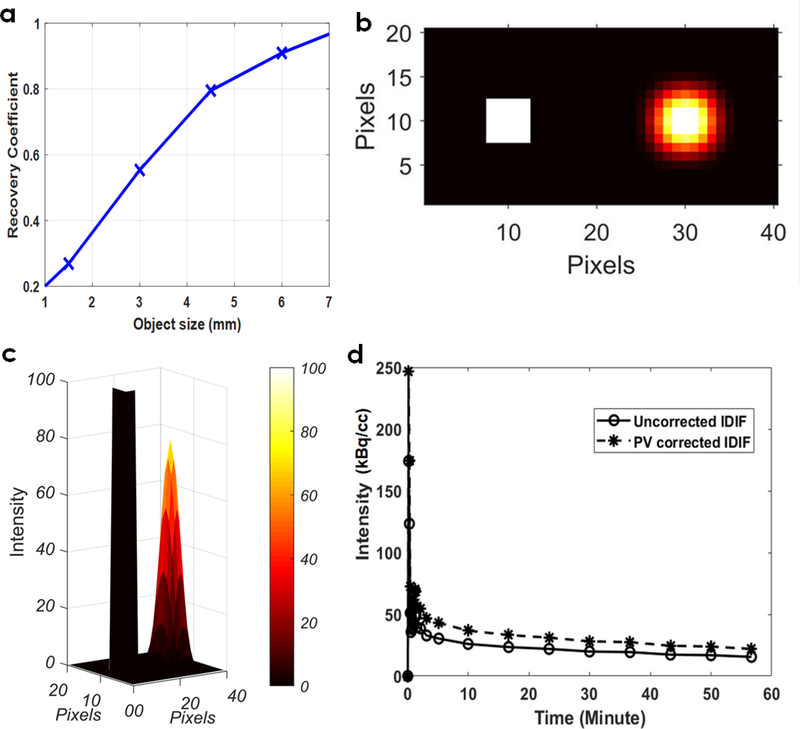
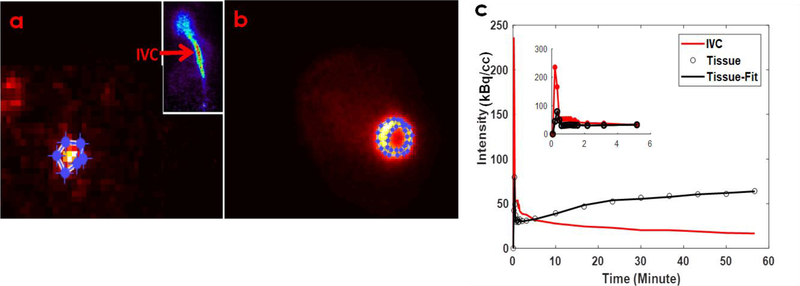
The purpose of this work was to compute blood input function from the inferior vena cava (IVC) with partial volume (PV) corrections and compare to that obtained from the left ventricular blood pool (LVBP) with spill-over (SP) and PV corrections. These were then used to compute and validate rates of myocardial 2-deoxy-2-[18F]fluoro-D-glucose (FDG) uptake (Ki) from dynamic positron emission tomography (PET) images of rat hearts in vivo in comparison to that obtained from invasive arterial blood sampling. Whole body 60 min dynamic FDG PET/CT imaging of n = 8 control Wistar Kyoto (WKY) rats were performed using Albira trimodal PET/CT/SPECT scanner. Image derived blood input function (IDIF) obtained from IVC corrected for PV averaging (IVC-PV) and IDIF from the left ventricular blood pool (LVBP) with SP and PV corrections (LVBP-SP-PV) were computed. Next, computed Ki (indirect comparison) in a 5-parameter (using IVC-PV) and a 15-parameter (using LVBP-SP-PV) 3-compartment models in WKY rat hearts in vivo were compared to that obtained using arterial blood sampling reported in literature in control Spraque Dawley (SD) rats. Using IVC-PV in a three-compartment five-parameter model resulted in a ~46% deviation in the mean computed Ki compared to that obtained with LVBP-SP-PV in a three-compartment 15-parameter model with a ~57% deviation in the mean computed Ki. The mean computed Ki in WKY rat hearts using the above methods, however, did not differ significantly to that obtained from invasive arterial blood sampling in SD rat hearts (p = 0.91 for IVC-PV and p = 0.58 for LVBP-SP-PV). Hence, Ki obtained in WKY rat hearts with input curve from IVC (IVC-PV) in a dynamic FDG PET scan is comparatively more repetitive to that obtained from the LVBP (LVBP-SP-PV). Ki computed using both the methods, however, agree well with each other and that obtained using arterial blood sampling.
本研究旨在通过静脉血输入函数(IVC)的偏置体积(PV)校正,并与左心室血池(LVBP)的溢出(SP)和 PV 校正进行比较,以计算并验证动态正电子发射断层扫描(PET)图像中大鼠心肌 2-脱氧-2-[18F]氟代-D-葡萄糖(FDG)摄取率(Ki)。采用 Albira 三模态 PET/CT/SPECT 扫描仪对 8 只正常 Wistar Kyoto(WKY)大鼠进行了全身 60 分钟动态 FDG PET/CT 成像。计算并比较了从 IVC 获得的校正后 PV 平均值的 IVC-PV (IDIF)和从左心室血池(LVBP)获得的 SP 和 PV 校正(LVBP-SP-PV)的 IDIF。接着,在 5 个参数(使用 IVC-PV)和 15 个参数(使用 LVBP-SP-PV)的 3 室模型中计算了 WKY 大鼠体内的 Ki(间接比较),并与文献中报道的正常 Spraque Dawley(SD)大鼠动脉血取样的 Ki 进行了比较。在三参数五参数模型中使用 IVC-PV 会导致平均计算 Ki 出现约 46%的偏差,而在三参数 15 参数模型中使用 LVBP-SP-PV 会导致平均计算 Ki 出现约 57%的偏差。然而,上述方法在 WKY 大鼠心脏中计算的平均 Ki 与 SD 大鼠心脏中从动脉血取样获得的 Ki 没有显著差异(IVC-PV 为 p=0.91,LVBP-SP-PV 为 p=0.58)。因此,在动态 FDG PET 扫描中,使用 IVC 输入曲线(IVC-PV)获得的 WKY 大鼠心脏 Ki 重复性更高。然而,使用这两种方法计算的 Ki 与动脉血取样获得的 Ki 一致性良好。