Nuss Philippe, Ferreri Florian, Bourin Michel
Department of Adult Psychiatry and Medical Psychology, Sorbonne University, Saint-Antoine Hospital, Paris, France.
Inserm UMR_S938, Saint-Antoine Research Centre, Sorbonne University, Paris, France.
Neuropsychiatr Dis Treat. 2019 Jul 3;15:1781-1795. doi: 10.2147/NDT.S200568. eCollection 2019.
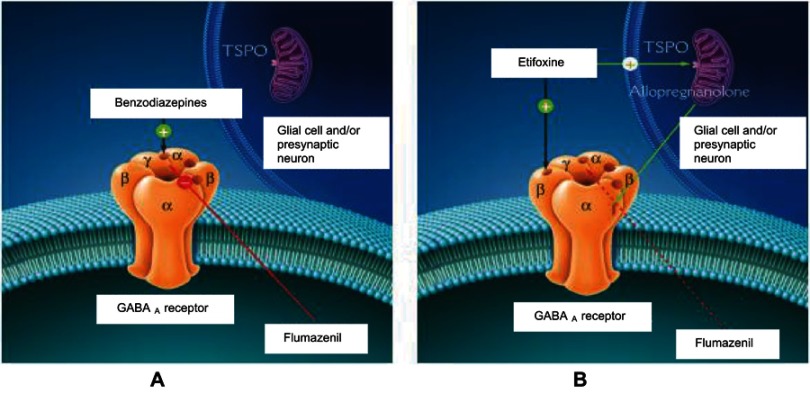
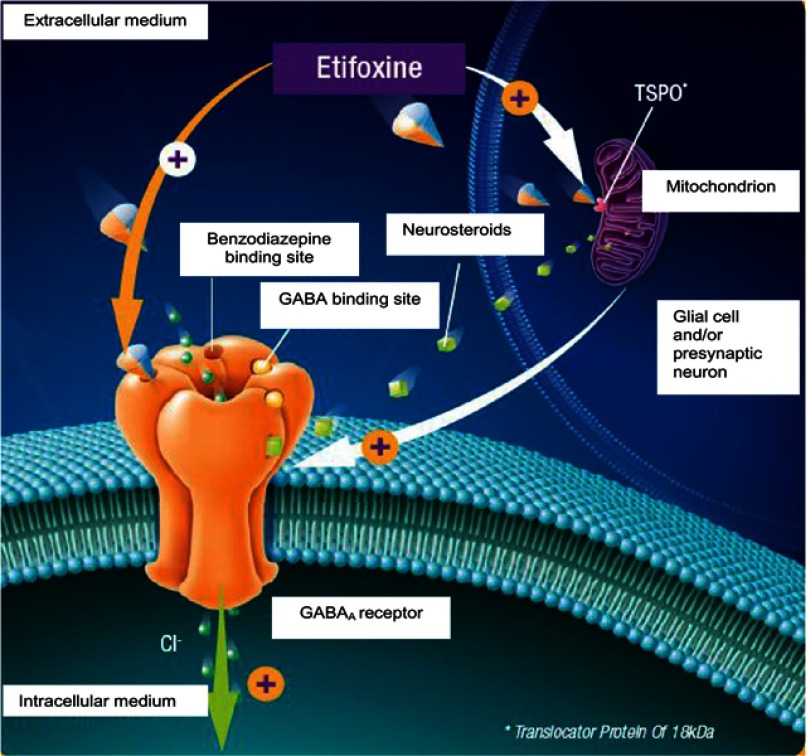
Treating the signs and symptoms of anxiety is an everyday challenge in clinical practice. When choosing between treatment options, anxiety needs to be understood in the situational, psychiatric, and biological context in which it arises. Etifoxine, a non-benzodiazepine anxiolytic drug belonging to the benzoxazine class, is an effective treatment for anxiety in response to a stressful situation. In the present review, we focused on several aspects of the cerebral and somatic biological mechanisms involved in anxiety and investigated the extent to which etifoxine's mode of action can explain its anxiolytic activity. Its two mechanisms of action are the modulation of GABAergic neurotransmission and neurosteroid synthesis. Recent data suggest that the molecule possesses neuroprotective, neuroplastic, and anti-inflammatory properties. Etifoxine was first shown to be an effective anxiolytic in patients in clinical studies comparing it with clobazam, sulpiride, and placebo. Randomized controlled studies have demonstrated its anxiolytic efficacy in patients with adjustment disorders (ADs) with anxiety, showing it to be superior to buspirone and comparable to lorazepam and phenazepam, with a greater number of markedly improved responders and a better therapeutic index. Etifoxine's noninferiority to alprazolam has also been demonstrated in a comparative trial. Significantly less rebound anxiety was observed after abrupt cessation of etifoxine compared with lorazepam or alprazolam. Consistent with this finding, etifoxine appears to have a very low dependence potential. Unlike lorazepam, it has no effect on psychomotor performance, vigilance, or free recall. Severe adverse events are in general rare. Skin and subcutaneous disorders are the most frequently reported, but these generally resolve after drug cessation. Taken together, its dual mechanisms of action in anxiety and the positive data yielded by clinical trials support the use of etifoxine for treating the anxiety signs and symptoms of individuals with ADs.
在临床实践中,治疗焦虑症的体征和症状是一项日常挑战。在选择治疗方案时,需要在焦虑症产生的情境、精神和生物学背景中去理解它。依替福辛是一种属于苯并恶嗪类的非苯二氮䓬类抗焦虑药物,是应对压力情境时治疗焦虑症的有效药物。在本综述中,我们聚焦于焦虑症所涉及的大脑和躯体生物学机制的几个方面,并研究了依替福辛的作用方式在多大程度上能够解释其抗焦虑活性。其两种作用机制是对γ-氨基丁酸能神经传递的调节和神经甾体合成。最近的数据表明,该分子具有神经保护、神经可塑性和抗炎特性。在与氯巴占、舒必利和安慰剂进行比较的临床研究中,依替福辛首次被证明对患者是一种有效的抗焦虑药物。随机对照研究已证明其对伴有焦虑的适应障碍(AD)患者具有抗焦虑疗效,显示其优于丁螺环酮,与劳拉西泮和非那西泮相当,有更多显著改善的应答者且治疗指数更佳。在一项对比试验中也证明了依替福辛不劣于阿普唑仑。与劳拉西泮或阿普唑仑相比,突然停用依替福辛后观察到的反跳性焦虑明显更少。与此发现一致,依替福辛似乎具有非常低的成瘾潜力。与劳拉西泮不同,它对精神运动表现、警觉性或自由回忆没有影响。严重不良事件总体上很少见。皮肤和皮下疾病是最常报告的,但这些通常在停药后会缓解。综上所述,其在焦虑症中的双重作用机制以及临床试验产生的阳性数据支持使用依替福辛治疗患有AD的个体的焦虑体征和症状。