Qiu Feng, Su Bingsen, Li Zhao, Chen Wenke, Cao Longbing, Chen Fu, Liu Dongdong, He Jingling, Lin Ni
Department of Laboratory Medicine, Nanhai Hospital, Southern Medical University, Foshan, Guangdong 528244, People's Republic of China.
Department of Laboratory Medicine, Zhongshan Torch Development Zone Hospital, Zhongshan, Guangdong 528437, People's Republic of China.
Cancer Manag Res. 2019 Jul 4;11:6151-6162. doi: 10.2147/CMAR.S205052. eCollection 2019.
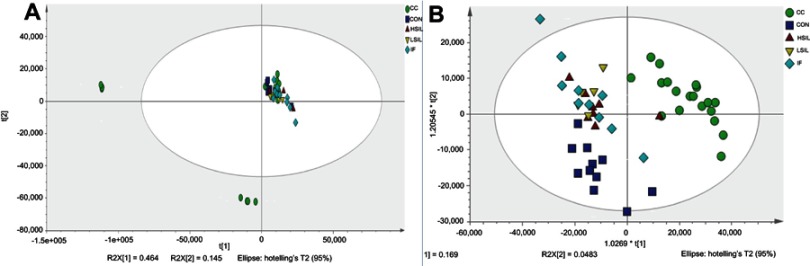
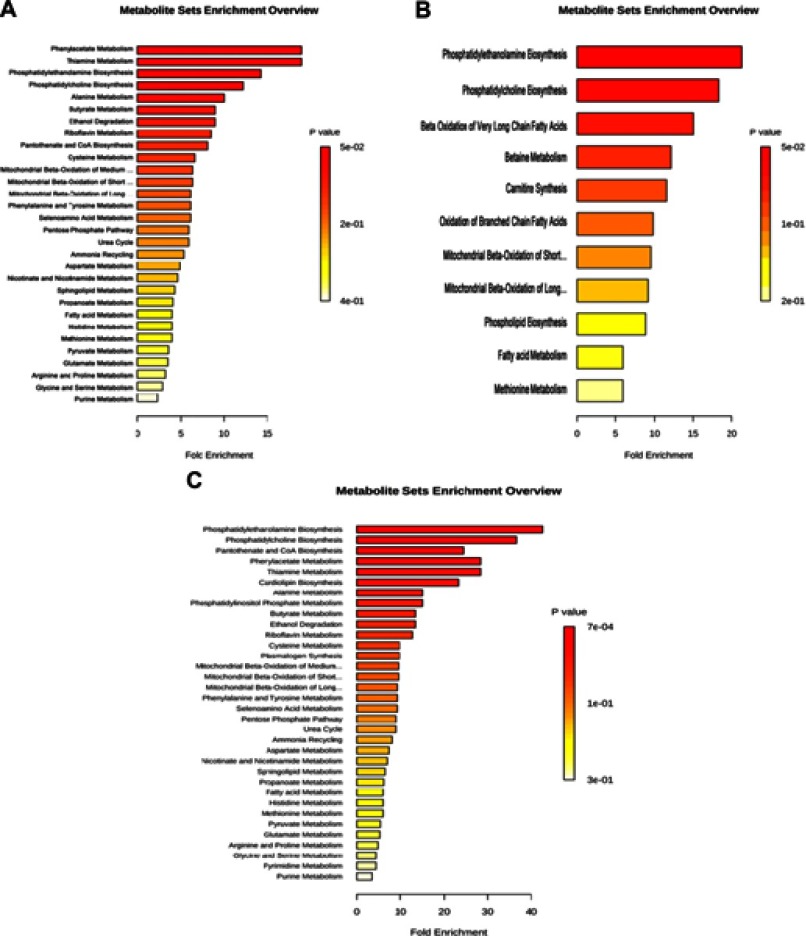
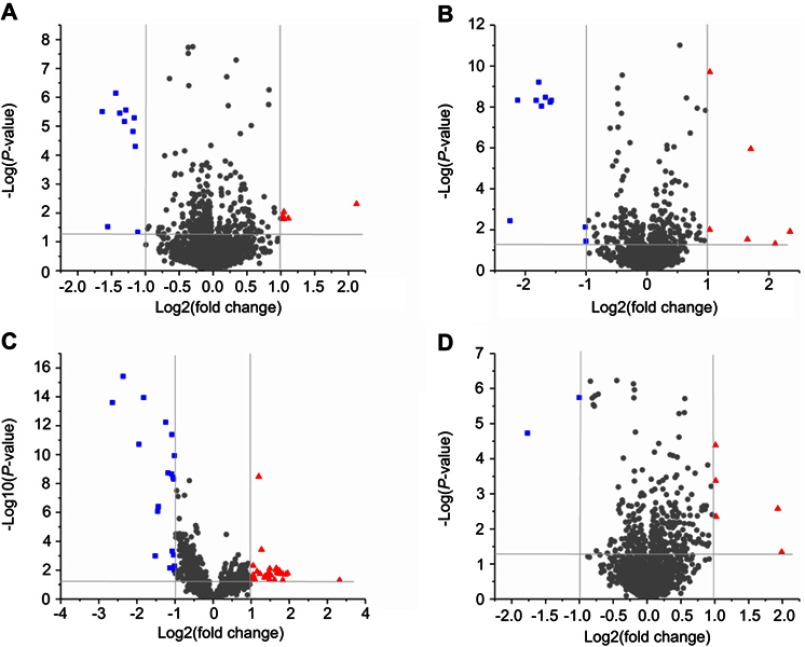
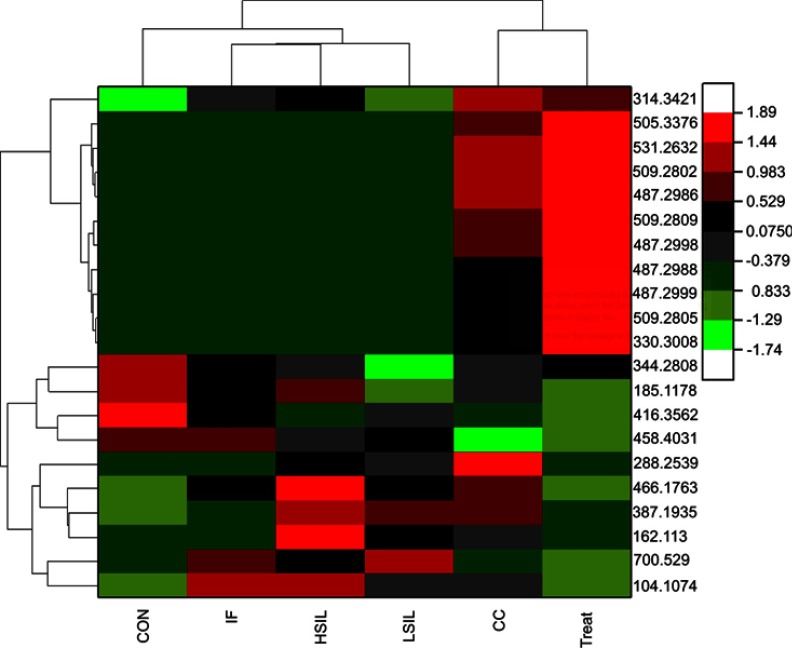
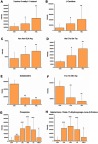
According to the statistics of WHO/IARC, cervical cancer (CC) has become the fourth malignant cancer of female worldwide and it is one of the main causes of death of women in developing countries. Potential plasma and metabolic biomarkers for CC precancerous lesions and cervicitis were indicated by LC-MS techniques, and their underlying mechanisms and functions were analyzed. Plasma samples were selected from healthy people (control), low-grade squamous intraepithelial lesions (LSIL), high-grade squamous intraepithelial lesions (HSIL), CC, and post-treatment patients. All polypeptide types and sequences were detected by LC-MS/MS and the results were normalized by using Pareto-scaling. Potential metabolic biomarkers were screened by applying MetaboAnalyst 4.0 software and XCMS software, and analysis of variance and enrichment analysis were performed. Metabolic pathway analysis and functional enrichment analysis were used to further investigate the significance and pathological mechanisms of potential biomarkers. Compared with healthy people, 9 differentially expressed metabolites were screened, 4 of which were up-regulated and 5 were down-regulated. LSIL group screened 7 differentially expressed metabolites, 5 of which were up-regulated and 2 were down-regulated; CC group screened 12 differentially expressed metabolites were screened, of which 9 were up-regulated and 3 were down-regulated. Eight differentially expressed metabolites were screened in the IF group, of which 5 showed up-regulation and 3 showed down-regulation. In functional enrichment analysis, differential metabolism was found to be associated with addition and coagulation cascades. Among all potential biomarkers, 2-amino-3-methyl-1-butanol, L-carnitine, Asn Asn Gln Arg, Ala Cys Ser Trp, Soladulcidine, Ala Ile Gln Arg, 2-amino-3 -Methyl-1-butanol, L-carnitine, Asn Asn Gln Arg, Ala Cys Ser Trp, Soladulcidine, Ala Ile Gln Arg can be used as predictors of precancerous lesions at different stages of CC. Among all biomarkers, 6α-fluoro-11β1,17-dihydroxypren-4-ene-3,20-dione has higher expression in the CC and HSIL groups and lower expression in the treatment group. By applying molecular markers to assess the progression of the disease, the accuracy and specificity of the diagnosis can be improved, which has certain prospects in clinical applications.
根据世界卫生组织/国际癌症研究机构(WHO/IARC)的统计,宫颈癌(CC)已成为全球女性第四大恶性肿瘤,是发展中国家女性主要死因之一。液相色谱-质谱联用(LC-MS)技术揭示了CC癌前病变和宫颈炎潜在的血浆及代谢生物标志物,并分析了其潜在机制和功能。选取了健康人(对照组)、低级别鳞状上皮内病变(LSIL)、高级别鳞状上皮内病变(HSIL)、CC患者及治疗后患者的血浆样本。通过LC-MS/MS检测所有多肽类型和序列,并采用帕累托标度法对结果进行归一化处理。应用MetaboAnalyst 4.0软件和XCMS软件筛选潜在的代谢生物标志物,并进行方差分析和富集分析。利用代谢途径分析和功能富集分析进一步探究潜在生物标志物的意义及病理机制。与健康人相比,筛选出9种差异表达代谢物,其中4种上调,5种下调。LSIL组筛选出7种差异表达代谢物,其中5种上调,2种下调;CC组筛选出12种差异表达代谢物,其中9种上调,3种下调。在治疗组筛选出8种差异表达代谢物,其中5种上调,3种下调。在功能富集分析中,发现差异代谢与补体和凝血级联反应有关。在所有潜在生物标志物中,2-氨基-3-甲基-1-丁醇、L-肉碱、天冬酰胺天冬酰胺谷氨酰胺精氨酸、丙氨酸半胱氨酸丝氨酸色氨酸、蜀羊泉碱、丙氨酸异亮氨酸谷氨酰胺精氨酸、2-氨基-3-甲基-1-丁醇、L-肉碱、天冬酰胺天冬酰胺谷氨酰胺精氨酸、丙氨酸半胱氨酸丝氨酸色氨酸、蜀羊泉碱、丙氨酸异亮氨酸谷氨酰胺精氨酸可作为CC不同阶段癌前病变的预测指标。在所有生物标志物中,6α-氟-11β,17-二羟基孕-4-烯-3,20-二酮在CC组和HSIL组中表达较高,在治疗组中表达较低。通过应用分子标志物评估疾病进展,可提高诊断的准确性和特异性,在临床应用中有一定前景。