Park Silvia, Choi Eun-Kyung, Kim Im-Ryung, Cho Juhee, Jang Jun Ho
Department of Hematology, Catholic Hematology Hospital, Seoul St. Mary's Hospital, College of Medicine, The Catholic University of Korea, Seoul, Korea.
Leukemia Research Institute, College of Medicine, The Catholic University of Korea, Seoul, Korea.
Blood Res. 2019 Jun;54(2):137-143. doi: 10.5045/br.2019.54.2.137. Epub 2019 Jun 25.
Hematopoietic stem cell transplantation (HSCT) is an exhausting process that impacts both the patient and caregiver.
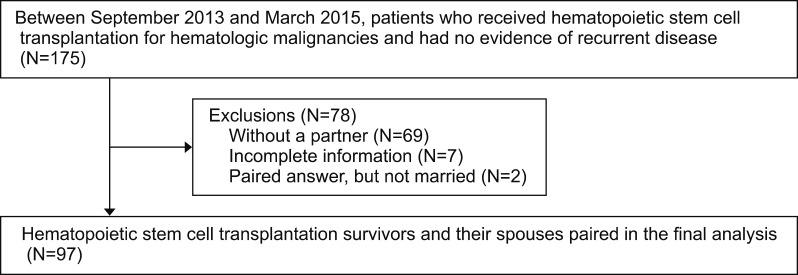
This was a cross-sectional, HSCT survivor-spouse caregiver matching study to determine quality of life (QoL) and depression among HSCT survivors and their caregivers. QoL and depression were measured with the World Health Organization Quality of Life: Brief Version (26 items) and the 9-item Patient Health Questionnaire, respectively. Data from 97 married couples were analyzed.
There were no significant differences in overall QoL and psychological, social, and environmental health between survivors and spouse caregivers (=0.345, 0.424, 0.415, and 0.253); however, physical QoL was better in the spouse caregiver group (=0.011). There was no difference in mean depression scale scores (5.3 vs. 5.1, =0.812) or proportion of severe depression (15.6% vs. 13.7%, =0.270) between the two groups. We found that family income had a significant impact on overall QoL and environmental health among spouse caregivers (=0.013 and 0.023), and female gender, co-morbidities, and family income were the important factors associated with depression among spouse caregivers (=0.007, 0.017 and 0.049).
This study found that there were no significant differences in QoL or level of depression between HSCT survivors and their spouse caregivers. Family income, gender, and co-morbidities showed significant association with spouse caregiver distress.
造血干细胞移植(HSCT)是一个使人疲惫不堪的过程,对患者和照料者都会产生影响。
这是一项横断面的HSCT幸存者 - 配偶照料者匹配研究,旨在确定HSCT幸存者及其照料者的生活质量(QoL)和抑郁情况。分别使用世界卫生组织生活质量简表(26项)和9项患者健康问卷来测量生活质量和抑郁情况。对97对已婚夫妇的数据进行了分析。
幸存者和配偶照料者在总体生活质量以及心理、社会和环境健康方面没有显著差异(P = 0.345、0.424、0.415和0.253);然而,配偶照料者组的身体生活质量更好(P = 0.011)。两组之间的平均抑郁量表得分(5.3对5.1,P = 0.812)或重度抑郁比例(15.6%对13.7%,P = 0.270)没有差异。我们发现家庭收入对配偶照料者的总体生活质量和环境健康有显著影响(P = 0.013和0.023),并且女性性别、合并症和家庭收入是与配偶照料者抑郁相关的重要因素(P = 0.007、0.017和0.049)。
本研究发现HSCT幸存者及其配偶照料者在生活质量或抑郁水平上没有显著差异。家庭收入、性别和合并症与配偶照料者的痛苦有显著关联。