Environmental Policy Group, Department of Social Sciences, Wageningen University, Hollandseweg 1, 6706 KN, Wageningen, the Netherlands; C/o Food and Healthy Living Group, Aeres University of Applied Sciences, Stadhuisstraat 18, 1315 AK, Almere, the Netherlands.
Healthy Diets from Sustainable Food Systems Initiative, Bioversity International, Via Dei Tre Denari, 472/a, 00054, Maccarese (Fiumicino), Italy.
Appetite. 2019 Nov 1;142:104370. doi: 10.1016/j.appet.2019.104370. Epub 2019 Jul 13.
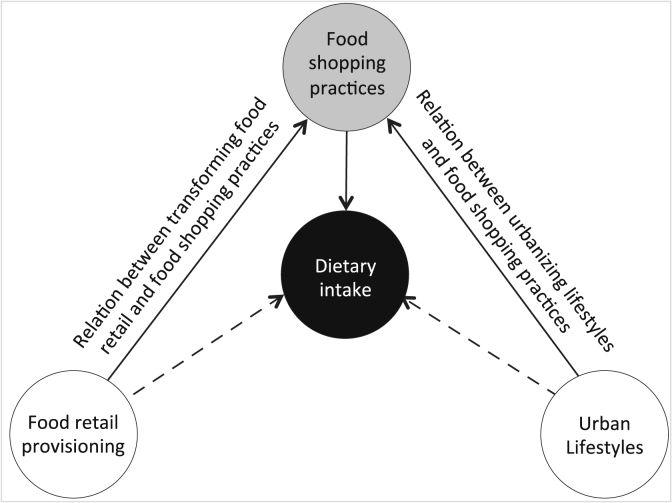
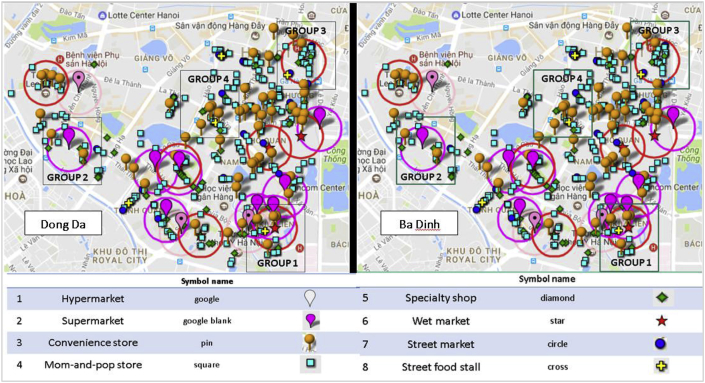
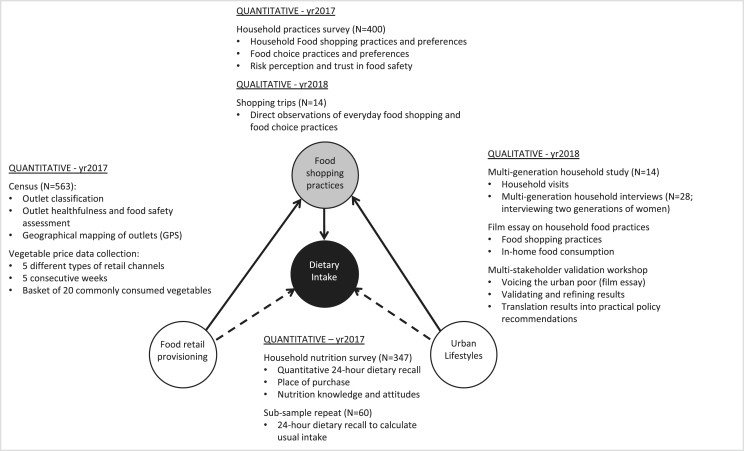
Nutrition insecurity among urban poor in modernizing Asian metropolises is a critical issue. It is well recognized that in urban Asia the poor are food insecure. Across Asia the food retail environment is transforming rapidly, in which supermarkets increasingly replace traditional food vending, like markets and street vendors that the urban poor depend upon. The question is, how these transformations impact the diets of the urban poor? What drives their food choice? What are their daily shopping practices and how does that affect their dietary intake? To investigate this, we developed a cross-disciplinary nutrition and social practices study with a sequential quantitative-qualitative mixed-method design. Building on empirical evidence from Hanoi, Vietnam, the study links (i) food choice and measured dietary intake, with (ii) food retail environment, through (iii) food shopping practices and preferences of 400 women of reproductive age within the context of (iv) their transformative urban lifestyles. Methods included are a retail census with GPS coordinates to map the food retail environment, a household survey, a 24-h diet recall, multi-generation household interviews and shopping trips. We demonstrate that integrated sociological and nutritional perspectives are productive in rapidly generating evidence to comprehend the complex trade-offs between food safety and nutrition in everyday food consumption practices. We describe and reflect on our theoretical mix of dietary intake and social practices research, and our holistic mixed method approach which besides combining quantitative and qualitative methods, also voices the urban poor first hand.
现代化亚洲大都市中城市贫困人口的营养不安全是一个关键问题。众所周知,亚洲城市中的贫困人口存在粮食不安全问题。在整个亚洲,食品零售环境正在迅速转变,超市越来越多地取代了传统的食品销售方式,如城市贫困人口依赖的市场和街头小贩。问题是,这些转变如何影响城市贫困人口的饮食?驱动他们食物选择的因素是什么?他们的日常购物行为如何影响他们的饮食摄入?为了研究这个问题,我们开展了一项跨学科的营养和社会实践研究,采用了顺序的定量-定性混合方法设计。该研究以越南河内的实证证据为基础,将(i)食物选择和测量的饮食摄入量,与(ii)通过(iii)她们转型城市生活方式背景下 400 名育龄妇女的食品购物行为和偏好,与(iv)食品零售环境联系起来。所采用的方法包括带有 GPS 坐标的零售普查,以绘制食品零售环境图、家庭调查、24 小时饮食回忆、多代家庭访谈和购物旅行。我们证明,社会学和营养学的综合视角有助于快速生成证据,以理解日常食品消费实践中食品安全和营养之间的复杂权衡。我们描述并反思了我们在饮食摄入和社会实践研究方面的理论融合,以及我们的整体混合方法方法,该方法除了结合定量和定性方法外,还直接反映了城市贫困人口的声音。