• 文献检索
  • 文档翻译
  • 深度研究
  • 学术资讯
  • Suppr Zotero 插件Zotero 插件
  • 邀请有礼
  • 套餐&价格
  • 历史记录
应用&插件
Suppr Zotero 插件Zotero 插件浏览器插件Mac 客户端Windows 客户端微信小程序
定价
高级版会员购买积分包购买API积分包
服务
文献检索文档翻译深度研究API 文档MCP 服务
关于我们
关于 Suppr公司介绍联系我们用户协议隐私条款
关注我们

Suppr 超能文献

核心技术专利:CN118964589B侵权必究
粤ICP备2023148730 号-1Suppr @ 2026

文献检索

告别复杂PubMed语法,用中文像聊天一样搜索,搜遍4000万医学文献。AI智能推荐,让科研检索更轻松。

立即免费搜索

文件翻译

保留排版,准确专业,支持PDF/Word/PPT等文件格式,支持 12+语言互译。

免费翻译文档

深度研究

AI帮你快速写综述,25分钟生成高质量综述,智能提取关键信息,辅助科研写作。

立即免费体验

缅甸的“森林疟疾”?在多样化环境中追踪传播景观。

'Forest malaria' in Myanmar? Tracking transmission landscapes in a diversity of environments.

机构信息

Aix Marseille Univ, IRD, INSERM, SESSTIM, ISSPAM, 27 boulevard Jean Moulin, 13005, Marseille, France.

Institut de Recherche pour le Développement, UMR 228 Espace-Dev (IRD, UA, UG, UM, UR), Phnom Penh, Cambodia.

出版信息

Parasit Vectors. 2023 Sep 12;16(1):324. doi: 10.1186/s13071-023-05915-w.

DOI:10.1186/s13071-023-05915-w
PMID:37700295
原文链接:https://pmc.ncbi.nlm.nih.gov/articles/PMC10498628/
Abstract

BACKGROUND

In the Greater Mekong Subregion, case-control studies and national-level analyses have shown an association between malaria transmission and forest activities. The term 'forest malaria' hides the diversity of ecosystems in the GMS, which likely do not share a uniform malaria risk. To reach malaria elimination goals, it is crucial to document accurately (both spatially and temporally) the influence of environmental factors on malaria to improve resource allocation and policy planning within given areas. The aim of this ecological study is to characterize the association between malaria dynamics and detailed ecological environments determined at village level over a period of several years in Kayin State, Myanmar.

METHODS

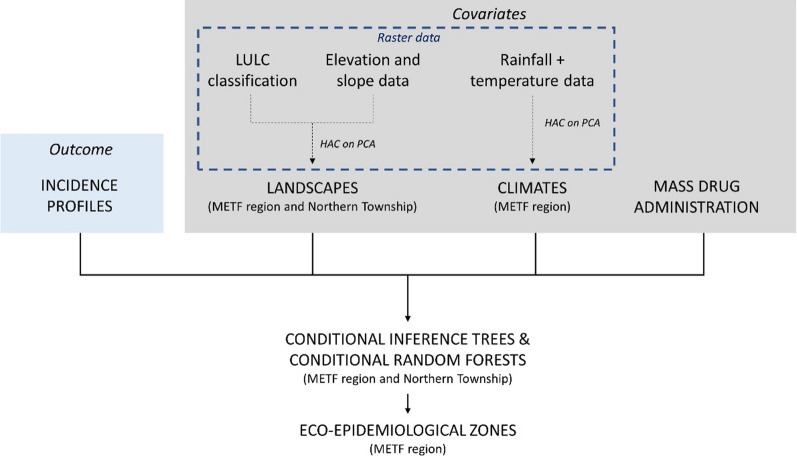
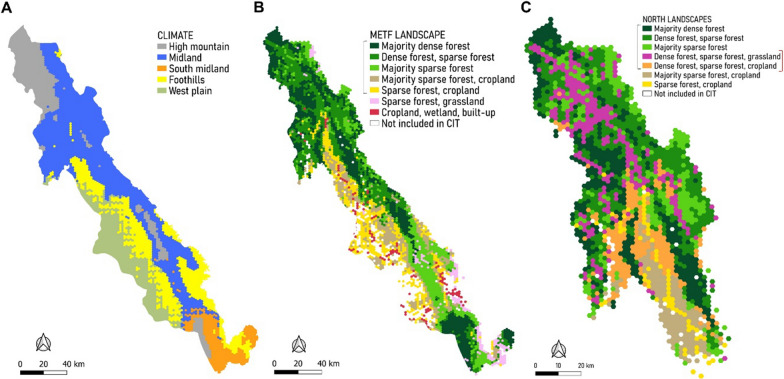
We characterized malaria incidence profiles at village scale based on intra- and inter-annual variations in amplitude, seasonality, and trend over 4 years (2016-2020). Environment was described independently of village localization by overlaying a 2-km hexagonal grid over the region. Specifically, hierarchical classification on principal components, using remote sensing data of high spatial resolution, was used to assign a landscape and a climate type to each grid cell. We used conditional inference trees and random forests to study the association between the malaria incidence profile of each village, climate and landscape. Finally, we constructed eco-epidemiological zones to stratify and map malaria risk in the region by summarizing incidence and environment association information.

RESULTS

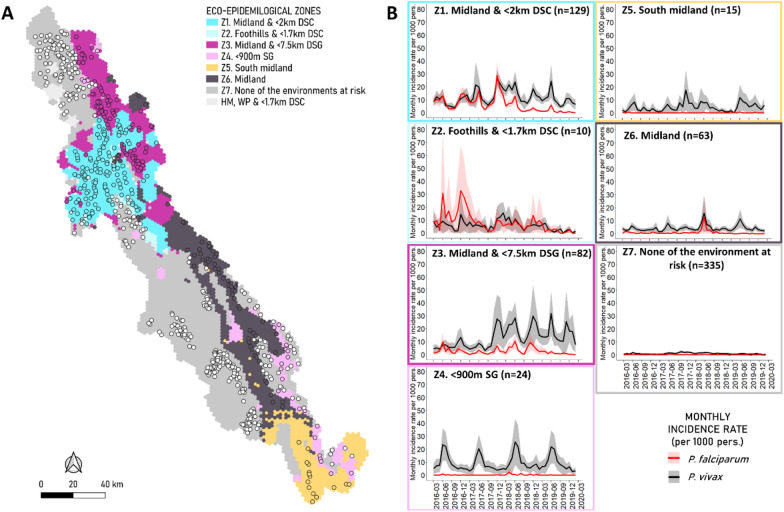
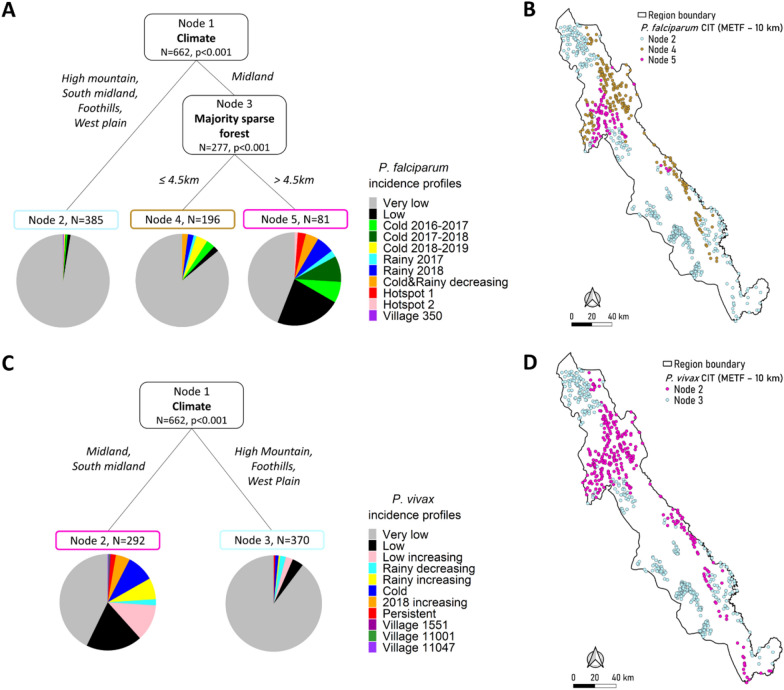
We identified a high diversity of landscapes (n = 19) corresponding to a gradient from pristine to highly anthropogenically modified landscapes. Within this diversity of landscapes, only three were associated with malaria-affected profiles. These landscapes were composed of a mosaic of dense and sparse forest fragmented by small agricultural patches. A single climate with moderate rainfall and a temperature range suitable for mosquito presence was also associated with malaria-affected profiles. Based on these environmental associations, we identified three eco-epidemiological zones marked by later persistence of Plasmodium falciparum, high Plasmodium vivax incidence after 2018, or a seasonality pattern in the rainy season.

CONCLUSIONS

The term forest malaria covers a multitude of contexts of malaria persistence, dynamics and populations at risk. Intervention planning and surveillance could benefit from consideration of the diversity of landscapes to focus on those specifically associated with malaria transmission.

摘要

背景

在大湄公河次区域,病例对照研究和国家级分析表明疟疾传播与森林活动之间存在关联。“森林疟疾”一词掩盖了次区域内各种生态系统的多样性,这些生态系统可能并不具有统一的疟疾风险。为了实现消除疟疾的目标,准确记录(时空上)环境因素对疟疾的影响至关重要,这有助于在特定地区内改善资源分配和政策规划。本生态研究旨在描述在缅甸克钦邦的一个村庄层面上,在几年的时间内,疟疾动态与详细的生态环境之间的关联。

方法

我们根据振幅、季节性和趋势在 4 年内(2016-2020 年)的年内和年际变化,在村庄尺度上描述疟疾发病率特征。环境通过在该区域上叠加一个 2 公里的六边形网格,独立于村庄定位进行描述。具体来说,使用高空间分辨率的遥感数据进行主成分分层分类,将每个网格单元分配给一个景观和气候类型。我们使用条件推理树和随机森林来研究每个村庄的疟疾发病率概况、气候和景观之间的关联。最后,我们构建了生态流行病学区,通过总结发病率和环境关联信息,对该地区的疟疾风险进行分层和制图。

结果

我们确定了 19 种高度多样化的景观(n=19),对应从原始到高度人为改造的景观的梯度。在这种景观多样性中,只有三种与受疟疾影响的景观相关。这些景观由密集和稀疏森林的镶嵌体组成,被小块的农业斑块所分割。一个单一的气候,适度的降雨量和适合蚊子存在的温度范围,也与受疟疾影响的景观相关。基于这些环境关联,我们确定了三个生态流行病学区,标志是疟原虫持续性较高、2018 年后间日疟发病率较高或雨季季节性模式。

结论

森林疟疾一词涵盖了疟疾持续存在、动态和高危人群的多种情况。干预规划和监测可以从考虑景观多样性中受益,重点关注那些与疟疾传播特别相关的景观。

https://cdn.ncbi.nlm.nih.gov/pmc/blobs/8348/10498628/94ff59ad2b3a/13071_2023_5915_Fig6_HTML.jpg
https://cdn.ncbi.nlm.nih.gov/pmc/blobs/8348/10498628/70c04cca8283/13071_2023_5915_Fig1_HTML.jpg
https://cdn.ncbi.nlm.nih.gov/pmc/blobs/8348/10498628/60e96e9ef56b/13071_2023_5915_Fig2_HTML.jpg
https://cdn.ncbi.nlm.nih.gov/pmc/blobs/8348/10498628/9a8280b9e4f8/13071_2023_5915_Fig3_HTML.jpg
https://cdn.ncbi.nlm.nih.gov/pmc/blobs/8348/10498628/ac6a6bb71ffe/13071_2023_5915_Fig4_HTML.jpg
https://cdn.ncbi.nlm.nih.gov/pmc/blobs/8348/10498628/ede79c1e9059/13071_2023_5915_Fig5_HTML.jpg
https://cdn.ncbi.nlm.nih.gov/pmc/blobs/8348/10498628/94ff59ad2b3a/13071_2023_5915_Fig6_HTML.jpg
https://cdn.ncbi.nlm.nih.gov/pmc/blobs/8348/10498628/70c04cca8283/13071_2023_5915_Fig1_HTML.jpg
https://cdn.ncbi.nlm.nih.gov/pmc/blobs/8348/10498628/60e96e9ef56b/13071_2023_5915_Fig2_HTML.jpg
https://cdn.ncbi.nlm.nih.gov/pmc/blobs/8348/10498628/9a8280b9e4f8/13071_2023_5915_Fig3_HTML.jpg
https://cdn.ncbi.nlm.nih.gov/pmc/blobs/8348/10498628/ac6a6bb71ffe/13071_2023_5915_Fig4_HTML.jpg
https://cdn.ncbi.nlm.nih.gov/pmc/blobs/8348/10498628/ede79c1e9059/13071_2023_5915_Fig5_HTML.jpg
https://cdn.ncbi.nlm.nih.gov/pmc/blobs/8348/10498628/94ff59ad2b3a/13071_2023_5915_Fig6_HTML.jpg

相似文献

1
'Forest malaria' in Myanmar? Tracking transmission landscapes in a diversity of environments.缅甸的“森林疟疾”?在多样化环境中追踪传播景观。
Parasit Vectors. 2023 Sep 12;16(1):324. doi: 10.1186/s13071-023-05915-w.
2
Spatio-temporal associations between deforestation and malaria incidence in Lao PDR.老挝人民民主共和国森林砍伐与疟疾发病率的时空关联。
Elife. 2021 Mar 9;10:e56974. doi: 10.7554/eLife.56974.
3
Malaria in the Greater Mekong Subregion: heterogeneity and complexity.大湄公河次区域的疟疾:异质性和复杂性。
Acta Trop. 2012 Mar;121(3):227-39. doi: 10.1016/j.actatropica.2011.02.016. Epub 2011 Mar 5.
4
Community-based molecular and serological surveillance of subclinical malaria in Myanmar.缅甸基于社区的亚临床疟疾分子和血清学监测。
BMC Med. 2021 May 28;19(1):121. doi: 10.1186/s12916-021-01993-8.
5
Spatio-temporal trends of malaria incidence from 2011 to 2017 and environmental predictors of malaria transmission in Myanmar.2011 年至 2017 年期间疟疾发病率的时空趋势以及缅甸疟疾传播的环境预测因子。
Infect Dis Poverty. 2023 Jan 28;12(1):2. doi: 10.1186/s40249-023-01055-6.
6
Seasonal dynamics and microgeographical spatial heterogeneity of malaria along the China-Myanmar border.中缅边境疟疾的季节动态和微观地理空间异质性
Acta Trop. 2016 May;157:12-19. doi: 10.1016/j.actatropica.2016.01.022. Epub 2016 Jan 23.
7
Forest malaria in Cambodia: the occupational and spatial clustering of Plasmodium vivax and Plasmodium falciparum infection risk in a cross-sectional survey in Mondulkiri province, Cambodia.柬埔寨森林地区疟疾:柬埔寨蒙多基里省横断面调查中间日疟原虫和恶性疟原虫感染风险的职业及空间聚集情况
Malar J. 2020 Nov 19;19(1):413. doi: 10.1186/s12936-020-03482-4.
8
Spatiotemporal dynamics of malaria in Banmauk Township, Sagaing region of Northern Myanmar: characteristics, trends, and risk factors.缅甸北部实皆地区班茂镇疟疾的时空动态:特征、趋势和危险因素。
BMC Infect Dis. 2022 Jul 28;22(1):653. doi: 10.1186/s12879-022-07634-6.
9
Effectiveness of repellent delivered through village health volunteers on malaria incidence in villages in South-East Myanmar: a stepped-wedge cluster-randomised controlled trial protocol.通过乡村卫生志愿者提供驱虫剂对缅甸东南部村庄疟疾发病率的影响:一项 stepped-wedge 整群随机对照试验方案。
BMC Infect Dis. 2018 Dec 14;18(1):663. doi: 10.1186/s12879-018-3566-y.
10
Effect of generalised access to early diagnosis and treatment and targeted mass drug administration on Plasmodium falciparum malaria in Eastern Myanmar: an observational study of a regional elimination programme.缅甸东部普遍获得早期诊断和治疗以及有针对性的大规模药物治疗对恶性疟原虫疟疾的影响:区域消除规划的观察性研究。
Lancet. 2018 May 12;391(10133):1916-1926. doi: 10.1016/S0140-6736(18)30792-X. Epub 2018 Apr 24.

引用本文的文献

1
Impact of intensive control on malaria population genomics in Eastern Myanmar.强化控制对缅甸东部疟疾群体基因组学的影响。
Res Sq. 2025 Jun 26:rs.3.rs-6875020. doi: 10.21203/rs.3.rs-6875020/v1.

本文引用的文献

1
Malaria temporal dynamic clustering for surveillance and intervention planning.疟疾时间动态聚类用于监测和干预规划。
Epidemics. 2023 Jun;43:100682. doi: 10.1016/j.epidem.2023.100682. Epub 2023 Mar 27.
2
Spatio-temporal trends of malaria incidence from 2011 to 2017 and environmental predictors of malaria transmission in Myanmar.2011 年至 2017 年期间疟疾发病率的时空趋势以及缅甸疟疾传播的环境预测因子。
Infect Dis Poverty. 2023 Jan 28;12(1):2. doi: 10.1186/s40249-023-01055-6.
3
A Disease Control-Oriented Land Cover Land Use Map for Myanmar.
一份面向疾病防控的缅甸土地覆盖与土地利用地图。
Data (Basel). 2021 Jun;6(6). doi: 10.3390/data6060063. Epub 2021 Jun 13.
4
Achieving global malaria eradication in changing landscapes.在不断变化的环境中实现全球消除疟疾。
Malar J. 2021 Feb 2;20(1):69. doi: 10.1186/s12936-021-03599-0.
5
Forest malaria in Cambodia: the occupational and spatial clustering of Plasmodium vivax and Plasmodium falciparum infection risk in a cross-sectional survey in Mondulkiri province, Cambodia.柬埔寨森林地区疟疾:柬埔寨蒙多基里省横断面调查中间日疟原虫和恶性疟原虫感染风险的职业及空间聚集情况
Malar J. 2020 Nov 19;19(1):413. doi: 10.1186/s12936-020-03482-4.
6
Current vector research challenges in the greater Mekong subregion for dengue, Malaria, and Other Vector-Borne Diseases: A report from a multisectoral workshop March 2019.2019年3月多部门研讨会报告:湄公河次区域登革热、疟疾及其他媒介传播疾病当前的媒介研究挑战
PLoS Negl Trop Dis. 2020 Jul 30;14(7):e0008302. doi: 10.1371/journal.pntd.0008302. eCollection 2020 Jul.
7
Resolving the cause of recurrent Plasmodium vivax malaria probabilistically.概率解决间日疟原虫疟疾复发的原因。
Nat Commun. 2019 Dec 6;10(1):5595. doi: 10.1038/s41467-019-13412-x.
8
Agricultural land-uses consistently exacerbate infectious disease risks in Southeast Asia.农业用地的使用不断加剧东南亚的传染病风险。
Nat Commun. 2019 Sep 20;10(1):4299. doi: 10.1038/s41467-019-12333-z.
9
Characterising residual malaria transmission in forested areas with low coverage of core vector control in central Viet Nam.描述越南中部森林地区疟疾传播的剩余情况,该地区核心病媒控制覆盖率较低。
Parasit Vectors. 2019 Sep 18;12(1):454. doi: 10.1186/s13071-019-3695-1.
10
Spatiotemporal epidemiology, environmental correlates, and demography of malaria in Tak Province, Thailand (2012-2015).泰国达府疟疾的时空流行病学、环境相关性和人口统计学研究(2012-2015 年)。
Malar J. 2019 Jul 16;18(1):240. doi: 10.1186/s12936-019-2871-2.